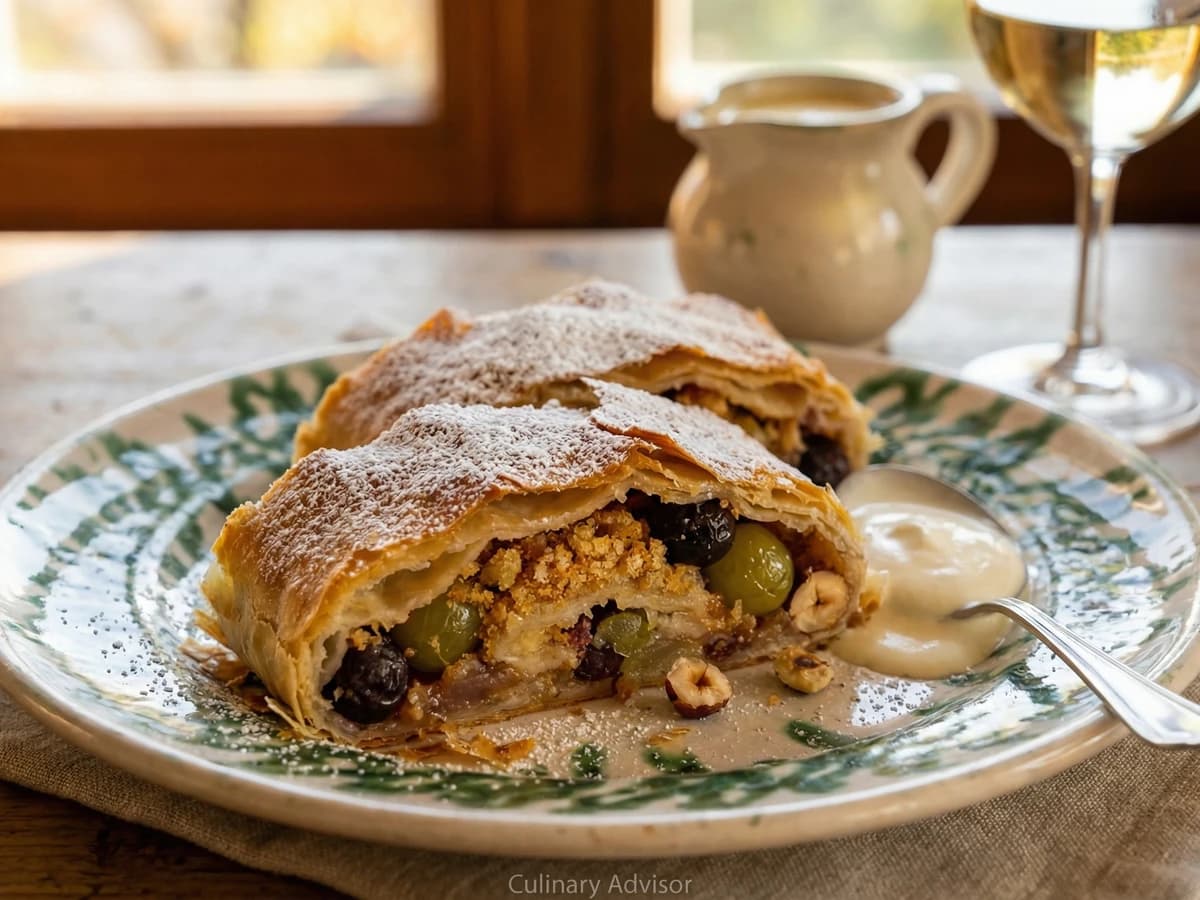
Torn bread soaked in sweet vanilla cream, rolled in hand-stretched dough, and baked in a custard bath until golden and trembling. Vienna's oldest strudel, and still its most comforting.
Pastries & Cookies
Austrian
Dinner Party
Special Occasion
1 hr
Active Time
45 min cook•1 hr 45 min total
Yield6 servings
Milchrahmstrudel is the strudel Austrians make when they want to be held. Not the showpiece Apfelstrudel you bring to the table when guests are watching, but the quiet one, the one that sits in a bath of warm vanilla custard and doesn't need to impress anyone. It just needs to be eaten with a spoon and a sigh.
In my grandmother Eva's kitchen in Deal, Gretel would tear up yesterday's Semmeln into rough cubes, soak them in warm sweetened milk until they went soft and swollen, then fold in eggs and raisins and a grating of lemon zest. She'd stretch the dough on a floured cloth on the kitchen table, roll the whole thing up like a pillow, and set it into a buttered dish. Then came the custard. She'd pour it around the strudel, not over it, and slide the dish into the oven. Forty minutes later, the kitchen smelled like warm vanilla and browned butter, and the top had gone golden and just slightly trembling when you moved the dish. Gretel always said this was the strudel that separated Viennese cooks from everyone else, because it looks like nothing and tastes like everything.
The technique is forgiving. The dough stretches the same way it does for any strudel, thin enough to read through, but the filling is gentler than fruit. Soaked bread, sweetened cream, eggs, a handful of rum-plumped raisins. You're not fighting juice or acidity. You're coaxing something soft and plain into something extraordinary through patience and good custard. This is Mehlspeisen at its purest: flour, eggs, butter, milk, sugar, vanilla, and the knowledge of what to do with them.
The earliest known strudel recipe appears in a handwritten Viennese cookbook from 1696, held in the Vienna City Library, and it describes a milk and bread filling nearly identical to Milchrahmstrudel. Strudel dough itself traces back to Ottoman and Byzantine layered pastry traditions that entered Austrian kitchens through centuries of Habsburg contact with the east. While Apfelstrudel became the international ambassador, Milchrahmstrudel and its cousin Topfenstrudel remained the everyday Mehlspeisen of Viennese home kitchens, the strudels you made when you had stale bread, good milk, and a little time.
The technique, the tradition, and the story behind every dish.
stale Semmeln or day-old white breadtorn into 2cm cubes
4 rolls or 200g
whole milk (for filling)warmed
300ml
granulated sugar (for filling)
50g
Vanillezucker (vanilla sugar)
2 packets, about 16g
lemonzested
1
raisinssoaked in 3 tablespoons dark rum
60g
eggs (for filling)separated
4 large
unsalted buttermelted, divided
80g
salt (for egg whites)
pinch
whole milk (for custard)
300ml
heavy cream (for custard)
200ml
eggs (for custard)
2 large
granulated sugar (for custard)
40g
vanilla extract or Vanillezucker (for custard)
1 teaspoon or 1 packet
powdered sugar
for dusting
Schlagobers (whipped cream) (optional)
for serving
Equipment Needed
•Large baking dish (approximately 30cm x 20cm)
•Clean cotton cloth for stretching dough (a tablecloth works perfectly)
•Rolling pin
•Pastry brush
•Hand mixer or whisk for egg whites
Instructions
1
Make the strudel dough
Mound the griffiges Mehl on a clean work surface and make a well in the center. Pour in the lukewarm water, oil, vinegar, and salt. Work the liquid into the flour with your fingertips, then knead the dough firmly for eight to ten minutes. It will start shaggy and reluctant. Keep going. You're developing gluten, and gluten is what lets you stretch this dough thin enough to read a newspaper through it later. When it's smooth, elastic, and pulls away from the surface cleanly, shape it into a ball. Brush the surface with a little oil, cover with a warm bowl turned upside down, and let it rest for at least thirty minutes.
The vinegar is not for flavor. The acid relaxes the gluten and makes the dough easier to stretch later. One teaspoon. Don't skip it.
Use griffiges Mehl if you can find it. Austrian coarse flour has less protein than American all-purpose, which gives you a more supple, cooperative dough. If you can't find it, use all-purpose flour and add an extra splash of oil.
2
Soak the bread
While the dough rests, place the torn bread cubes in a large bowl. Warm the 300ml milk gently (you want it comfortable to touch, not hot) and pour it over the bread. Let it sit for fifteen minutes. The bread should absorb the milk and become soft and swollen but not dissolving into mush. If your bread is very stale, it may need a few extra minutes. If it's only a day old, check it at ten. You want soft cubes that hold their shape when you press them, not a paste.
3
Build the filling
In a separate bowl, beat the egg yolks with the sugar, Vanillezucker, and lemon zest until pale and slightly thickened. Stir this into the soaked bread. Add the rum-soaked raisins, rum and all. Fold everything together gently. In a clean bowl, whisk the egg whites with a pinch of salt to stiff peaks, glossy and firm. Fold them into the bread mixture in two additions, lifting from the bottom to keep the air. This is what gives the filling its lightness. Without the whipped whites, you'd have a heavy bread pudding. With them, you have something closer to a souffle wrapped in pastry.
Soak the raisins in rum for at least an hour before you start, or the night before if you can remember. Properly soaked raisins are plump and fragrant. Dry raisins in a strudel are just disappointment.
4
Stretch the dough
Cover a table (at least 80cm by 60cm) with a clean cloth and dust it well with flour. Place the rested dough in the center and roll it out with a rolling pin as far as it will go easily. Then put the pin down. From here, you use your hands. Slide your hands, backs of your fists facing up, under the dough and gently pull it outward from the center, working your way around the edges. Move slowly. Let gravity help. The dough should stretch thin enough that you can see the pattern of the cloth through it. The edges will be thicker; that's fine, you'll trim or fold them. If it tears, don't panic. A small tear won't matter once it's rolled. A large one means your dough didn't rest long enough or you pulled too fast.
Take off your rings and watch before stretching. One snag and you'll tear a hole you can't fix. Gretel always said the dough tells you when it's ready: it stops fighting back.
5
Fill and roll
Brush the stretched dough generously with about half the melted butter. Spread the bread filling in a thick line along the nearest long edge, leaving a few centimeters bare at the sides. Use the cloth underneath to help you roll: lift the edge of the cloth and the dough will fold over the filling and start to roll itself. Keep lifting the cloth, guiding the strudel into a loose roll. Don't pack it tight. The filling needs room to expand as the egg whites puff in the oven. Tuck the ends under and carefully transfer the roll, seam side down, into a buttered baking dish. A 30cm by 20cm dish works well. Bend the strudel gently into a horseshoe if it's too long for your dish.
6
Make the custard bath
Preheat the oven to 180°C (350°F). Whisk together the 300ml milk, cream, two eggs, 40g sugar, and vanilla until smooth. This is the Rahmguss, the custard that transforms this from a dry rolled pastry into something rich and trembling. Pour it gently around the strudel in the dish, not over the top. You want the custard to come about halfway up the sides of the roll. The top stays exposed so it can brown.
The custard ratio matters. Too little and the strudel bakes dry. Too much and the bottom goes soggy. Halfway up the roll is the target. The dough will absorb the custard from below while the top crisps in the oven heat.
7
Bake the strudel
Brush the exposed top of the strudel with the remaining melted butter. Slide the dish into the oven and bake for 40 to 45 minutes. After twenty minutes, check the color. If the top is browning too fast, lay a sheet of foil loosely over it. The strudel is done when the top is deep golden brown, the custard has set around the base but still trembles slightly when you nudge the dish, and the kitchen smells like warm vanilla and toasted butter. Pull it out and let it sit for five minutes, no longer. It firms up just enough to slice but stays creamy inside.
8
Dust and serve
Dust the top generously with powdered sugar. Cut thick slices with a sharp knife and serve warm in shallow bowls, spooning some of the baked custard from the dish alongside each piece. A spoonful of cold, unsweetened Schlagobers on the side is traditional and not optional in my kitchen. The cold cream against the warm custard and the crisp, buttery pastry is the whole point. Mahlzeit!
Chef Tips
•Use genuinely stale bread. Fresh bread doesn't absorb the milk properly and your filling will be wet and heavy instead of light and custardy. If your bread isn't stale, cut it into cubes and dry them in a low oven for fifteen minutes. Semmeln are ideal, but any plain white bread with a good crumb works.
•The dough must rest for a full thirty minutes, minimum. I know it's tempting to stretch it early. Don't. Under-rested dough snaps back, tears, and makes you swear at your kitchen table. The gluten needs time to relax. Walk away. Make coffee. Come back when the dough is ready, not when you are.
•Gretel always said the Rahmguss, the custard bath, is what makes Milchrahmstrudel a Viennese dish instead of a rolled bread pudding. Use good whole milk and real cream. This is not the moment for low-fat substitutions. The custard soaks into the bottom layers of dough while the top stays crisp, and that contrast is the soul of the dish.
•Serve warm, not hot. Straight from the oven, the custard is too liquid and the slices fall apart. Five minutes of resting lets everything settle just enough to hold a slice on a spoon while staying soft and trembling inside.
Advance Preparation
•Strudel dough can be made up to four hours ahead and left to rest at room temperature under its warm bowl. Longer resting actually makes it easier to stretch.
•Raisins should be soaked in rum at least one hour ahead, or the night before for the best flavor.
•The custard bath can be whisked together and refrigerated up to a day ahead. Give it a quick stir before pouring.
•The assembled strudel does not wait. Once rolled and placed in the custard, it must go straight into the oven. Don't assemble ahead of time or the dough will go soggy before it ever sees heat.
Frequently Asked Questions
Nutrition Information
1 serving (about 280g)
Calories
745 calories
Total Fat
38 g
Saturated Fat
19 g
Trans Fat
0 g
Unsaturated Fat
19 g
Cholesterol
275 mg
Sodium
420 mg
Total Carbohydrates
83 g
Dietary Fiber
2 g
Sugars
34 g
Protein
18 g
Where cooking meets culture.
Culinary guides, cultural storytelling, and the editorial depth that makes cooking meaningful.