Chef Zohra
Boushnikha
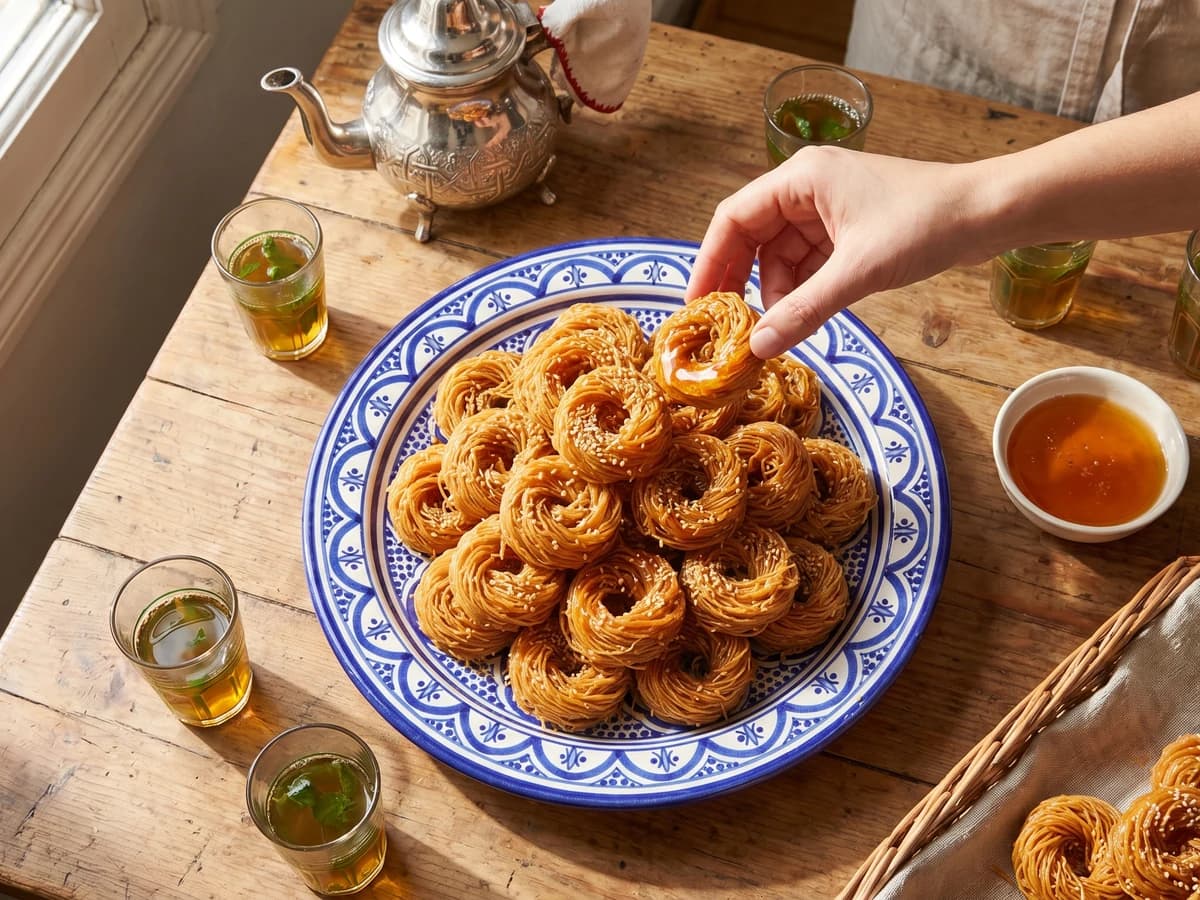
A Ramadan sweet lighter than chebakia: fine milk dough drawn into threads, fried until crisp, then bathed in orange-blossom honey and shared from a generous plate.
A cooking platform built around craft, culture, and the stories behind what we eat.
Created by
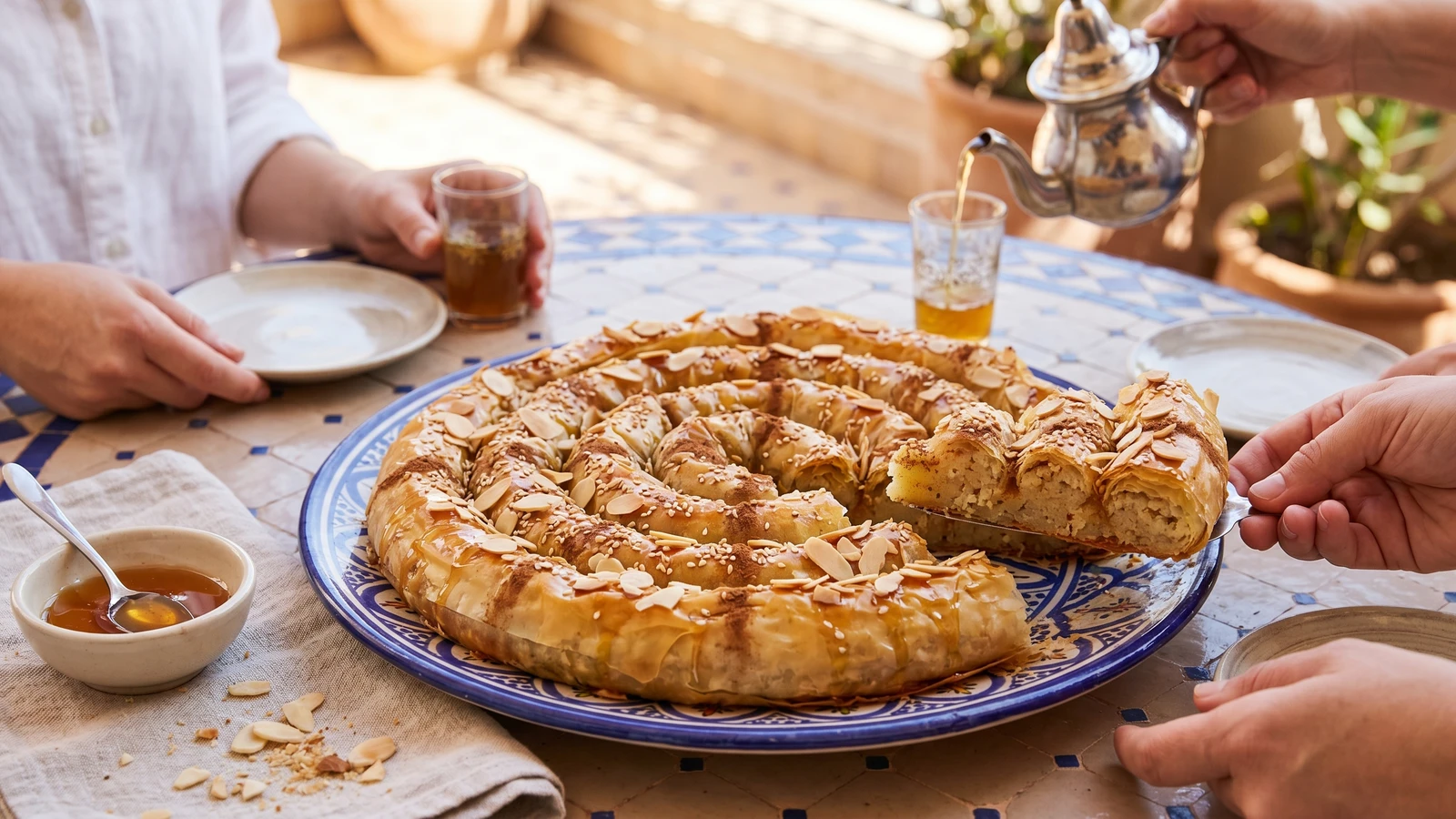
A Fassi celebration pastry coiled like its name, warqa wrapped around almond paste scented with orange blossom, baked gold, then brushed with honey until the spiral catches the light.
Everything here turns on the coil. You roll the almond paste into a long rope, tuck it inside warqa, then wind it gently, not tight, because the pastry needs room to crisp while the almond warms and swells. If you force it, it splits. If you keep your hands light, it becomes the snake that gives m'hanncha its name.
This is celebration pastry, the kind that sits in the center of a wedding tray or an Eid table while small glasses of mint tea travel from hand to hand. The filling is almonds, sugar, cinnamon, butter, and orange blossom water, nothing noisy, nothing pretending to be new. La balance est dans les yeux (the scale is in the eyes), but the paste should feel like soft clay: firm enough to roll, fragrant enough that you smell the orange blossom before it reaches the oven.
Use warqa if you can find it. If filo is what your market gives you, use it honestly and keep every sheet covered until the moment you brush it with butter, because dry pastry cracks before the welcome even begins. Bake it gold, gloss it with warm honey, and bring it out whole. This is la cuisine du lien (the cooking of connection) with honey on your fingers. Une table, c'est une porte qu'on laisse ouverte (a table is a door you leave open).
M'hanncha belongs to the Fassi and northern Moroccan citadin pastry repertoire, shaped by the Andalusi-Maghribi taste for almonds, sugar, cinnamon, and orange blossom water that strengthened after the migrations from al-Andalus in the 15th and 16th centuries. Warqa, the leaf-thin pastry used for pastilla and briouates, is documented in medieval Maghribi and Andalusi cooking and became a mark of skill in the imperial cities, especially Fez. The first written date for m'hanncha itself is not settled; its place on wedding and Eid trays is certain.
Quantity
500g
Quantity
160g
Quantity
1 1/2 tsp, plus more for finishing
Quantity
1/4 tsp
ground
Quantity
1/4 tsp
Quantity
60g
melted, for the almond paste
Quantity
2 tbsp, plus 1 tsp more if needed
Quantity
12 sheets
thawed if using filo
Quantity
100g
melted, for brushing
Quantity
1 egg white, or 1 tbsp flour mixed with 1 tbsp water
for sealing
Quantity
120g
Quantity
1 tbsp
for the honey
Quantity
2 tbsp
Quantity
2 tbsp
Quantity
1 tbsp
| Ingredient | Quantity |
|---|---|
| blanched almonds | 500g |
| fine sugar | 160g |
| ground cinnamon | 1 1/2 tsp, plus more for finishing |
| meska horra (gum mastic) (optional)ground | 1/4 tsp |
| fine sea salt | 1/4 tsp |
| unsalted buttermelted, for the almond paste | 60g |
| orange blossom water | 2 tbsp, plus 1 tsp more if needed |
| warqa, or large filo sheetsthawed if using filo | 12 sheets |
| unsalted buttermelted, for brushing | 100g |
| egg white or flour pastefor sealing | 1 egg white, or 1 tbsp flour mixed with 1 tbsp water |
| honey | 120g |
| orange blossom waterfor the honey | 1 tbsp |
| toasted sesame seeds | 2 tbsp |
| toasted sliced almonds (optional) | 2 tbsp |
| icing sugar (optional) | 1 tbsp |
Heat the oven to 160C / 325F. Spread the almonds on a tray and toast for 10 to 12 minutes, shaking once, until they smell sweet and take only a pale gold color. Let them cool completely before grinding. Warm almonds release oil too fast, and the paste turns heavy before your hands have done any work.
Pulse the cooled almonds with the sugar, cinnamon, meska horra, and salt until fine, stopping before the mixture turns oily. Add the melted butter and 2 tbsp orange blossom water, then pulse just until it clumps when squeezed. The paste should feel like soft clay, not wet sand; add the extra teaspoon of orange blossom water only if it refuses to hold.
Turn the almond paste onto the counter and knead it for half a minute, just until smooth. Divide it into 6 equal pieces and roll each one into a rope about 35 to 40 cm long, roughly the thickness of your thumb. Keep the ropes covered while you work so the almond paste stays supple.
Raise the oven to 180C / 350F and line a large baking sheet or round tray with parchment. Put the warqa or filo under a barely damp towel and work with one section at a time. Warqa stays supple only while covered; once dry, it cracks, and a cracked sheet cannot make a clean coil.
Lay a buttered pastry strip with the long side facing you. Place one almond rope along the lower third, fold the side edges in, then roll the pastry around the filling into a long loose cigar. Seal the edge with egg white or flour paste. Roll it snug enough to hold, not tight; the almond expands as it warms, and a tight roll tears.
Set the first roll seam side down in the center of the tray and curl it into a spiral. Add the next roll by tucking its end under the first and sealing the join, then keep coiling until the snake is complete. Leave a breath between the rings so the pastry can crisp without splitting. Brush the whole coil with melted butter.
Bake for 30 to 35 minutes, rotating the tray halfway through, until the pastry is deep gold, dry to the touch, and crisp at the outer curve. If the edges color too quickly, lower the oven to 170C / 340F for the last minutes. The pastry must bake through before the honey goes on, or the glaze will soften what your hands worked to build.
Warm the honey with 1 tbsp orange blossom water until loose and fragrant. Brush or spoon it over the hot m'hanncha, then scatter with toasted sesame seeds and sliced almonds. Let it rest for 15 minutes so the honey settles into the layers. Dust lightly with icing sugar and a little cinnamon if you like, then bring it whole to the table and cut it into wedges with mint tea beside it.
1 serving (about 110g)
Culinary guides, cultural storytelling, and the editorial depth that makes cooking meaningful.
Discover Culinary ExplorerChef Zohra
A Ramadan sweet lighter than chebakia: fine milk dough drawn into threads, fried until crisp, then bathed in orange-blossom honey and shared from a generous plate.

Chef Zohra
Tissue-thin warqa folded into small triangles around orange-blossom almond paste, fried until gold, then dipped warm into honey. This is the sweet Fassi briouat that makes tea feel like a feast.
Chef Zohra
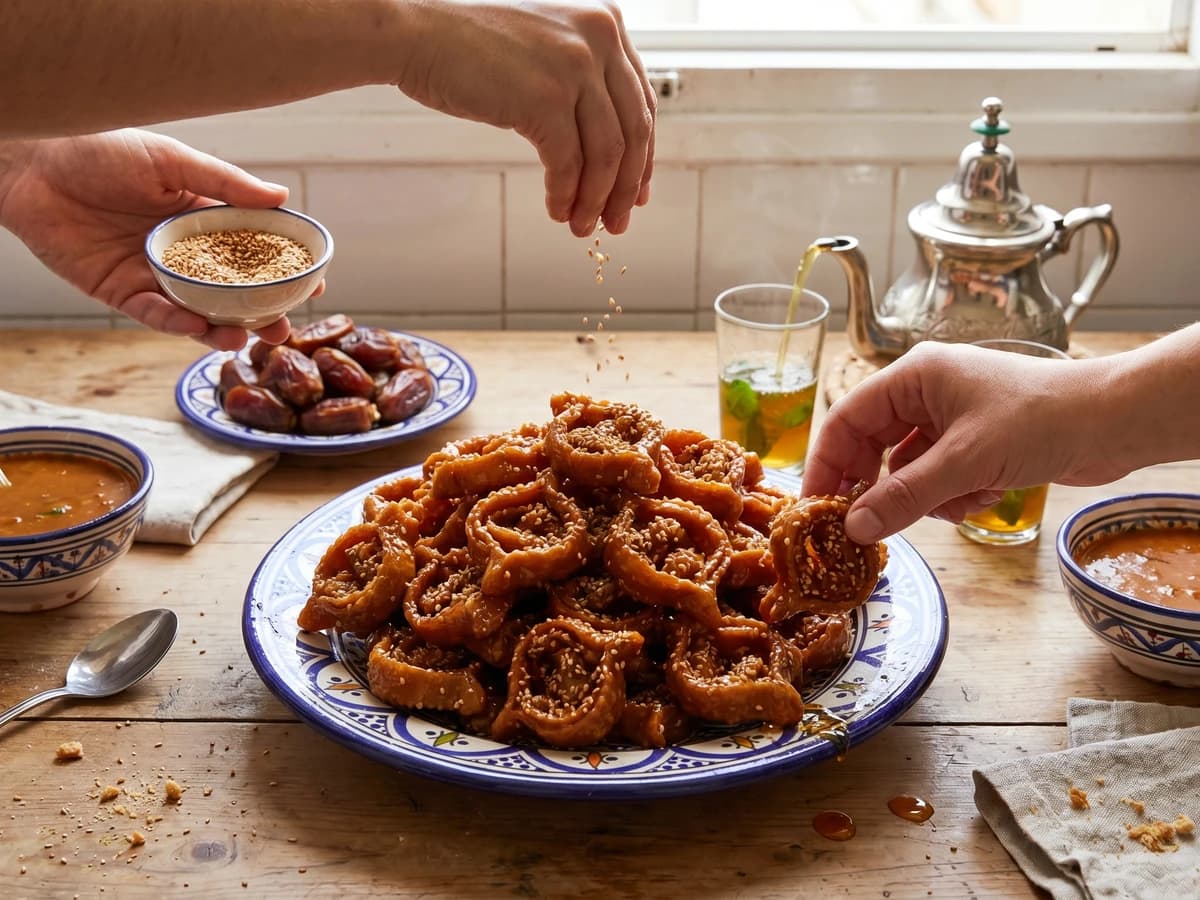
The flower of the Ramadan table: dough scented with toasted sesame, anise, saffron, and orange blossom water, fried crisp, then soaked in warm honey beside harira.

Chef Zohra
Slim warqa cigars filled with orange-blossom almond paste, fried until crisp under the teeth, then soaked in warm honey for the festive table.