
Chef Zohra
Boushnikha
A Ramadan sweet lighter than chebakia: fine milk dough drawn into threads, fried until crisp, then bathed in orange-blossom honey and shared from a generous plate.
A cooking platform built around craft, culture, and the stories behind what we eat.
Created by
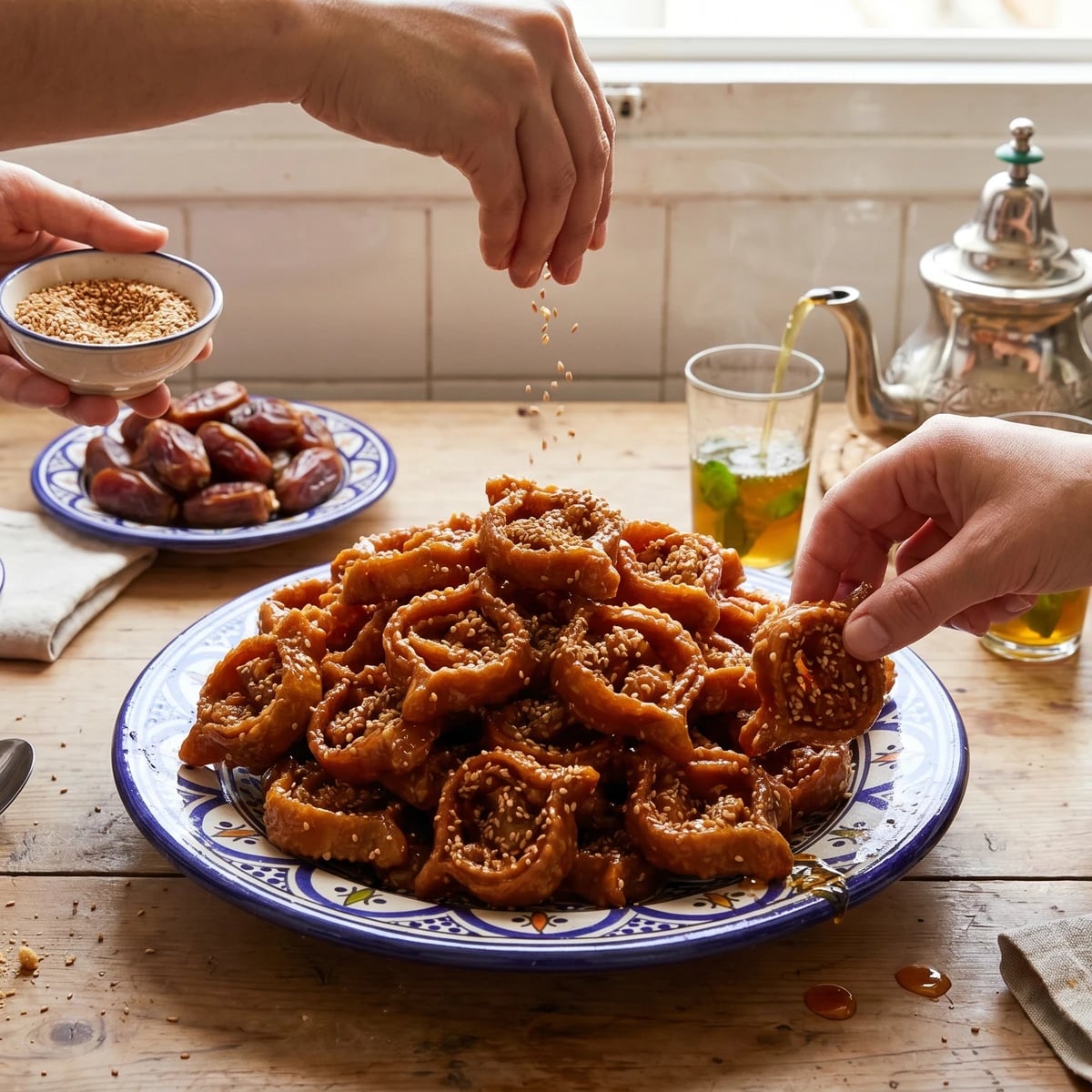
The flower of the Ramadan table: dough scented with toasted sesame, anise, saffron, and orange blossom water, fried crisp, then soaked in warm honey beside harira.
At the Ramadan table, chebakia waits beside harira like a little flower that has been through fire and honey. You break the fast with dates, soup, tea, and then this sticky, sesame-scented pastry, crisp at the edges and softening where the honey has entered. I make more than the tin can hold, because someone will carry a plate to the neighbor before sunset. This is la cuisine du lien (the cooking of connection) with sugar on your fingers.
The gesture matters more than the decoration. You cut the slits, thread the dough through itself, and open it into a flower so hot oil can reach every fold. The honey must be warm, not bubbling, and scented with orange blossom water; warm honey slips inside the pastry, cold honey sits on top like a coat.
Prepare yourself for a little work. Toast the sesame until it smells nutty, use real saffron threads bloomed in warm water, and let the dough rest so it rolls thin without fighting you. Chebakia is made ahead because Ramadan needs a generous hand. Une table, c'est une porte qu'on laisse ouverte (a table is a door you leave open), and a plate of these keeps it that way.
Chebakia belongs to the family of honeyed fried pastries documented in medieval Arabic and Andalusi cookbooks by the 13th century, before taking its Moroccan flowered form in cities such as Fez, Rabat, Meknes, and Marrakech. The name is often linked to shabaka, a net or lattice, because the dough is slit and woven before frying; in some regions you hear griouech or mkharka for related shapes. Its Ramadan place is shared across Morocco now, but the spicing keeps the trace of old trade routes: sesame, saffron, anise, cinnamon, mastic, and orange blossom water moving through markets tied to the Sahara, the Mediterranean, and Atlantic ports.
Quantity
500g
plus more for rolling
Quantity
150g
toasted, 100g finely ground and 50g kept whole
Quantity
2 tsp
Quantity
1 tsp
Quantity
1/2 tsp
crushed with 1 tsp sugar
Quantity
1 tsp
for crushing the mastic
Quantity
1/2 tsp
Quantity
1 tsp
Quantity
1 tsp
Quantity
1 large
lightly beaten
Quantity
60ml
Quantity
60g
melted
Quantity
2 tbsp
Quantity
3 tbsp
divided
Quantity
1 generous pinch
bloomed in 2 tbsp warm water
Quantity
120-160ml
as needed
Quantity
1.5L
for frying
Quantity
900g
warmed for soaking
| Ingredient | Quantity |
|---|---|
| all-purpose flourplus more for rolling | 500g |
| hulled sesame seedstoasted, 100g finely ground and 50g kept whole | 150g |
| ground anise | 2 tsp |
| ground cinnamon | 1 tsp |
| mastic gum (meska horra) (optional)crushed with 1 tsp sugar | 1/2 tsp |
| sugar (optional)for crushing the mastic | 1 tsp |
| fine sea salt | 1/2 tsp |
| baking powder | 1 tsp |
| instant yeast | 1 tsp |
| egglightly beaten | 1 large |
| olive oil | 60ml |
| unsalted buttermelted | 60g |
| white vinegar | 2 tbsp |
| orange blossom waterdivided | 3 tbsp |
| saffron threadsbloomed in 2 tbsp warm water | 1 generous pinch |
| lukewarm wateras needed | 120-160ml |
| neutral oilfor frying | 1.5L |
| honeywarmed for soaking | 900g |
Toast the sesame seeds in a dry pan over medium heat, stirring often, until they turn golden and smell nutty, 5 to 7 minutes. Cool them completely. Grind 100g of the sesame to a fine meal and keep the remaining 50g whole for finishing. Crush the mastic with the sugar if using, and bloom the saffron threads in 2 tbsp warm water for 10 minutes. These small aromatics steer the whole pastry, so start honest.
In a wide bowl, mix the flour, ground sesame, anise, cinnamon, salt, baking powder, yeast, and crushed mastic. Make a well and add the egg, olive oil, melted butter, vinegar, 2 tbsp orange blossom water, and the saffron water. Add the lukewarm water little by little, kneading as you go, until you have a firm dough that is smooth, dense, and not sticky. It should feel closer to pasta dough than bread dough.
Divide the dough into 4 pieces, rub each lightly with oil, cover, and let rest for 45 to 60 minutes. Do not wait for it to double; chebakia is not bread. The rest relaxes the dough so the slits stretch and fold without tearing.
Roll one piece of dough at a time on a lightly floured surface to about 2mm thick, thin enough that the shadow of your fingers almost shows through. Cut rectangles about 8 x 10cm with a fluted pastry wheel. In each rectangle, cut 4 long slits inside the border, leaving the edges attached so you have 5 connected strips. Keep the cut pieces covered while you work.
Lay one rectangle across your hand. Slip your index finger under the 1st, 3rd, and 5th strips, leaving the 2nd and 4th strips below, so the dough alternates over and under your finger. Pinch the two short ends together, then turn the shape gently through itself and open it into a flower. This shape is not decoration alone; it makes little channels so the oil crisps the folds and the honey enters them later.
Put the honey in a wide shallow pot and warm it over low heat until loose and glossy. Stir in the remaining 1 tbsp orange blossom water and keep it warm. Heat the frying oil in a heavy pot to 170-175°C. Use a pot deep enough that the oil sits well below the rim. The heat matters: too fierce and the sesame darkens before the dough cooks; too low and the pastry drinks oil.
Fry 5 or 6 chebakia at a time, without crowding the pot. Turn them gently with a spider or two forks until deep amber and crisp at the edges, about 4 to 6 minutes per batch. Let the oil return to temperature between batches. Lift each piece and pause over the pot just long enough for excess oil to fall back.
Move the hot chebakia directly into the warm honey. Press them under gently, turn them, and let them soak for 5 to 8 minutes, until the glaze clings and the folds look lacquered. This is the point of the dish: warm pastry and warm honey meeting at the right moment.
Lift the chebakia from the honey and set them on a rack over a tray. While they are still sticky, scatter the reserved whole toasted sesame over every piece. Let them cool completely before storing, or the tin will trap moisture and soften the pastry. Serve with harira, dates, mint tea, and enough pieces that the plate can travel down the table.
1 serving (about 47g)
Culinary guides, cultural storytelling, and the editorial depth that makes cooking meaningful.
Discover Culinary Explorer
Chef Zohra
A Ramadan sweet lighter than chebakia: fine milk dough drawn into threads, fried until crisp, then bathed in orange-blossom honey and shared from a generous plate.

Chef Zohra
Tissue-thin warqa folded into small triangles around orange-blossom almond paste, fried until gold, then dipped warm into honey. This is the sweet Fassi briouat that makes tea feel like a feast.

Chef Zohra
Slim warqa cigars filled with orange-blossom almond paste, fried until crisp under the teeth, then soaked in warm honey for the festive table.

Chef Zohra
Rabat's triangular answer to the briouat: thin warqa wrapped around toasted sesame and almonds, fried until gold, then dropped warm into honey scented with orange blossom.