Chef Zohra
Boushnikha
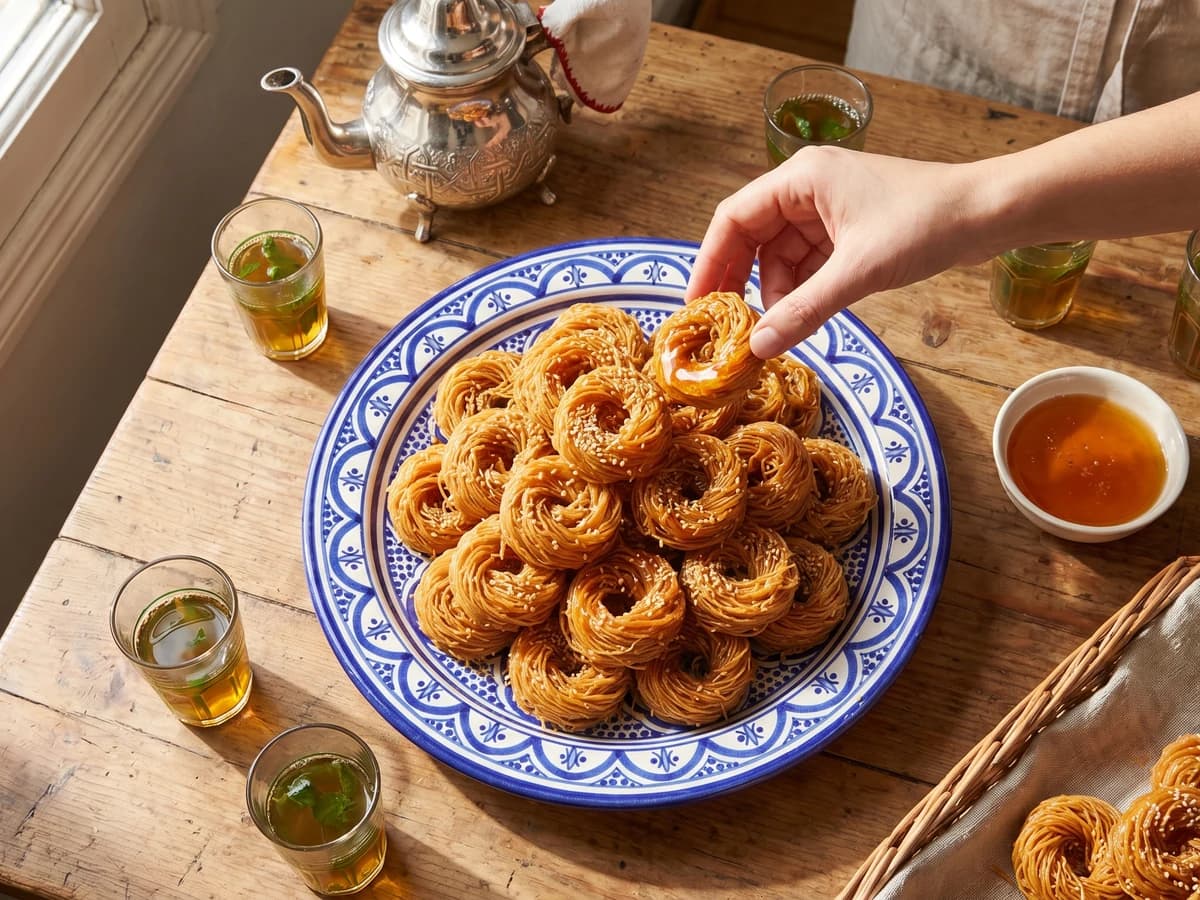
A Ramadan sweet lighter than chebakia: fine milk dough drawn into threads, fried until crisp, then bathed in orange-blossom honey and shared from a generous plate.
A cooking platform built around craft, culture, and the stories behind what we eat.

Created by
Tissue-thin warqa folded into small triangles around orange-blossom almond paste, fried until gold, then dipped warm into honey. This is the sweet Fassi briouat that makes tea feel like a feast.
Everything here turns on the fold. A briouat is small, yes, but it asks for a careful hand: the almond paste tucked tight, the warqa kept supple under a cloth, the seam sealed so the triangle holds its promise in the oil.
The old sweetness is precise. Blanched almonds, sugar, cinnamon, orange-blossom water, a little butter, and meska horra if your pantry has it. The paste must be fragrant but not wet, because wet filling leaks and heavy perfume buries the almond. La balance est dans les yeux, the scale is in the eyes, but your fingers will tell you too: the paste should roll without crumbling and without sticking like glue.
Then comes the gesture that decides the dish. Fry the triangles until they are gold and crisp, and move them while hot into warm honey. Hot pastry drinks warm honey into its thin layers; cold honey only sits on top. Serve them with mint tea, make more than your platter needs, and let someone take a few home. Une table, c'est une porte qu'on laisse ouverte, a table is a door you leave open.
Almond briouates belong to the citadin pastry register of Fez, Rabat, and Tetouan, where warqa work and almond-honey sweets were shaped by Andalusi cooks who entered Moroccan cities from the 9th century onward and again after 1492. Their sugar, almonds, and orange-blossom water sit on medieval Mediterranean and trans-Saharan trade routes, with sugar production becoming important in southern Morocco under the Saadians in the 16th century. The exact first date of the almond briouat is not proven, but its place at Ramadan, Eid, weddings, and the tea table is clear in the urban Moroccan repertoire.
Quantity
500g
skins removed and very dry
Quantity
150g
Quantity
1 tsp
Quantity
1/4 tsp
pounded with 1 tsp sugar
Quantity
2 tbsp
softened
Quantity
2 to 3 tbsp
for the almond paste
Quantity
1 pinch
Quantity
450g
cut into 6-7 cm strips, or about 24 large filo sheets as a substitute
Quantity
2 tbsp
only if using filo
Quantity
2 tbsp flour mixed with 2 tbsp water
for sealing
Quantity
1 to 1.25 liters
for frying
Quantity
500g
Quantity
2 tbsp
for the honey
Quantity
2 tbsp
| Ingredient | Quantity |
|---|---|
| blanched almondsskins removed and very dry | 500g |
| granulated sugar | 150g |
| ground cinnamon | 1 tsp |
| meska horra, gum arabic or mastic (optional)pounded with 1 tsp sugar | 1/4 tsp |
| unsalted buttersoftened | 2 tbsp |
| orange blossom waterfor the almond paste | 2 to 3 tbsp |
| fine sea salt | 1 pinch |
| warqa sheetscut into 6-7 cm strips, or about 24 large filo sheets as a substitute | 450g |
| melted butter or neutral oil (optional)only if using filo | 2 tbsp |
| plain flour pastefor sealing | 2 tbsp flour mixed with 2 tbsp water |
| neutral oilfor frying | 1 to 1.25 liters |
| honey | 500g |
| orange blossom waterfor the honey | 2 tbsp |
| toasted sesame seeds (optional) | 2 tbsp |
Heat 3 cm of neutral oil in a small heavy pan to 160°C, or use part of the frying oil before it has seen pastry. Add the dry blanched almonds in small batches and fry until pale gold, 3 to 5 minutes, stirring often. Pull them out a shade lighter than you want; almonds darken as they cool, and dark almonds make a bitter filling. Drain very well and cool completely.
Pulse the cooled almonds with the sugar in a food processor, stopping and scraping often. Stop before the almonds release too much oil; you want a moist, grainy paste, not almond butter. Work in the cinnamon, salt, meska horra if using, softened butter, and 2 tablespoons orange blossom water. Knead with your hand until the paste holds together.
Roll the almond paste into 36 small logs, each about 2.5 cm long. Keep them covered while you work. The filling should be firm enough to hold its shape inside the pastry, but tender enough to bite cleanly after frying.
Cut the warqa into long strips, 6 to 7 cm wide. Keep the stack covered with a barely damp cloth so the edges stay supple. If you are using filo, use two thin layers for each strip and brush them very lightly with melted butter or oil; filo is drier than warqa and cracks faster.
Place one almond log near the end of a strip. Fold one corner over the filling to make a triangle, then keep folding left and right, like a flag, with the edges aligned and the filling held snug. Brush the last flap with the flour paste and press to seal. That tight fold matters: air pockets open in the oil and invite oil into the filling.
Warm the honey with 2 tablespoons orange blossom water in a small saucepan until loose and glossy. Keep it warm over very low heat, but do not let it boil hard. Set a rack over a tray beside it, ready for the briouates.
Heat the frying oil in a heavy pot to 170-175°C, filling the pot less than halfway. Fry the briouates in small batches, turning once or twice, until evenly gold and crisp, about 3 to 4 minutes. If the oil is too cool, the layers drink oil; if it is too fierce, the outside colors before the pastry has crisped through.
Lift the hot briouates from the oil, let them drain for a few seconds, then slide them straight into the warm honey. Turn them gently and leave them 2 to 3 minutes so the honey enters the thin layers. Lift to the rack, sprinkle with toasted sesame if using, and let the glaze settle before serving.
1 serving (about 145g)
Culinary guides, cultural storytelling, and the editorial depth that makes cooking meaningful.
Discover Culinary ExplorerChef Zohra
A Ramadan sweet lighter than chebakia: fine milk dough drawn into threads, fried until crisp, then bathed in orange-blossom honey and shared from a generous plate.
Chef Zohra
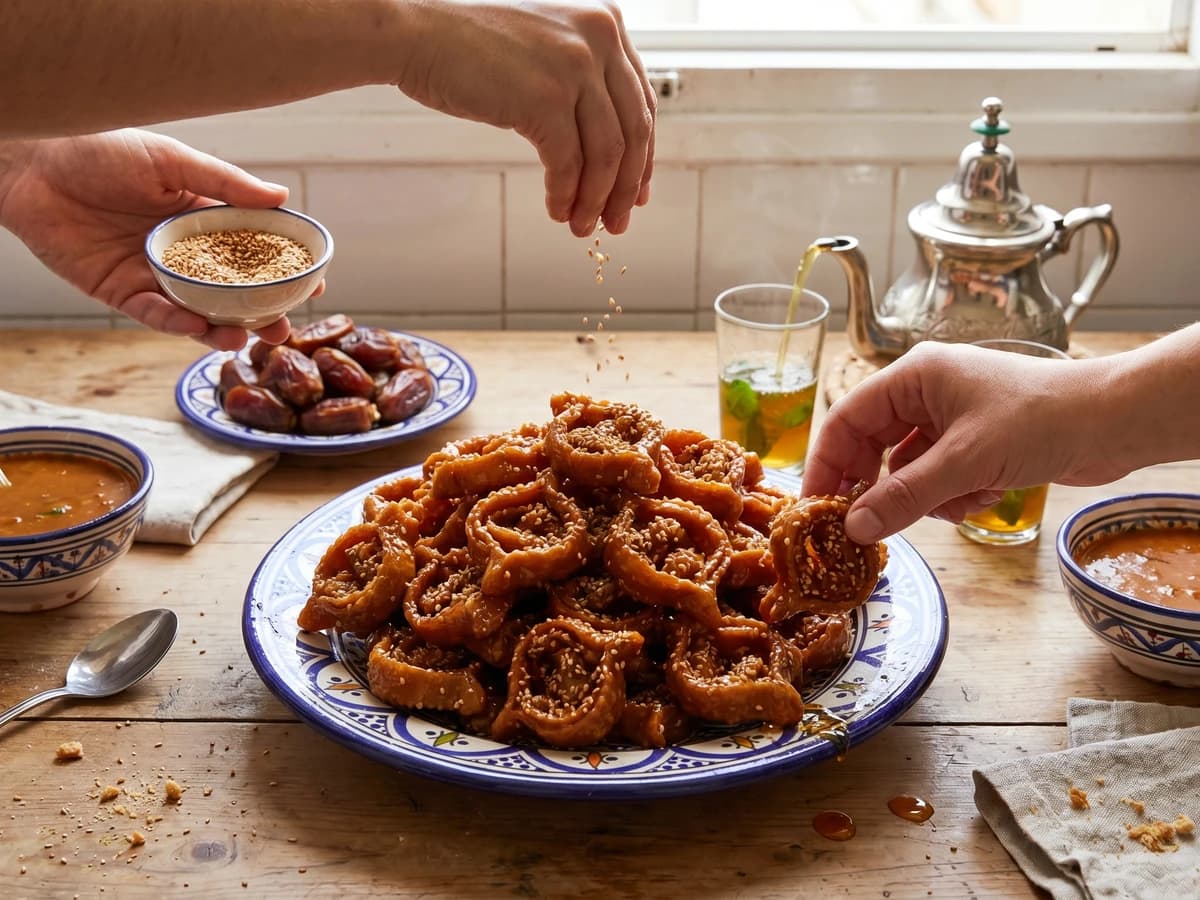
The flower of the Ramadan table: dough scented with toasted sesame, anise, saffron, and orange blossom water, fried crisp, then soaked in warm honey beside harira.

Chef Zohra
Slim warqa cigars filled with orange-blossom almond paste, fried until crisp under the teeth, then soaked in warm honey for the festive table.

Chef Zohra
The Moroccan biscuit that waits well: anise-scented logs baked once, cooled, sliced thin, then baked again until crisp enough for mint tea and generous enough for guests.