
Chef Zohra
Baghrir (بغرير)
The lacy Moroccan pancake of fine semolina, cooked on one side only so every little hole stays open for warm butter and honey.
A cooking platform built around craft, culture, and the stories behind what we eat.
Created by
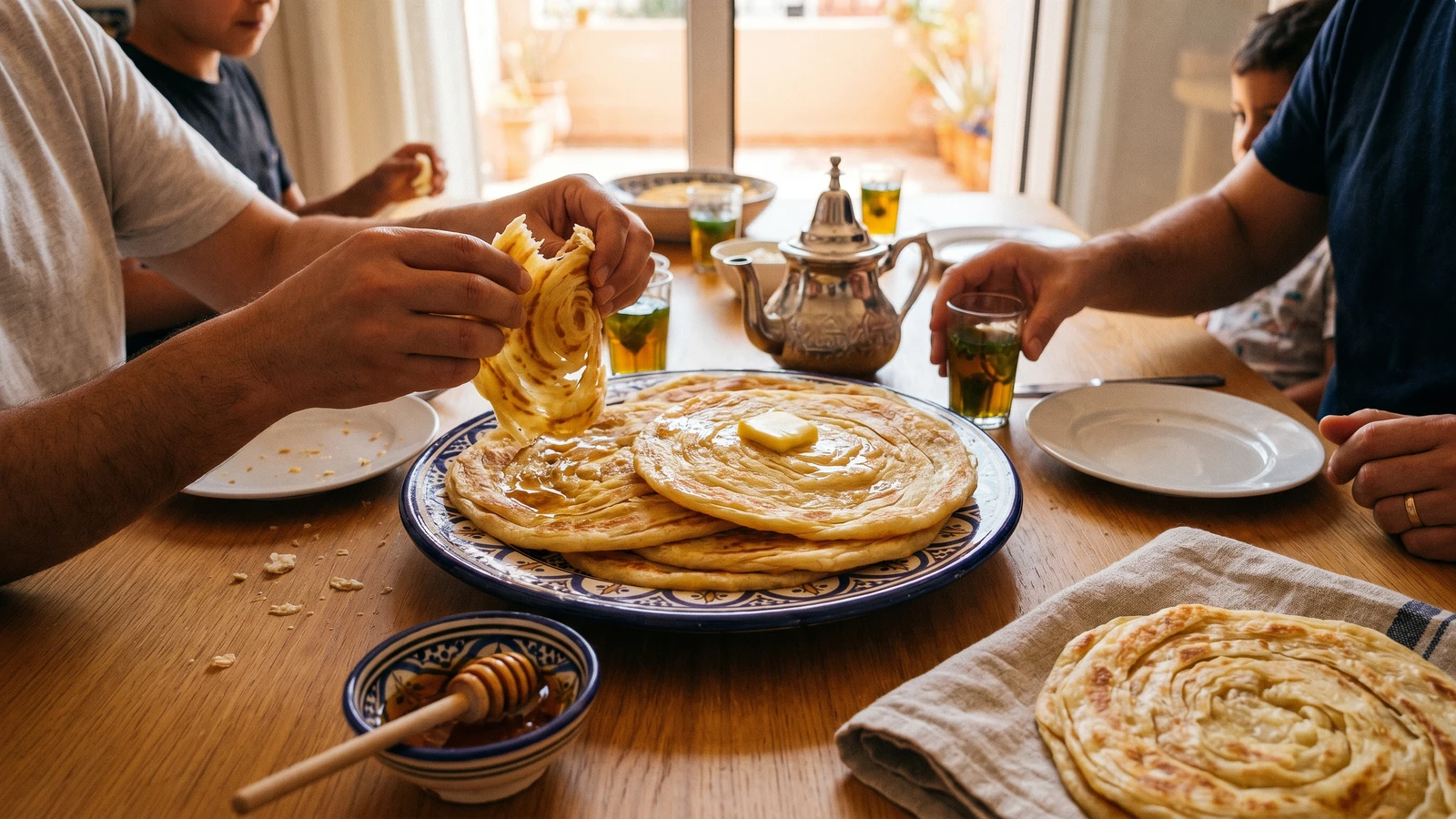
The round cousin of msemen, stretched thin, buttered, coiled, and pressed flat so the bread opens in warm rings at the table.
Everything in meloui turns on the coil. You stretch the dough thin, gloss it with butter and oil, scatter semolina over it, then roll it into a rope and curl it like a little snail. That spiral is not decoration. It is how the bread learns to pull apart in soft, buttery layers under your fingers.
Work unhurriedly. The dough needs kneading so it has strength, then resting so it becomes gentle enough to stretch without fighting you. If it tears a little, don't panic. Patch it with your palm, keep it oiled, and move on. La balance est dans les yeux, the scale is in the eyes, but the hand learns quickly here.
Meloui belongs to the tea table, to breakfast, to the evening when someone comes in tired and you want something hot and generous without making a feast. Serve it with honey, butter, amlou if you have it, and mint tea. Make one more than you think you need. A table is a door you leave open.
Meloui sits in the Maghrebi family of laminated griddle breads, alongside Moroccan msemen and related Amazigh and urban breads shaped across Morocco from the Middle Atlas to the old medinas. Its exact dating is not fixed in written sources, because breads like this lived in hands before they lived in books, but the technique belongs to the long North African grain culture built around wheat, semolina, household griddles, and tea-time hospitality. Regional names and proportions shift, with some families leaning more semolina and others more white flour, a small reminder that there are des cuisines marocaines, not one flat Moroccan kitchen.
Quantity
400g
plus more only if needed
Quantity
150g
plus 60g more for shaping
Quantity
1 1/2 tsp
Quantity
300ml
added gradually
Quantity
80ml
for hands and shaping
Quantity
80g
melted
Quantity
to serve
Quantity
to serve
| Ingredient | Quantity |
|---|---|
| all-purpose flourplus more only if needed | 400g |
| fine semolinaplus 60g more for shaping | 150g |
| fine sea salt | 1 1/2 tsp |
| warm wateradded gradually | 300ml |
| neutral oilfor hands and shaping | 80ml |
| unsalted buttermelted | 80g |
| honey (optional) | to serve |
| butter (optional) | to serve |
Mix the flour, 150g fine semolina, and salt in a wide bowl. Add the warm water gradually, pulling the flour in with your fingers until you have a soft dough that is tacky but not wet. Knead 10 to 12 minutes, by hand or mixer, until it feels elastic and smooth under your palm.
Oil your hands and the work surface lightly. Divide the dough into 8 balls, tucking each one smooth underneath. Rub each ball with a little oil, cover with plastic or a clean towel, and rest 20 minutes. This rest matters: it relaxes the dough so it stretches thin without snapping back.
Mix the melted butter with the oil in a small bowl. Working with one ball at a time on an oiled surface, press and stretch it outward with oiled hands until it is very thin, almost translucent in places. Brush with the butter-oil mixture and scatter lightly with fine semolina.
Fold one edge of the thin dough toward the center, then the other edge over it to make a long strip. Brush again with butter-oil, sprinkle with a little semolina, then roll the strip lengthwise into a rope. Coil the rope into a tight spiral and tuck the end underneath. Repeat with the rest, then rest the coils 10 minutes so they soften before flattening.
Take one rested coil and press it gently from the center outward into a round about 12 to 15cm wide. Keep the spiral visible. If the dough resists, let it sit another few minutes and press again. Forcing it makes tough bread.
Heat a heavy griddle or skillet over medium heat and wipe it with the thinnest film of oil. Cook each meloui 3 to 4 minutes per side, turning a few times, until both sides are golden with darker freckles and the edges feel cooked through. Keep the heat moderate, because high heat browns the outside before the center has time to finish.
Serve the meloui warm, with honey and butter at the table. Tear it with your hands so the layers separate. If you are making a pile, keep the cooked breads wrapped in a clean towel so they stay tender while the next ones cook.
1 serving (about 135g)
Culinary guides, cultural storytelling, and the editorial depth that makes cooking meaningful.
Discover Culinary ExplorerChef Zohra
The lacy Moroccan pancake of fine semolina, cooked on one side only so every little hole stays open for warm butter and honey.

Chef Zohra
Small rounds of Moroccan bread puffed on a hot pan, tender inside with a pocket ready for sauce, olives, honey, or whatever the table has made room for.

Chef Zohra
A Chaouia griddle bread halfway between loaf and light beignet, made from a loose semolina dough spread by hand, fried gold, and eaten warm with butter, honey, or olive oil.

Chef Zohra
A pan-cooked semolina galette, golden at the edges and tenderly crumbly inside, called harcha in much of Morocco and mbesses in the Oujda east.