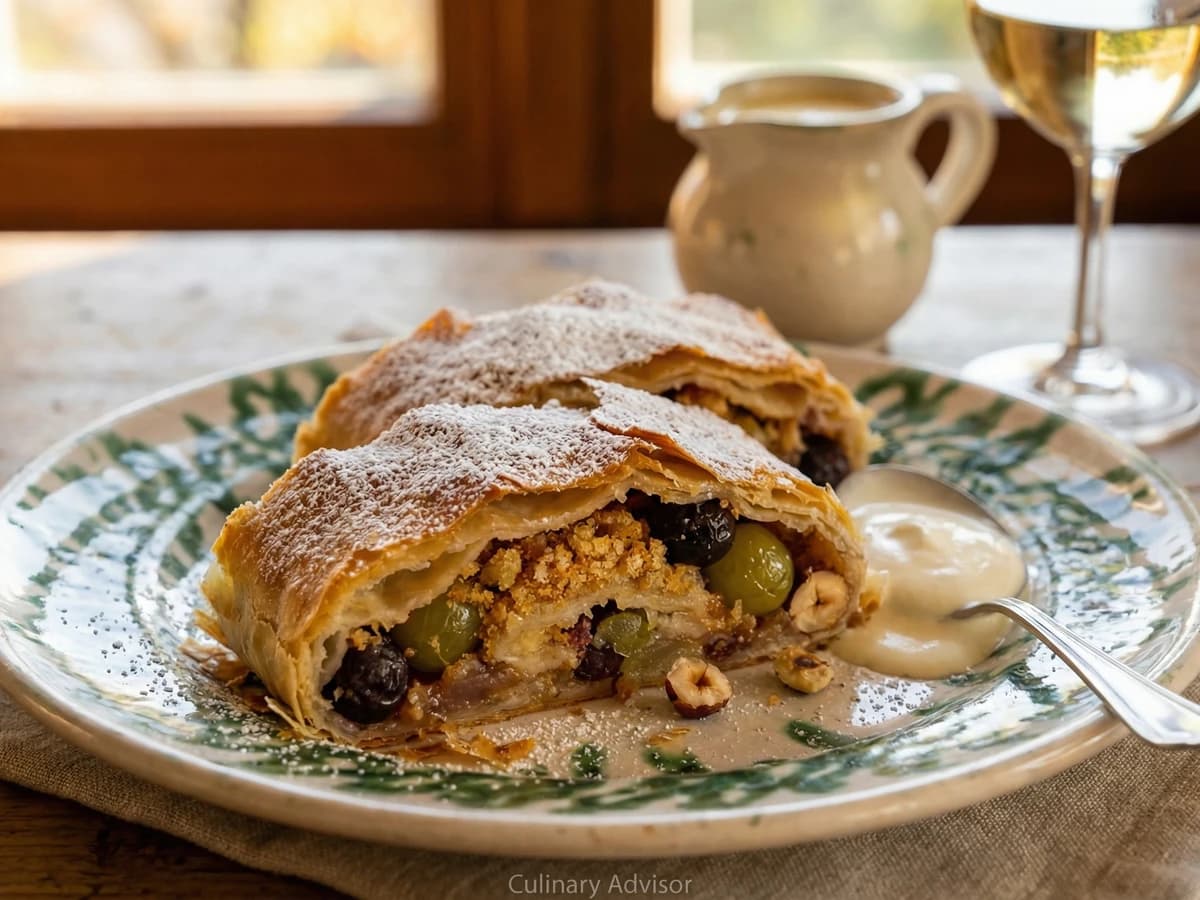
Ground almonds, lemon zest, and Vanillezucker folded into a light, souffled filling, wrapped in paper-thin hand-stretched dough and baked until the whole kitchen smells like a Viennese Konditorei on a Saturday morning.
Pastries & Cookies
Austrian
Dinner Party
Special Occasion
1 hr
Active Time
35 min cook•1 hr 35 min total
Yield8 servings
Gretel always said that Austrians judge a baker by their strudel dough, and they judge a Konditorei by what it puts inside. Apfelstrudel gets the fame. Topfenstrudel gets the love. But Mandelstrudel, the almond strudel, is the one that tells you whether the baker actually understands Mehlspeisen. The filling is nothing more than ground almonds, sugar, egg yolks, a breath of lemon zest, and whipped egg whites folded through to give it lift. There's nowhere to hide. If your almonds aren't good, you'll taste it. If your technique is sloppy, you'll see it.
I first made this with Gretel in my grandmother Eva's kitchen in Deal. I was maybe ten or eleven. Gretel had me grind the almonds in a small hand mill clamped to the edge of the table, and I remember the smell coming off that mill: sweet, oily, warm, like nothing I'd ever smelled from a bag of shop-bought ground almonds. She folded in the egg whites with a big metal spoon and told me to count the strokes. Twelve, maybe fifteen. No more. "You fold until it's just mixed and then you stop. Every extra stroke pushes out the air you just put in." I still count.
Mandelstrudel belongs to the Viennese Konditorei tradition, the kind of pastry you'd find in glass cases at Demel or Gerstner, sliced to order and served on a white plate with coffee and that glass of water. It's not a rustic farmhouse strudel. It's precise, refined, and quietly spectacular. The dough shatters. The filling is light, almost like a warm almond cloud held together by egg and sugar. When you cut a slice and see those paper-thin layers of pastry wrapped around that pale golden filling, you understand why the Viennese treat their Mehlspeisen as the heart of the cuisine and not a sweet little afterthought.
Strudel dough itself arrived in Vienna through Ottoman and Hungarian influence, with roots in the layered pastry traditions of the Eastern Mediterranean. By the 18th century, Viennese bakers had claimed the technique as their own and were filling it with everything from apples to cabbage. Mandelstrudel became a fixture of the Konditorei by the early 1800s, particularly prized during Lent and on fast days when its richness could stand in for heavier butter-based pastries. Almond-based fillings also held special importance in Jewish Viennese baking, where they appeared in strudels served for Shabbat and holidays, making Mandelstrudel one of the places where Vienna's Jewish and Catholic baking traditions quietly overlapped.
The technique, the tradition, and the story behind every dish.
•Large clean tablecloth or bedsheet for stretching dough
•Rolling pin
•Food processor or nut grinder
•Baking sheet lined with parchment paper
•Pastry brush
•Hand mixer or whisk for egg whites
Instructions
1
Make the strudel dough
Mound the griffiges Mehl on a clean work surface and make a wide well in the center. Add the oil, vinegar, salt, and warm water. Work the liquid into the flour with your fingers, then start kneading. The dough will feel rough and shaggy at first. Keep going. After eight to ten minutes it should become smooth, soft, and slightly tacky, like the skin on the inside of your wrist. The vinegar relaxes the gluten, which is why your dough will stretch later instead of fighting you.
Use griffiges Mehl if you can get it. Austrian coarse flour has less gluten than standard all-purpose, which gives a more tender, pliable dough. If you're using all-purpose flour, add an extra splash of oil to soften it.
2
Rest the dough
Shape the dough into a smooth ball, brush the surface lightly with oil, and place it under a warmed bowl. Let it rest for at least thirty minutes. This is not optional and it's not idle time. The gluten strands need to relax completely or the dough will tear when you stretch it. You can leave it up to two hours. Longer rest, easier stretch.
Warm the bowl by filling it with hot water for a minute, then drying it. The gentle warmth keeps the dough supple while it rests.
3
Toast the breadcrumbs
Melt 30g of butter in a small pan over medium heat. Add the breadcrumbs and stir constantly until they turn a warm golden brown and smell nutty, about three to four minutes. Set aside to cool. These toasted crumbs go between the dough and the filling, where they do two critical things: they absorb moisture so the bottom stays crisp, and they add a quiet, toasty layer of flavor that you'd miss terribly if it weren't there.
4
Grind the almonds
Pulse the blanched almonds in a food processor until they're finely ground but still have some texture. You want a coarse meal, not a paste. Stop the machine and check every few pulses. The moment the almonds start clumping and looking oily, you've gone too far. A few slightly larger pieces are fine. They give the filling something to bite into.
5
Build the filling
In a large bowl, beat the egg yolks with the caster sugar and Vanillezucker until thick and pale, about two minutes by hand. Stir in the ground almonds, lemon zest, and milk. The mixture will be dense and fragrant. In a separate clean bowl, whisk the egg whites with a pinch of salt to stiff peaks, glossy and firm. Fold them into the almond mixture in two additions, gently, lifting from the bottom. The whipped whites make the filling light and souffled when it bakes. Handle them with respect.
The lemon zest is doing more work than you think. Without it, the almond filling can taste flat and one-dimensional. With it, everything lifts. Use a Microplane and zest only the bright yellow outer layer, never the bitter white pith.
6
Stretch the dough
Preheat your oven to 190°C (375°F). Cover a large table with a clean tablecloth or bedsheet and dust it generously with flour. Roll the dough out with a rolling pin into a rough rectangle, then set the pin aside. Slide your hands under the dough, palms down, knuckles up. Working from the center outward, gently pull and stretch the dough using the backs of your hands. Walk around the table. Let gravity help. The dough should become thin enough to read a newspaper through it. Don't panic about a few small tears along the edges. Trim any thick borders with kitchen scissors.
Gretel always said to take off your rings before stretching strudel dough. One snag from a ring and you've got a hole the size of your fist.
7
Fill and roll the strudel
Brush the entire surface of the stretched dough with about two-thirds of the melted butter. Scatter the toasted breadcrumbs evenly over the lower third of the dough, leaving a three-centimeter border along the edges. Spread the almond filling over the breadcrumbs in an even layer. Fold the side borders inward over the filling. Using the cloth underneath, lift the edge closest to you and roll the strudel away from you, letting the dough wrap around the filling in loose layers. Don't roll it tight. The filling expands as it bakes and it needs room. Guide it gently onto a parchment-lined baking sheet, seam side down, curving it into a slight crescent if it's too long for the tray.
8
Bake the strudel
Brush the top and sides with the remaining melted butter. Place in the preheated oven and bake for fifteen minutes. Open the oven carefully and brush the strudel again with any butter left in the dish, or a little extra melted butter if you've run out. This second brush is what builds the shattering, flaky crust. Continue baking for another fifteen to twenty minutes, until the pastry is deep golden brown and the surface sounds hollow when you tap it lightly with a fingernail. Let it rest on the tray for ten minutes before slicing.
If the top is browning too quickly, lay a sheet of aluminum foil loosely over it for the last ten minutes. You want deep gold, not scorched.
9
Slice and serve
Dust the strudel generously with powdered sugar. Use a sharp serrated knife to cut thick slices on a slight diagonal, letting the layers show at the cut. The filling should be puffed and golden inside, the almonds fragrant and just barely set, the dough around it paper-thin and crackling. Serve warm with a spoonful of Schlagobers (unsweetened whipped cream) or a small pour of vanilla sauce alongside. Mahlzeit!
Chef Tips
•Grind the almonds yourself from whole blanched nuts. Pre-ground almond flour is too fine and too dry. You want the oils released fresh, right before they go into the filling. That's where the flavor lives.
•The egg whites are what separate a dense, heavy almond strudel from a light, souffled one. Whip them properly to stiff peaks and fold them in gently. This is the same principle as a Salzburger Nockerl: the air you trap is the texture you eat.
•Don't be afraid of the dough. Strudel dough is more forgiving than people think. Small tears don't matter because you're rolling it up in layers. The butter between the layers seals everything. Work with confidence and it will reward you.
•Serve Mandelstrudel warm, not hot. Straight from the oven the filling is too soft to slice cleanly. Give it ten minutes on the tray. The filling sets just enough, the layers hold their shape, and the flavor is actually better when it's had a moment to settle.
Advance Preparation
•The strudel dough can rest for up to two hours under a warm bowl. Longer rest makes stretching easier.
•The almond filling can be prepared (without the egg whites) up to a day ahead and refrigerated. Fold in freshly whipped egg whites just before assembling.
•Toasted breadcrumbs keep in an airtight container for a week. Make extra and save yourself the step next time.
•Baked Mandelstrudel is best the day it's made but can be reheated in a 160°C oven for ten minutes the next day. The layers won't be quite as crisp, but the filling stays beautiful.
Frequently Asked Questions
Nutrition Information
1 serving (about 135g)
Calories
520 calories
Total Fat
30 g
Saturated Fat
10 g
Trans Fat
0 g
Unsaturated Fat
19 g
Cholesterol
105 mg
Sodium
95 mg
Total Carbohydrates
52 g
Dietary Fiber
4 g
Sugars
21 g
Protein
12 g
Where cooking meets culture.
Culinary guides, cultural storytelling, and the editorial depth that makes cooking meaningful.