Culinary Explorer

A cooking platform built around craft, culture, and the stories behind what we eat.
Discover Culinary Explorer
Mā (Tuvaluan Fermented Breadfruit Keeping-Paste)

Mā (Tuvaluan Fermented Breadfruit Keeping-Paste)

Created by

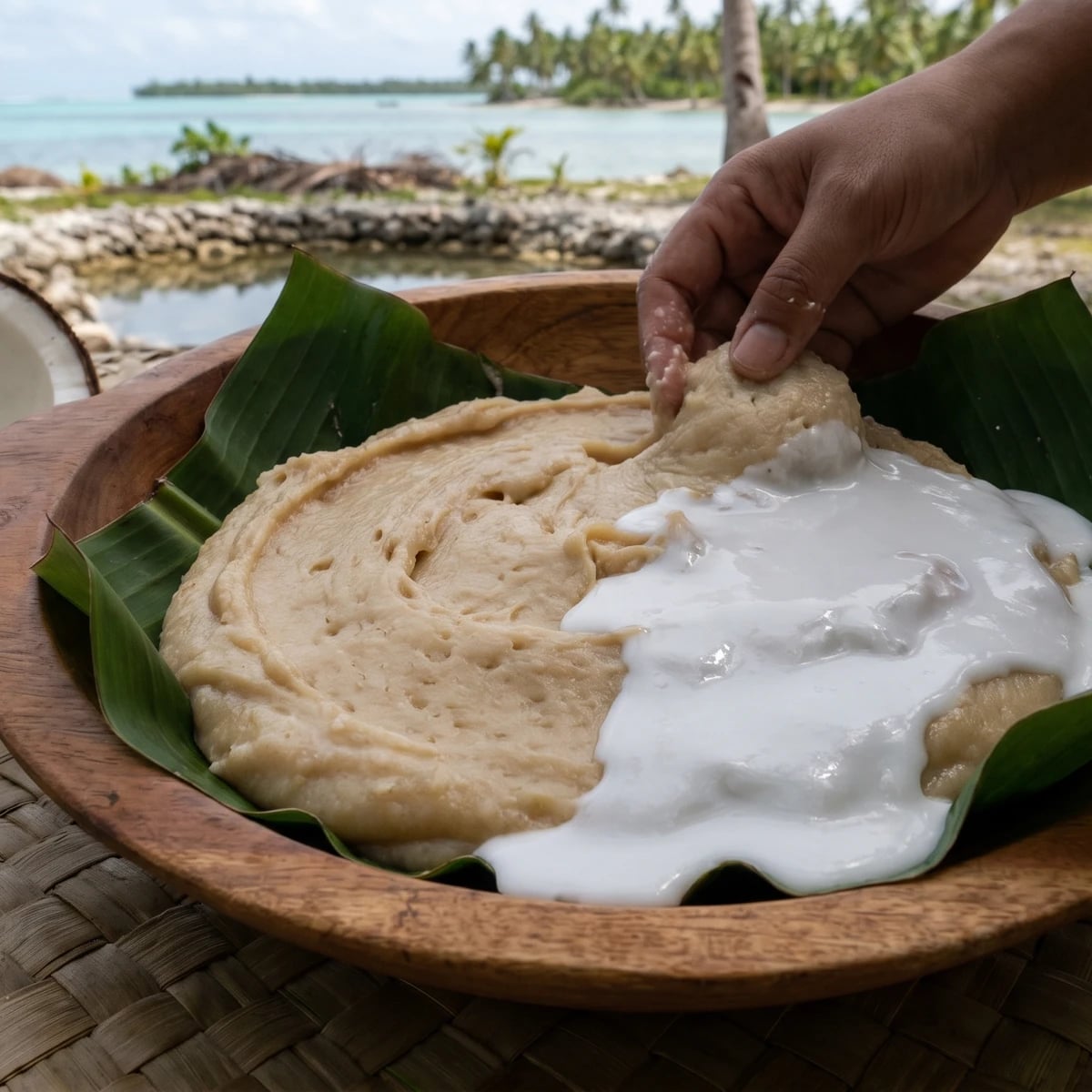
Ripe breadfruit folded into leaf, weighted, and left to sour into mā, Tuvalu's old keeping-paste for the lean season, served warm with coconut cream beside pulaka and fish.

Side Dishes
Polynesian, Tuvaluan
Make Ahead
Budget Friendly
45 min
Active Time
1 hr cook168 hr 45 min total
YieldAbout 4 cups, 8 to 10 side servings

Pulaka comes first in Tuvalu, the giant swamp-taro hauled from pits dug down into coral, and those pits are going salty now. That one hurts. On the low islands, where the lagoon is close enough to hear and the soil is thin coral, food has always been a kind of promise: pulaka in the pit, breadfruit on the tree, toddy tapped from the coconut, fish from the reef, enough to keep the family when the weather turns or the ship is late.

Mā belongs to Tuvalu's hand. It is ripe breadfruit, softened, packed away, and let to ferment until it becomes a sour keeping-paste, the kind of food that says the old people were thinking ahead before the lean month even showed its face. Tokelau has its own atoll food world too, with pulaka pits, coconut, fish, and old ways of holding food against scarcity. Name them both, yeah, but don't smear them together. Tuvalu is Tuvalu. Tokelau is Tokelau.

Back home in Hawaiʻi I know breadfruit as ʻulu, and across the Triangle it answers to other names: ʻuru in Tahiti, kuru in the Cook Islands, mei in parts of the west. One ocean, one canoe, one root, but this dish is not mine to claim. I cook it open-handed and send you to Tuvaluan elders for the deep pit knowledge, because the old buried mā carries more than a method. It carries survival.

For a home kitchen, we make a small, careful batch in a clean jar, not a deep coral pit. Eat what you have. If your breadfruit is ripe and soft, use it. If the island store has coconut cream in a can and rice from the barge, that truth sits on the table too. Food on a barge is the wound. Feeding the island from its own ground is the repair.

Mā is part of Tuvalu's coral-atoll larder, where ripe breadfruit was traditionally packed into leaf-lined pits and fermented into a sour paste that could hold through months when fresh crops were scarce. On islands with little soil and rising saltwater, pulaka pits, breadfruit, coconut, toddy, reef fish, and careful preservation formed a food system built for survival long before imported rice and corned beef became everyday safety nets. Its cousins are not one generic island food: Hawaiʻi pounds ʻulu and kalo, Tahiti keeps ʻuru, the Cook Islands cook kuru, and Tokelau carries its own pulaka and preserved-food knowledge in a neighboring but distinct atoll world.

The technique, the tradition, and the story behind every dish.

Discover Culinary Explorer

Ingredients

very ripe breadfruit

Quantity

3 pounds

soft but not rotten

banana leaves or breadfruit leaves

Quantity

as needed

rinsed and wilted over heat

fine sea salt (optional)

Quantity

1 teaspoon

filtered water

Quantity

1/2 cup

as needed for packing

thick coconut cream

Quantity

1 cup

fresh if possible, for serving

sea salt

Quantity

to taste

for serving

Equipment Needed

  • 1-quart glass jar or small fermentation crock
  • Fermentation weight or small sealed water-filled jar
  • Steamer basket or large pot with rack
  • Potato masher or heavy wooden spoon

Instructions

  1. 1

    Choose the fruit

    Use breadfruit that has gone fully ripe, with flesh soft enough to yield under your thumb and a sweet, fermented-fruit smell, not a rotten or moldy one. Trim away bruised, black, or fuzzy spots. No blame the breadfruit if it is underripe; it needs time before it can become mā.

    If your breadfruit is still hard and starchy, cook it another way and wait for a ripe one. This keeping-paste begins with softness.
  2. 2

    Clean and steam

    Wash the breadfruit, cut it into large wedges, remove the core, and steam the wedges for 45 to 60 minutes, until the flesh collapses easily and pulls from the skin. The old pit method begins raw or naturally softened, but a small home batch benefits from this steady cook. It keeps the work clean and makes the mash pack tight.

  3. 3

    Mash it smooth

    When cool enough to handle, scoop the flesh into a clean bowl and mash it with the salt if using. Work it until it becomes a heavy, sticky paste with only small fibers showing. Add filtered water by the spoon only if it is too dry to press down firmly.

  4. 4

    Line the jar

    Line a very clean 1-quart glass jar or fermentation crock with wilted banana leaf or breadfruit leaf, letting the leaf come up the sides. The leaf is memory of the pit, not decoration. Press the breadfruit paste in hard, layer by layer, so no air pockets hide inside.

  5. 5

    Weight and ferment

    Fold leaf over the top, set on a clean fermentation weight or a small sealed water-filled jar, and cover loosely so gas can escape. Leave at cool room temperature, 68F to 75F, for 5 to 7 days, checking daily. It should smell pleasantly sour, fruity, and yeasty, with a pale tan color and a soft tang. If you see fuzzy mold, pink streaks, black patches, or smell rot, throw it out. We no gamble with fermentation.

  6. 6

    Chill or hold

    When the mā tastes tangy and settled, move it to the refrigerator. This home version is not the year-long buried pit of Tuvalu, so treat it like a living food and eat it within 2 weeks. The old people knew their pits, their leaves, their climate, their hands. In your kitchen, cleanliness is the elder watching over you.

  7. 7

    Warm and serve

    To serve, spoon mā into a small pot with a splash of water and warm it gently, stirring until it softens and shines. Fold in thick coconut cream or serve the cream over the top, then salt lightly if it wants it. Set it beside fish, pulaka, rice, or corned beef if that's the meal today. Deep food and everyday food can sit together. That's how people actually eat.

Chef Tips

  • This is Tuvaluan mā, not a generic atoll dish. Tokelau has its own pulaka and preservation knowledge, close in ecology but carried by its own people.
  • Ask for ripe breadfruit, not just mature breadfruit. Mature breadfruit cooks like a starch; ripe breadfruit ferments into this sour paste.
  • Traditional buried mā can keep a very long time because the pit, packing, leaf, climate, and inherited practice all work together. A kitchen jar is smaller and less forgiving, so keep it clean, watch it closely, and refrigerate once it tastes right.
  • Fresh coconut cream gives the cleanest finish if you can squeeze it. A thick can is fine on a weeknight. Eat what you have, no need make it precious.
  • Coconut crab taken few and rarely, toddy tapped from the tree, reef fish, pulaka, rice from the ship, corned beef from the tin: that is part of the Tuvalu table now. We tell the truth and still feed from the ground when the ground will feed us.

Advance Preparation

  • Steam and mash the breadfruit the same day you pack the jar, while the fruit is still clean and fresh.
  • Ferment 5 to 7 days ahead, then refrigerate and use within 2 weeks.
  • Warm only what you plan to eat. Keep the remaining mā cold and covered with clean leaf or parchment pressed against the surface.

Frequently Asked Questions

Nutrition Information

1 serving (about 145g)

Calories
210 calories
Total Fat
10 g
Saturated Fat
8 g
Trans Fat
0 g
Unsaturated Fat
1 g
Cholesterol
0 mg
Sodium
320 mg
Total Carbohydrates
30 g
Dietary Fiber
6 g
Sugars
11 g
Protein
2 g

Note: Chef personas and recipes are created with AI assistance. Cook with care: follow safe food-handling practices, check doneness with a thermometer when needed, and adapt for allergies and your kitchen.

Where cooking meets culture.

Culinary guides, cultural storytelling, and the editorial depth that makes cooking meaningful.

Discover Culinary Explorer

More from The Atoll Table: Tuvalu & Tokelau

Browse the full collection