
Chef Jeong-sun
Agwi-jjim (Braised Monkfish with Bean Sprouts)
Firm monkfish buried under crisp soybean sprouts, minari, and a red gochugaru sauce thickened at the end; Masan's market dish asks for heat, timing, and a steady hand.
A cooking platform built around craft, culture, and the stories behind what we eat.

Created by
Cheap, oily Pacific saury grilled whole with salt until the skin blisters and chars, the weeknight fish that brings autumn to the Korean table without asking for much.
Kkongchi belongs to autumn. At the market, you know the good ones by the clear eyes, firm belly, and blue-silver skin that still looks alive under the light. Cook the month you're standing in. When saury is fat, it needs almost nothing from you except salt, heat, and the discipline not to fuss with it.
This is a weeknight fish, not a banquet fish, and I mean that with respect. My mother put it on the table with rice, kimchi, and one hot soup, and nobody asked for more. The flesh is rich because Pacific saury carries its own oil, and that is why the grill must be hot. Gentle heat makes the skin stick and the belly collapse. Strong heat chars the skin, sets the flesh, and leaves the inside moist.
There is one honest question here: the gut. Many Koreans eat kkongchi whole, including the bitter innards, because that bitterness belongs to the fish in season. I do too when the fish is very fresh. If your fish has traveled far, smells strong, or was thawed without care, clean the belly and cook it gutted. 시대가 바뀌면 음식도 바뀌어야 해요. When times change, food must change too, but the seasoning stays restrained. Let the fish taste like itself.
Pacific saury, called kkongchi in Korea and sanma in Japan, has long been an inexpensive autumn fish around the northern Pacific, eaten at home because it is oily, plentiful, and quick to grill. In Korea, kkongchi-gui became a plain rice-table main especially suited to charcoal grills, broilers, and fish-grilling drawers in home kitchens, while canned saury took the same fish into postwar stews such as kkongchi-kimchi-jjigae. Its season is still its identity: autumn saury carries more fat, which is why the grilled version is best then.
Quantity
4 fish, about 250 to 300g each
rinsed and patted very dry
Quantity
2 teaspoons
divided
Quantity
1 teaspoon
for the grate or pan
Quantity
1
cut into wedges
Quantity
2 tablespoons
Quantity
1 tablespoon
Quantity
1 teaspoon
finely sliced
Quantity
1 teaspoon
finely chopped
Quantity
1/2 teaspoon
| Ingredient | Quantity |
|---|---|
| whole Pacific saury (kkongchi)rinsed and patted very dry | 4 fish, about 250 to 300g each |
| coarse sea saltdivided | 2 teaspoons |
| neutral oilfor the grate or pan | 1 teaspoon |
| lemon or Korean citron wedge (optional)cut into wedges | 1 |
| soy sauce | 2 tablespoons |
| rice vinegar | 1 tablespoon |
| scallionfinely sliced | 1 teaspoon |
| green chilifinely chopped | 1 teaspoon |
| toasted sesame seeds | 1/2 teaspoon |
Look at the fish before you season it. The eyes should be clear, the belly firm, and the smell clean and briny, not sour or harsh. If the fish is very fresh, leave it whole. If it was frozen, traveled far, or the belly feels soft, slit the belly, remove the innards, rinse quickly, and dry it well. The bitter gut is good only when the fish is good.
Pat the fish dry with paper towels, including inside the belly if gutted. Rub 1/2 teaspoon coarse sea salt over each fish, using most of it on the skin and a pinch inside the belly. Set the fish on a rack for 10 minutes. Salt seasons the flesh and pulls a little surface moisture out, so the skin chars instead of tearing.
Stir together the soy sauce, rice vinegar, scallion, green chili, and toasted sesame seeds. Keep it sharp and light. This is a fish dip, not a sauce to cover mistakes, so do not add sugar or gochujang here.
Heat a charcoal grill, gas grill, broiler, or ridged grill pan to high heat. Brush the grate or pan with 1 teaspoon neutral oil. The cooking surface must be hot before the fish touches it, because saury skin sticks when it meets lukewarm metal.
Lay the fish down in a single layer and leave them alone for 5 to 6 minutes. Do not move them early. The skin will grip at first, then release when it has browned and blistered. If you force it, you lose the best part.
Turn each fish carefully with a fish spatula or tongs and grill the second side 4 to 5 minutes, until the skin is charred in places and the thickest part flakes easily. Whole ungutted fish may need 1 extra minute because the belly protects the flesh. The fish is done when the oil beads on the skin and the flesh pulls cleanly from the center bone.
Move the fish to a long plate and serve immediately with rice, kimchi, the soy-vinegar dip, and lemon or citron wedges if using. Eat from the back first, lifting the flesh away from the bones. If you kept the gut, taste a small bite with rice before deciding. Bitterness needs rice beside it.
1 serving (about 165g)
Culinary guides, cultural storytelling, and the editorial depth that makes cooking meaningful.
Discover Culinary ExplorerChef Jeong-sun
Firm monkfish buried under crisp soybean sprouts, minari, and a red gochugaru sauce thickened at the end; Masan's market dish asks for heat, timing, and a steady hand.

Chef Jeong-sun
A quick Korean rice bowl built on contrast: warm rice, cold popping flying-fish roe, chopped vegetables, gim, sesame oil, and the crisp rice bottom a hot stone bowl gives you.
Chef Jeong-sun
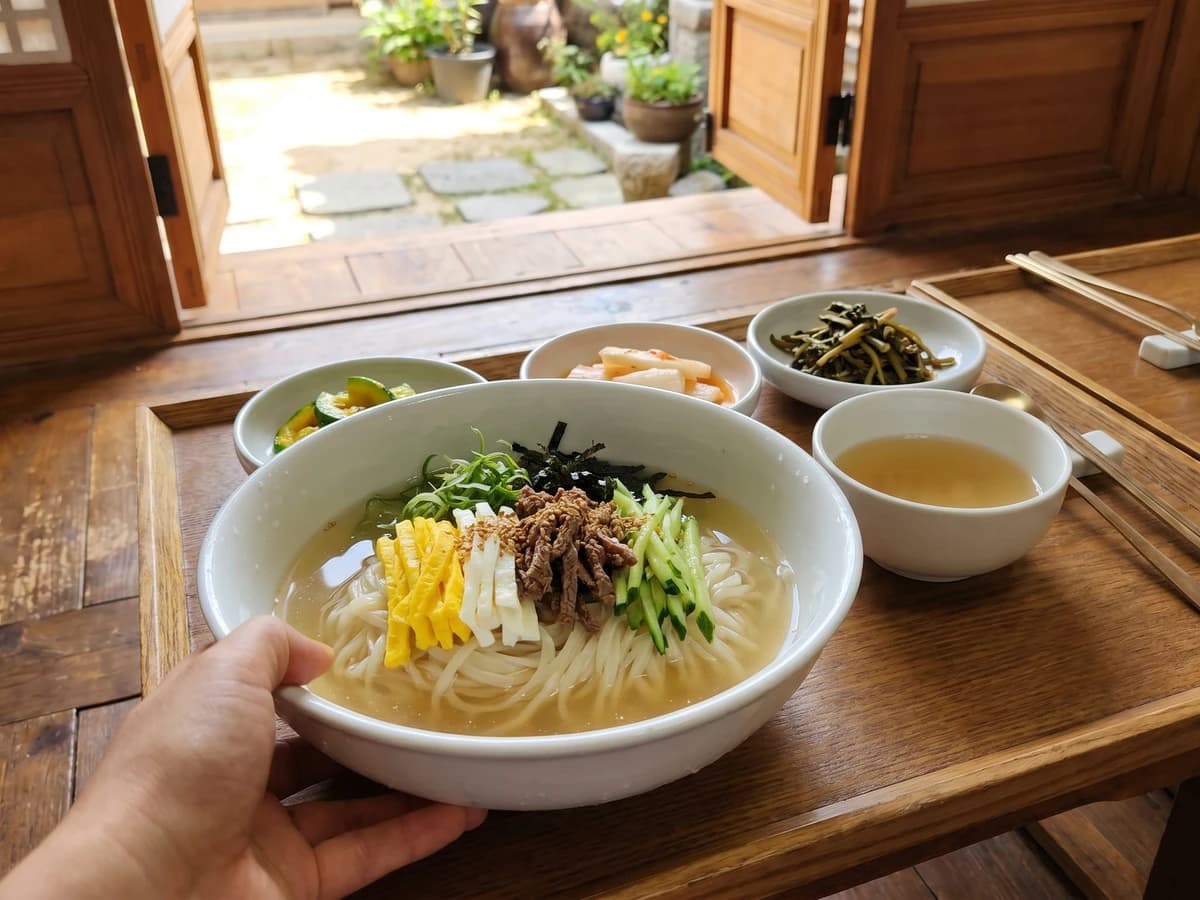
Andong's guest noodles, wheat and roasted soybean flour rolled thin, boiled and rinsed cold, then set in a clear chilled anchovy broth with careful strips of beef, egg, and cucumber.

Chef Jeong-sun
Andong's ritual-table rice served on an ordinary day: separate soy-sesame namul, warm rice, and clear radish soup, mixed without gochujang so every vegetable keeps its own voice.