
Chef Jeong-sun
Albap (Flying-Fish Roe Rice Bowl)
A quick Korean rice bowl built on contrast: warm rice, cold popping flying-fish roe, chopped vegetables, gim, sesame oil, and the crisp rice bottom a hot stone bowl gives you.
A cooking platform built around craft, culture, and the stories behind what we eat.

Created by
Firm monkfish buried under crisp soybean sprouts, minari, and a red gochugaru sauce thickened at the end; Masan's market dish asks for heat, timing, and a steady hand.
Agwi-jjim lives or dies by the bean sprouts. People look at the red sauce first, but the crunch is the point: thick soybean sprouts stacked high, cooked just long enough to bend, not long enough to collapse. If they go limp, the dish loses its back.
My teacher made me watch the pot with the lid on and my hands behind me. 눈동냥, 귀동냥: borrowing with the eyes and ears. Monkfish is lean and firm, almost springy, and it needs a hard, brief braise, not a long stew. The sauce must cling at the end, glossy from starch, but it should not bury the fish under gochujang sweetness. This is gochugaru's work, clean heat and red color.
Tonight this dish will ask you to prepare everything before the heat starts. Cut the fish, rinse the sprouts, mix the seasoning, stir the starch slurry, and only then turn on the stove. Once the sprouts go in, you move quickly. Serve it wide and hot, with rice, kimchi, and a few quiet banchan beside it, because agwi-jjim is already loud enough.
Agwi-jjim is most closely tied to Masan, now part of Changwon in South Gyeongsang Province, where it grew from the fish market and harbor tavern table in the mid-twentieth century. Older Masan versions often used dried monkfish, which gave a chewier texture, while many home and restaurant versions today use fresh or frozen monkfish for easier cooking. Mideodeok, a small local sea squirt with a briny pop, is a signature addition in the region, but the dish's recognizable spine remains monkfish, soybean sprouts, minari, gochugaru, and a starch-thickened sauce.
Quantity
800g
bone-in if possible, cut into 2-inch chunks
Quantity
1 tablespoon
for rinsing the fish
Quantity
1 tablespoon
Quantity
500g
preferably thick-stemmed, rinsed and drained
Quantity
120g
cut into 2-inch lengths
Quantity
100g
rinsed
Quantity
1/2 medium
sliced 1/2 inch thick
Quantity
2
cut into 2-inch lengths
Quantity
1
sliced on the diagonal
Quantity
1
sliced on the diagonal
Quantity
3/4 cup
Quantity
5 tablespoons
medium-coarse
Quantity
2 tablespoons
Quantity
1 tablespoon
Quantity
1 tablespoon
Quantity
1 tablespoon
minced
Quantity
1 teaspoon
grated
Quantity
1 tablespoon
Quantity
1 teaspoon
Quantity
1/2 teaspoon
ground
Quantity
1 tablespoon
Quantity
1 tablespoon
Quantity
2 tablespoons
Quantity
3 tablespoons
| Ingredient | Quantity |
|---|---|
| monkfish tail or piecesbone-in if possible, cut into 2-inch chunks | 800g |
| coarse saltfor rinsing the fish | 1 tablespoon |
| soju or rice wine | 1 tablespoon |
| soybean sproutspreferably thick-stemmed, rinsed and drained | 500g |
| minari (Korean water dropwort)cut into 2-inch lengths | 120g |
| mideodeok (warty sea squirt) (optional)rinsed | 100g |
| onionsliced 1/2 inch thick | 1/2 medium |
| scallionscut into 2-inch lengths | 2 |
| green chilisliced on the diagonal | 1 |
| red chili (optional)sliced on the diagonal | 1 |
| anchovy-kelp broth or water | 3/4 cup |
| gochugaru (Korean chili flakes)medium-coarse | 5 tablespoons |
| soy sauce | 2 tablespoons |
| fish sauce | 1 tablespoon |
| gochujang (Korean red chili paste) | 1 tablespoon |
| garlicminced | 1 tablespoon |
| gingergrated | 1 teaspoon |
| mirin or rice wine | 1 tablespoon |
| sugar | 1 teaspoon |
| black pepperground | 1/2 teaspoon |
| toasted sesame oil | 1 tablespoon |
| toasted sesame seeds | 1 tablespoon |
| potato starch | 2 tablespoons |
| cold water | 3 tablespoons |
Rub the monkfish pieces with the coarse salt, rinse under cold water, and drain well. Sprinkle with the soju or rice wine and let it sit 10 minutes while you prepare the vegetables. Monkfish is lean, but it can carry a muddy smell if handled carelessly; the salt rub cleans the surface and the rice wine sharpens it without perfume.
In a bowl, stir together the gochugaru, soy sauce, fish sauce, gochujang, garlic, ginger, mirin, sugar, black pepper, and 3 tablespoons of the broth until it becomes a thick red paste. Use only 1 tablespoon gochujang. Too much makes the dish sweet and muddy; agwi-jjim should taste of fish, sprouts, and chili, not a jar of paste.
Stir the potato starch with 3 tablespoons cold water in a small bowl and keep it near the stove. Do not add it early. Starch thickens fast, and if it cooks too long it turns dull and heavy instead of glossy.
Set a wide heavy pot or deep skillet over medium-high heat. Add the onion, monkfish, mideodeok if using, the remaining broth, and the sauce. Fold gently so the fish is coated, then cover and cook 7 minutes. The fish should release liquid and begin to firm. Keep the pieces mostly in one layer so they cook evenly and do not break.
Pile the soybean sprouts over the fish, cover tightly, and cook 5 minutes without lifting the lid. Pick one rule for sprouts and obey it: lid on the whole time or lid off the whole time. Here we use lid on, because the pile is high and needs trapped heat. Lift the lid too often and half-cooked sprouts give the kitchen a raw bean smell.
Uncover and fold the sprouts down into the sauce with two spoons, lifting from the bottom so the fish does not shred. Add the minari, scallions, and chilies. Cook uncovered 3 to 4 minutes, just until the minari bends and the sprouts stay crisp at the center. Taste the sauce now. If it needs salt, add soy sauce 1 teaspoon at a time; do not guess from the color.
Stir the starch slurry again, then drizzle in half while folding the pot gently. Wait 20 seconds. Add more only if the sauce still runs like broth. You want a glossy red coating that clings to the sprouts and fish, not a paste. Notebook 42 says the whole 2 tablespoons is right for juicy fresh monkfish; drier fish may need less.
Turn off the heat and fold in the sesame oil. Scatter sesame seeds over the top and serve immediately on a wide platter or straight from the pan. The sprouts keep their crunch only for a short while. Bring rice to the table, and at the end, if there is sauce left, stir in a bowl of warm rice for bokkeumbap. That last spoon is why people forgive the mess.
1 serving (about 400g)
Culinary guides, cultural storytelling, and the editorial depth that makes cooking meaningful.
Discover Culinary ExplorerChef Jeong-sun
A quick Korean rice bowl built on contrast: warm rice, cold popping flying-fish roe, chopped vegetables, gim, sesame oil, and the crisp rice bottom a hot stone bowl gives you.
Chef Jeong-sun
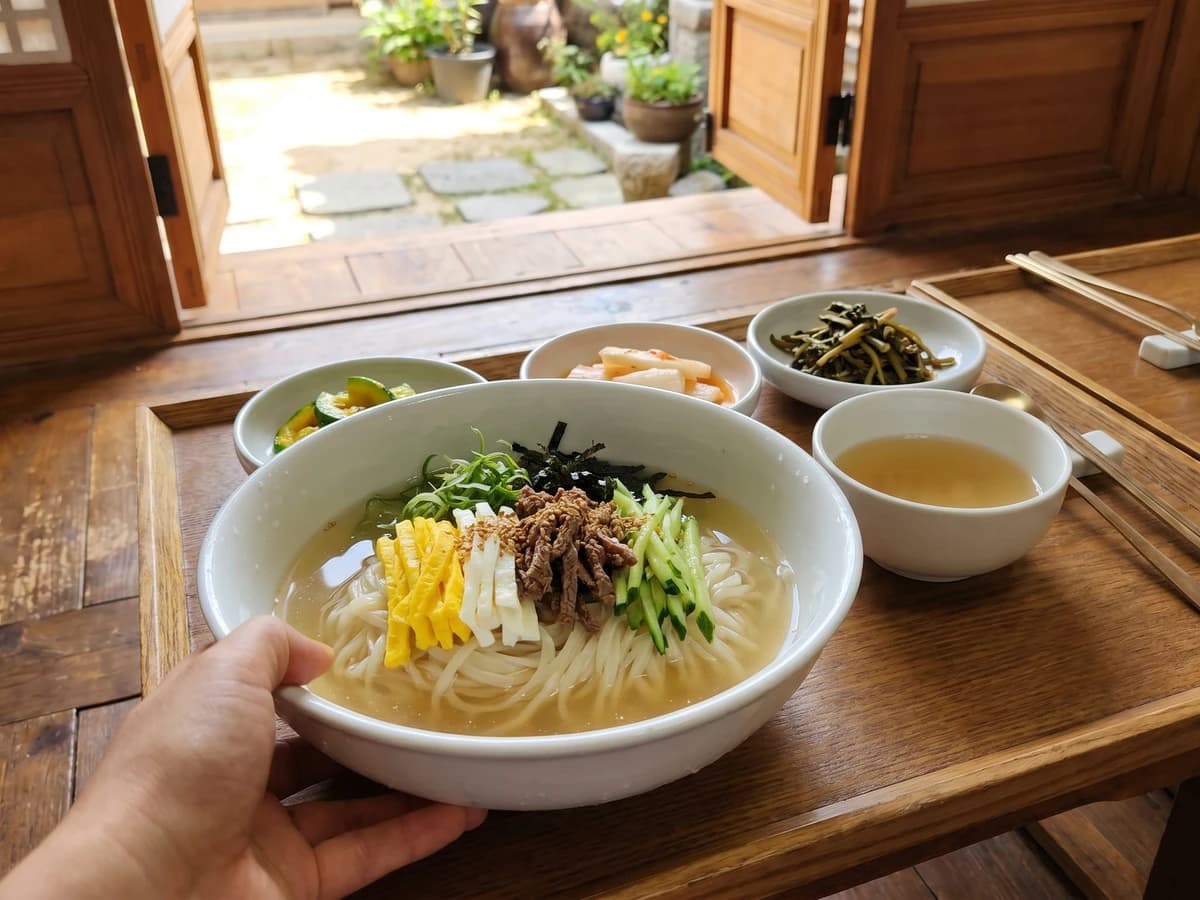
Andong's guest noodles, wheat and roasted soybean flour rolled thin, boiled and rinsed cold, then set in a clear chilled anchovy broth with careful strips of beef, egg, and cucumber.

Chef Jeong-sun
Andong's ritual-table rice served on an ordinary day: separate soy-sesame namul, warm rice, and clear radish soup, mixed without gochujang so every vegetable keeps its own voice.

Chef Jeong-sun
A generous Andong market braise of chicken, potatoes, chilies, and glass noodles in glossy soy sauce, cooked in the right order so the noodles soak up flavor without turning heavy.