
Chef Jeong-sun
Agwi-jjim (Braised Monkfish with Bean Sprouts)
Firm monkfish buried under crisp soybean sprouts, minari, and a red gochugaru sauce thickened at the end; Masan's market dish asks for heat, timing, and a steady hand.
A cooking platform built around craft, culture, and the stories behind what we eat.

Created by
Plump winter cockles from the southern mudflats, cooked only until they open, then served in their half shells with a restrained soy, scallion, garlic, and sesame dressing.
Kkomak belongs to winter and to the southern mudflats. Cook the month you're standing in. When the cockles are good, their shells are heavy for their size and the meat inside is sweet, mineral, and firm. When they are not good, no amount of soy sauce will rescue them, and my teacher would have sent them back without a word.
Beolgyo in Boseong County, South Jeolla Province, is the Korean name most closely tied to kkomak, with cockles harvested from the tidal flats of Suncheon Bay and nearby mudflats especially prized in winter. Kkomak-jjim and kkomak-muchim became strong regional table dishes because the southern coast had abundant shellfish, good soy seasoning, and a rice table that welcomed small, intensely seasoned seafood. The dish has no court story to borrow; its history sits with tidal work, market bowls, and Jeolla households that knew exactly when not to overcook a cockle.
Quantity
1 kg
Quantity
8 cups
for purging
Quantity
4 tablespoons
for purging
Quantity
6 cups
for cooking
Quantity
1 tablespoon
for cooking water
Quantity
4 tablespoons
Quantity
1 tablespoon
Quantity
1 tablespoon
Quantity
1 tablespoon
finely minced
Quantity
2 teaspoons
minced
Quantity
1 tablespoon
Quantity
2 teaspoons
Quantity
2 teaspoons
Quantity
1 teaspoon maesil-cheong or 1/2 teaspoon sugar
Quantity
1 small
finely chopped
Quantity
1 small
finely chopped
| Ingredient | Quantity |
|---|---|
| fresh live cockles (kkomak) | 1 kg |
| cold waterfor purging | 8 cups |
| coarse sea saltfor purging | 4 tablespoons |
| waterfor cooking | 6 cups |
| coarse sea saltfor cooking water | 1 tablespoon |
| soy sauce | 4 tablespoons |
| soup soy sauce (guk-ganjang) (optional) | 1 tablespoon |
| water or cooled cooking liquid | 1 tablespoon |
| scallionfinely minced | 1 tablespoon |
| garlicminced | 2 teaspoons |
| gochugaru (Korean chili flakes) | 1 tablespoon |
| toasted sesame oil | 2 teaspoons |
| toasted sesame seeds | 2 teaspoons |
| maesil-cheong (green plum syrup) or sugar | 1 teaspoon maesil-cheong or 1/2 teaspoon sugar |
| green chili (optional)finely chopped | 1 small |
| red chili (optional)finely chopped | 1 small |
Put the cockles in a bowl and sort them one by one. Discard any cracked shells, any that stay open when tapped, and any that smell sour or muddy in the wrong way. This dish is plain enough that poor shellfish cannot hide.
Dissolve 4 tablespoons coarse sea salt in 8 cups cold water. Add the cockles, cover the bowl with a dark lid or towel, and leave them in the refrigerator for 2 hours so they spit out sand. The salt water should taste like the sea. Too weak, and they do not purge properly; too strong, and they tighten.
Drain the cockles and scrub them under cold running water, rubbing shell against shell until the ridges feel clean. Change the water as many times as needed. My teacher made us do this without complaint, and she was right. Grit at the table ruins all the careful cooking after it.
Stir together the soy sauce, soup soy sauce, water or cooled cooking liquid, scallion, garlic, gochugaru, sesame oil, sesame seeds, maesil-cheong, and chilies if using. Taste it before it touches the cockles. It should be salty, nutty, and sharp with scallion, not sweet. Let the cockle taste like itself.
Bring 6 cups water and 1 tablespoon coarse sea salt to a lively simmer, not a hard rolling boil. Add the cockles and stir in one direction for 3 to 5 minutes, just until many shells gape and the meat looks plump and opaque. The one-direction stirring helps the flesh settle neatly in one shell half. Boil them hard and they shrink into rubber.
Lift the cockles out as soon as they are cooked. Do not rinse them. When cool enough to handle, twist off the empty top shell and keep the meat sitting in the deeper half. Discard any cockles that remain tightly shut or smell off. A few may only crack open; open those with a spoon at the hinge only if the shell has loosened and the meat is opaque.
Arrange the half-shells on a platter and spoon about 1/2 teaspoon dressing over each cockle. Do not flood them. The sauce should season the meat and gather in the shell, not cover the platter. Serve at room temperature with rice, kimchi, and one clean vegetable banchan.
1 serving (about 85g)
Culinary guides, cultural storytelling, and the editorial depth that makes cooking meaningful.
Discover Culinary ExplorerChef Jeong-sun
Firm monkfish buried under crisp soybean sprouts, minari, and a red gochugaru sauce thickened at the end; Masan's market dish asks for heat, timing, and a steady hand.

Chef Jeong-sun
A quick Korean rice bowl built on contrast: warm rice, cold popping flying-fish roe, chopped vegetables, gim, sesame oil, and the crisp rice bottom a hot stone bowl gives you.
Chef Jeong-sun
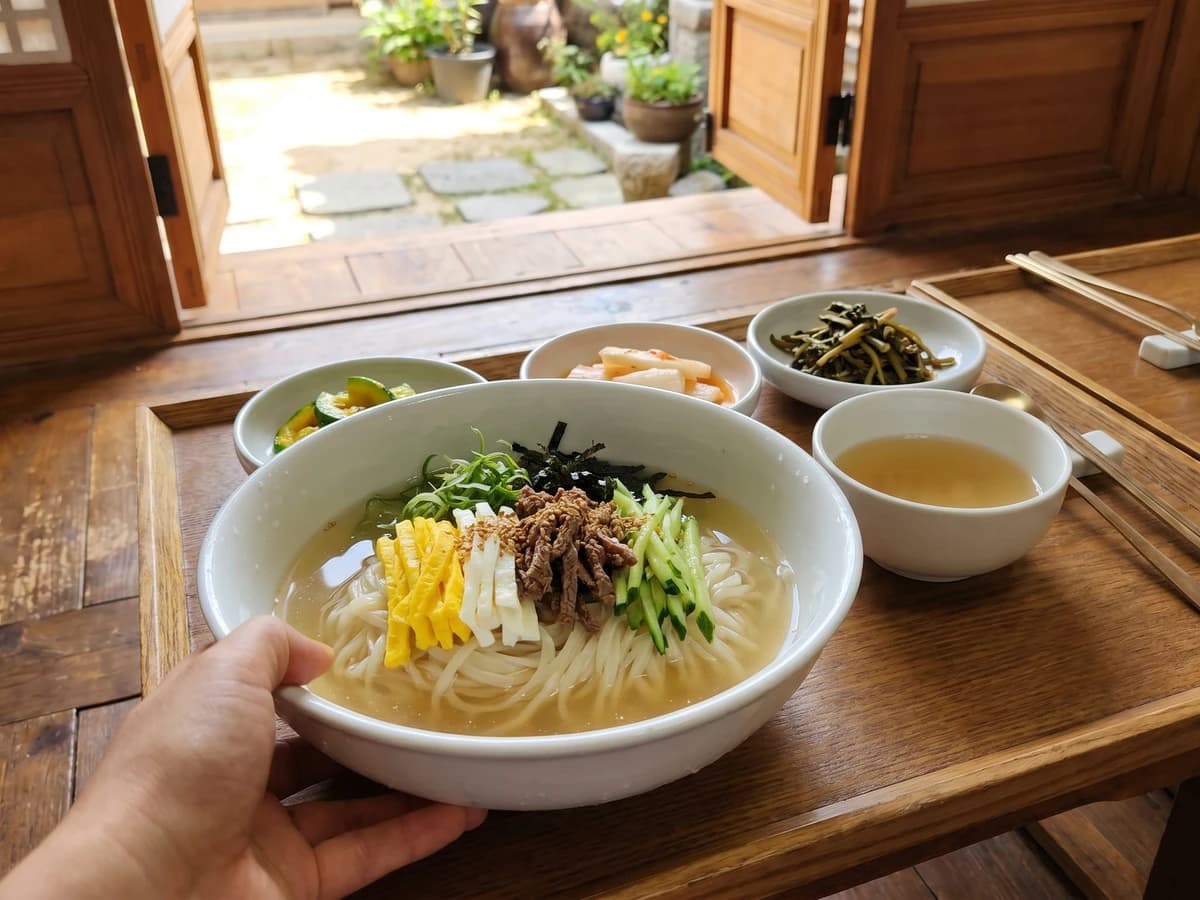
Andong's guest noodles, wheat and roasted soybean flour rolled thin, boiled and rinsed cold, then set in a clear chilled anchovy broth with careful strips of beef, egg, and cucumber.

Chef Jeong-sun
Andong's ritual-table rice served on an ordinary day: separate soy-sesame namul, warm rice, and clear radish soup, mixed without gochujang so every vegetable keeps its own voice.