Chef Elsa
Almjause (Alpine Hut Snack Board)
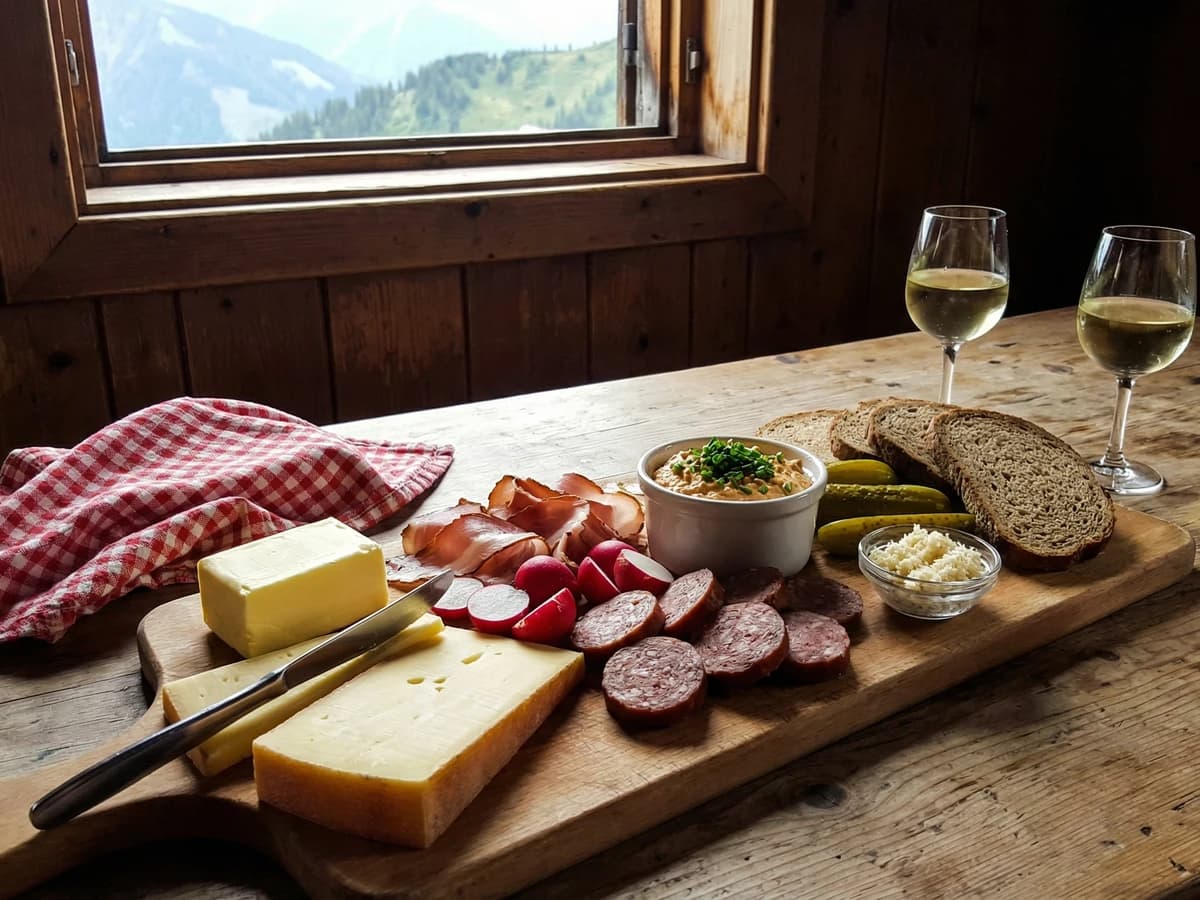
A wooden board loaded with mountain cheese, juniper-smoked Speck, air-dried Hauswürstel, handmade Liptauer, fresh Kren, and thick-cut Bauernbrot, the way Austrian Almhütten have fed hikers for generations.
A cooking platform built around craft, culture, and the stories behind what we eat.
Created by
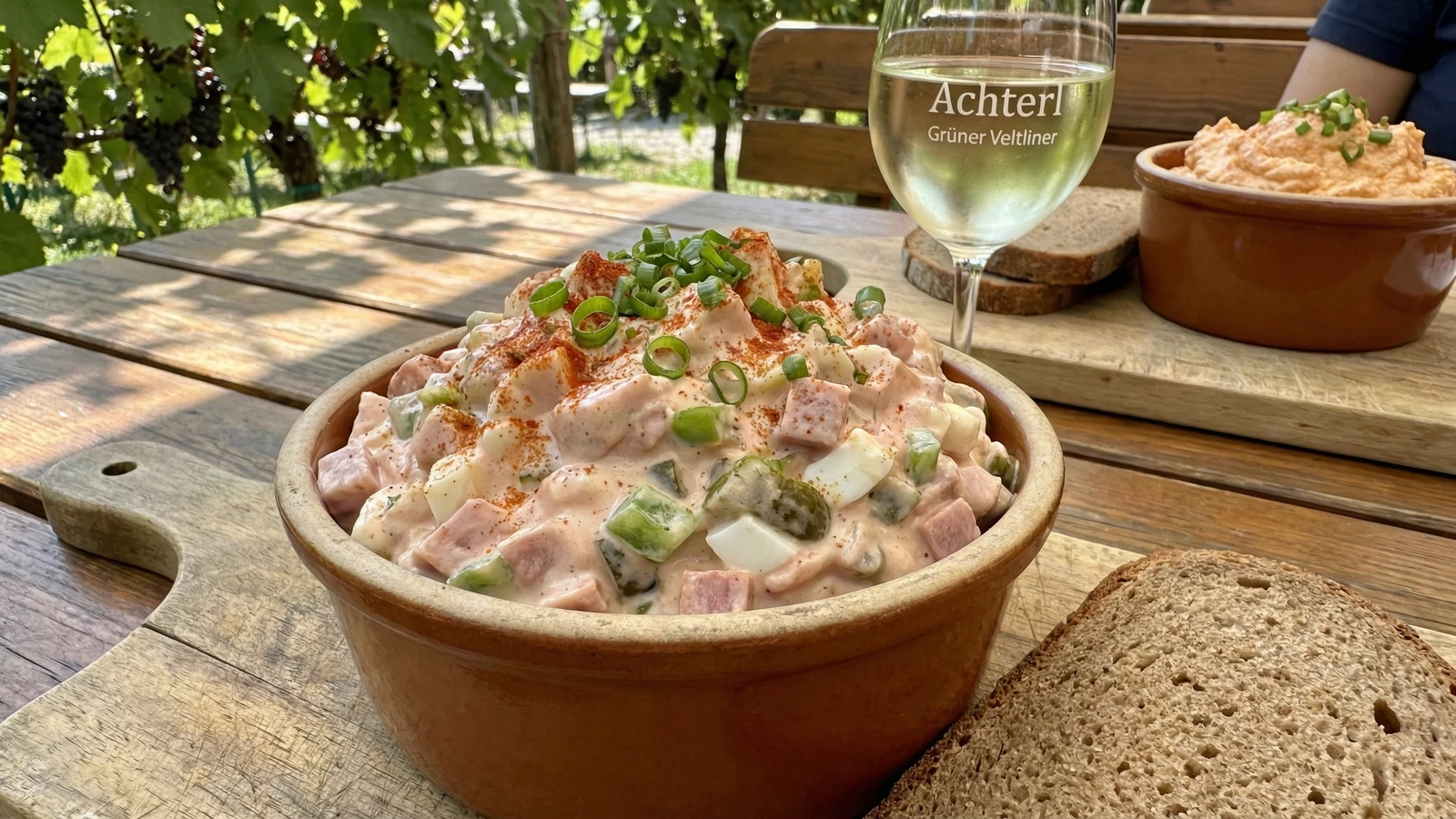
The Weinviertel's beloved Heuriger spread, a cheerful tangle of diced Extrawurst, hard-boiled eggs, pickles, and peppers folded into cream cheese and mustard on dark bread.
Every Heuriger in the Weinviertel has its own version of this spread, and every Buschenschank owner will tell you theirs is the right one. That's part of the charm. Kellergatsch is what happens when a wine tavern cook looks at whatever is left over from yesterday's Brettljause and decides nobody is going home hungry.
I first tasted it on one of those childhood trips with Gretel and my grandmother Eva, somewhere between Retz and Poysdorf, at a Heuriger with a grape arbor so thick the afternoon light came through green. The Wirt brought out a wooden board with three or four Aufstriche, and this one, pink and flecked with bits of pickle and pepper, disappeared before I could get a second helping. Gretel asked the man what was in it. He shrugged and said, "Everything from yesterday." She laughed, and then she got the recipe out of him anyway. She always did.
Kellergatsch is not a dish that asks for precision. It's a spread built on good instincts and whatever you have. Extrawurst, the mild, smooth Austrian sausage that every child grows up eating, gets diced small. Hard-boiled eggs, pickles, peppers, onion, all chopped to roughly the same size so every bite has a bit of everything. You fold it all through cream cheese loosened with a spoonful of mustard, and you spread it thick on dark bread. That's it. Ten minutes of chopping, no cooking beyond boiling the eggs, and you have something that makes a bottle of Grüner Veltliner very happy.
Kellergatsch belongs to the Aufstrich tradition of Lower Austria's Heuriger wine taverns, where vintners with a seasonal license serve their own wine alongside cold platters and spreads. The name likely derives from 'Keller' (cellar) and a dialect word for 'hodgepodge,' reflecting its origins as a thrifty way to use up leftover cold cuts, eggs, and pickled vegetables from the previous day's Brettljause. The Weinviertel, Austria's largest wine region north of Vienna, developed its own distinct Heuriger food culture around these simple, no-waste preparations that exist to accompany the local Grüner Veltliner and Zweigelt.
Quantity
200g
finely diced
Quantity
3 large
hard-boiled and finely diced
Quantity
4 medium
finely diced
Quantity
1 small
finely diced
Quantity
1 small
finely diced
Quantity
2 tablespoons
finely chopped
Quantity
200g
at room temperature
Quantity
2 tablespoons
Quantity
1 tablespoon
Quantity
1 tablespoon
Quantity
to taste
Quantity
to taste
freshly ground
Quantity
to taste
Quantity
for finishing
finely cut
Quantity
for serving
| Ingredient | Quantity |
|---|---|
| Extrawurst (or good-quality bologna)finely diced | 200g |
| eggshard-boiled and finely diced | 3 large |
| Essiggurkerl (pickled gherkins)finely diced | 4 medium |
| white onionfinely diced | 1 small |
| green bell pepper (Paprika)finely diced | 1 small |
| pickled mild pepper rings (Pfefferoni)finely chopped | 2 tablespoons |
| cream cheese (Frischkäse)at room temperature | 200g |
| Austrian mustard (Kremser Senf or Estragonsenf) | 2 tablespoons |
| pickle brine | 1 tablespoon |
| sunflower oil | 1 tablespoon |
| salt | to taste |
| white pepperfreshly ground | to taste |
| sweet Hungarian paprika | to taste |
| fresh chivesfinely cut | for finishing |
| dark rye bread or Hausbrot | for serving |
Place three eggs in a small pot and cover with cold water by about two centimeters. Bring to a boil, then reduce the heat and simmer for ten minutes. Transfer to a bowl of ice water and let them cool completely before peeling. Cold eggs dice cleanly. Warm eggs crumble into mush and your spread will look like you lost an argument with it.
Dice the Extrawurst, peeled eggs, Essiggurkerl, onion, green pepper, and Pfefferoni into pieces roughly the size of a small pea. Everything should be close to the same size. This matters more than people think. Kellergatsch works because every bite delivers a bit of sausage, a bit of egg, a bit of pickle, a bit of crunch. If you leave the pieces too large, you get a salad. Too fine and you lose the texture that makes it interesting. A small, even dice is the whole technique of this dish.
In a mixing bowl, stir the cream cheese with the mustard, pickle brine, and sunflower oil until smooth and slightly loosened. You want it spreadable, not stiff. The cream cheese needs to be at room temperature or it will fight you. Straight from the fridge it clumps around the diced ingredients instead of binding them. If you forgot to take it out early, give it thirty seconds in the microwave, no more.
Add all the diced ingredients to the cream cheese mixture and fold gently with a spatula. You're folding, not stirring. Stirring breaks up the egg and turns the spread murky. Fold until everything is evenly distributed and coated. Season with salt, white pepper, and a good pinch of sweet paprika. Taste it. The pickle brine and mustard should give it a tangy backbone, the Extrawurst brings salt and meatiness, and the peppers add a green, fresh bite. If it tastes flat, it needs more mustard or another splash of pickle brine. Trust your tongue.
Cover the bowl and refrigerate for at least thirty minutes. An hour is better. The resting time lets the flavors talk to each other. The pickle brine soaks into the egg, the mustard mellows slightly, the cream cheese firms up around everything. When you're ready to serve, mound the Kellergatsch into an earthenware crock or pile it generously onto a wooden board. Scatter fresh chives over the top and set out thick slices of dark rye bread alongside. This is Heuriger food. It belongs outside, with wine, with friends, with no agenda beyond eating well. Mahlzeit!
1 serving (about 160g)
Culinary guides, cultural storytelling, and the editorial depth that makes cooking meaningful.
Discover Culinary ExplorerChef Elsa
A wooden board loaded with mountain cheese, juniper-smoked Speck, air-dried Hauswürstel, handmade Liptauer, fresh Kren, and thick-cut Bauernbrot, the way Austrian Almhütten have fed hikers for generations.

Chef Elsa
Dark, spiced, and wickedly good: Blunzn mashed with onion, mustard, and marjoram into the kind of spread that disappears first from every Heuriger Brettl, scooped up on torn hunks of dark bread.

Chef Elsa
A silky potato and sour cream spread with raw onion and paprika, piled onto dark rye bread the way they serve it at every Heuriger in Lower Austria. No cheese, despite the name. Just good potatoes and honest cooking.
Chef Elsa
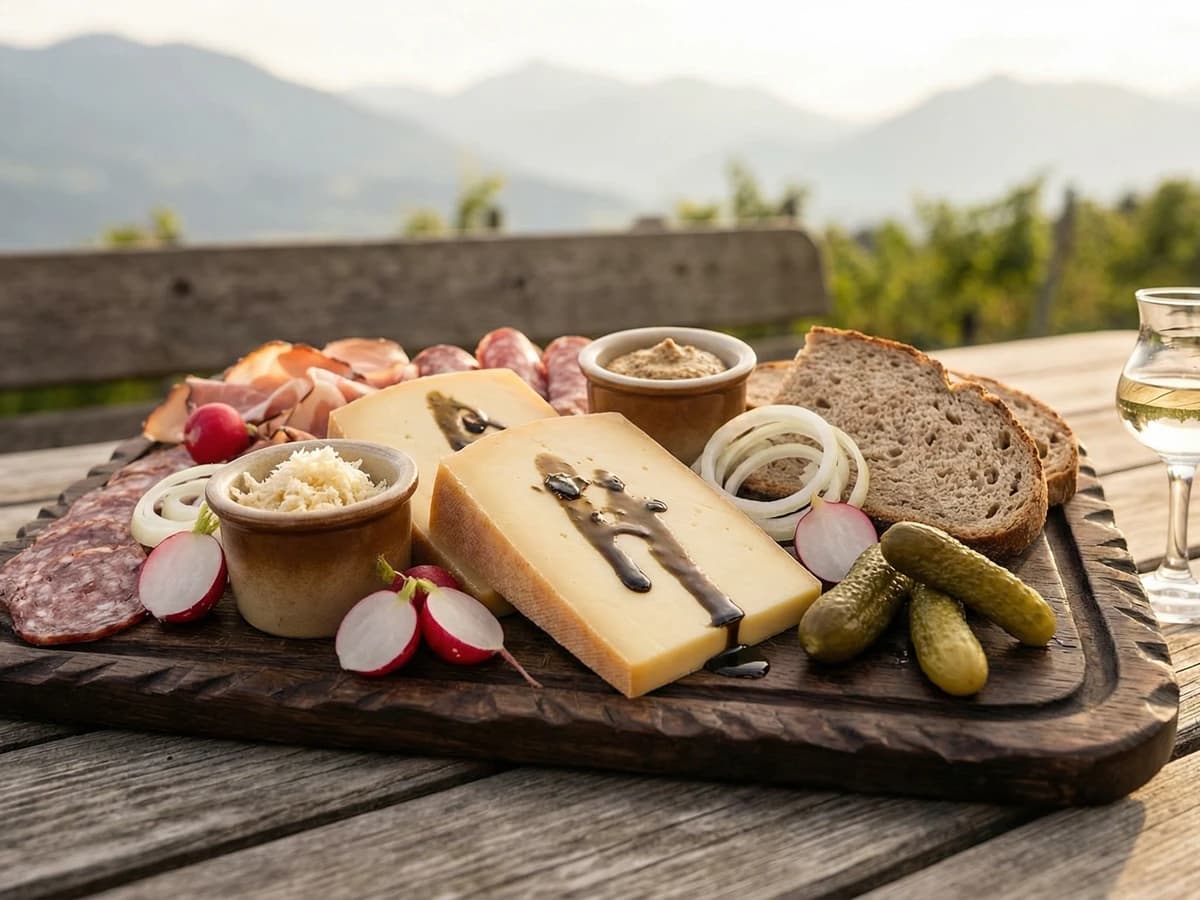
A proper Carinthian Brettljause built around PDO Gailtaler Almkäse, nutty raw-milk alpine cheese served with Speck, dark Bauernbrot, pickles, fresh horseradish, and everything you need for an afternoon on an Almhütte terrace.