
Chef Jeong-sun
Agwi-jjim (Braised Monkfish with Bean Sprouts)
Firm monkfish buried under crisp soybean sprouts, minari, and a red gochugaru sauce thickened at the end; Masan's market dish asks for heat, timing, and a steady hand.
A cooking platform built around craft, culture, and the stories behind what we eat.

Created by
Large, thin-skinned Kaesong mandu filled with pork, tofu, kimchi, and bean sprouts, poached gently and served two to a bowl in clear beef broth for the New Year table.
Kaesong-mandu belongs to the year turning. At Seollal, the bowl comes to the table with no small gesture: two dumplings, large enough that nobody can pretend they are a garnish, sitting in clear broth with jidan (egg garnish) and gim. My teacher Master Seong-nyeo made us wrap them standing, because seated students, she said, grew lazy at the edges. She was not wrong.
Do not let the size make you careless. A large mandu exposes every mistake: wet tofu leaks, long bean sprouts tear the wrapper, a thick skin turns one dumpling into a lump of flour. Press the tofu, chop the sprouts short, roll the rim thin, and test the filling in a pan before you trust it to the wrapper. That is the work tonight.
These are generous dumplings, but they are not heavy when made properly. Pork gives body, tofu loosens it, sprouts give a clean bite, and a little squeezed kimchi wakes it without staining the broth. I measure the salt because raw filling lies to the tongue, and because holiday food should not depend on one elder's hand being in the room. Write it down. Memory is a borrowed bowl.
Kaesong served as the capital of Goryeo from 919 to 1392, and its cooking kept a reputation for precise shapes, generous fillings, and merchant-house abundance long after the dynasty ended. Kaesong-mandu belongs to the northern mandu family: larger than many Seoul dumplings, thin-skinned, and often served in clear broth for Seollal and winter feasts. Korea's division and the 1950 to 1953 war carried many Kaesong family recipes south, where restaurants and home cooks kept the dumpling's name attached to its old city.
Quantity
2 cups (260g), plus more for dusting
Quantity
1/2 teaspoon
Quantity
2/3 cup (160ml)
Quantity
1 teaspoon
Quantity
450g
Quantity
12 cups
Quantity
1/2 large
peeled
Quantity
4 cloves
lightly crushed
Quantity
1
Quantity
1 teaspoon
Quantity
1 tablespoon
Quantity
1 1/2 teaspoons, plus more as needed
Quantity
300g
Quantity
200g
pressed and crumbled
Quantity
160g
blanched, squeezed dry, and chopped
Quantity
100g
squeezed dry and finely chopped
Quantity
60g
finely chopped
Quantity
2
finely chopped
Quantity
2 cloves
minced
Quantity
1 teaspoon
grated
Quantity
1
beaten
Quantity
1 tablespoon
Quantity
2 teaspoons
Quantity
1 teaspoon
lightly crushed
Quantity
1/2 teaspoon
Quantity
1/4 teaspoon
Quantity
2 teaspoons
Quantity
2
separated
Quantity
1 teaspoon
Quantity
1
thinly sliced
Quantity
1 sheet
cut into thin strips
| Ingredient | Quantity |
|---|---|
| all-purpose flour | 2 cups (260g), plus more for dusting |
| fine sea salt, for wrapper dough | 1/2 teaspoon |
| warm water | 2/3 cup (160ml) |
| neutral oil, for wrapper dough | 1 teaspoon |
| beef brisket or shank | 450g |
| cold water | 12 cups |
| onionpeeled | 1/2 large |
| garlic cloves, for brothlightly crushed | 4 cloves |
| scallion white | 1 |
| black peppercorns | 1 teaspoon |
| soup soy sauce (guk-ganjang) | 1 tablespoon |
| fine sea salt, for broth | 1 1/2 teaspoons, plus more as needed |
| ground pork shoulder | 300g |
| firm tofupressed and crumbled | 200g |
| mung bean sprouts (sukju)blanched, squeezed dry, and chopped | 160g |
| well-fermented napa cabbage kimchisqueezed dry and finely chopped | 100g |
| garlic chives (buchu)finely chopped | 60g |
| scallions, for fillingfinely chopped | 2 |
| garlic cloves, for fillingminced | 2 cloves |
| fresh gingergrated | 1 teaspoon |
| large egg, for fillingbeaten | 1 |
| soy sauce | 1 tablespoon |
| toasted sesame oil | 2 teaspoons |
| toasted sesame seedslightly crushed | 1 teaspoon |
| fine sea salt, for filling | 1/2 teaspoon |
| ground black pepper | 1/4 teaspoon |
| potato starch | 2 teaspoons |
| large eggs, for jidan garnishseparated | 2 |
| neutral oil, for jidan pan | 1 teaspoon |
| scallion, for garnishthinly sliced | 1 |
| roasted gimcut into thin strips | 1 sheet |
Stir the flour and 1/2 teaspoon salt in a bowl. Pour in the warm water slowly, mixing with chopsticks or your fingers until shaggy, then knead 7 to 8 minutes until smooth. Rub with 1 teaspoon oil, cover, and rest 30 minutes. Resting is not idleness. It relaxes the dough so you can roll a thin skin that stretches around the filling instead of fighting your hands.
Put the beef, 12 cups cold water, onion, 4 crushed garlic cloves, scallion white, and peppercorns in a wide pot. Bring it just to a boil, skim the gray foam, then lower the heat and simmer gently 75 minutes. Do not let it roll hard, or the broth clouds. Strain, season with soup soy sauce and 1 1/2 teaspoons salt, and add water if needed to make about 10 cups finished broth.
Press the tofu between towels for 20 minutes, then crumble it fine. Blanch the mung bean sprouts in boiling water for 2 minutes with the lid off, drain, cool, chop into 1/2-inch pieces, and squeeze hard in a towel. Squeeze the chopped kimchi the same way. Wet filling breaks dumplings. This is where many New Year bowls are lost before the soup even begins.
In a large bowl, mix the ground pork with soy sauce, 1/2 teaspoon salt, sesame oil, minced garlic, ginger, pepper, and potato starch until the meat turns sticky, about 1 minute. Add the tofu, sprouts, kimchi, chives, scallions, beaten egg, and crushed sesame seeds. Mix by hand until even, then fry 1 teaspoon of filling in a small pan and taste it cooked. If it tastes flat, add another 1/4 teaspoon salt to the bowl. Never taste raw pork filling.
Divide the rested dough into 16 pieces, about 26g each, and keep them covered. Roll each piece into an 11 to 12 cm round, leaving the center just a little thicker and the rim thin. Notebook 29 says the wrapper should show the filling's shadow but not tear. Dust only enough to prevent sticking, because too much flour keeps the edges from sealing.
Set one wrapper in your palm and place about 3 tablespoons, or 48 to 50g, filling in the center. Wet the rim lightly, fold into a half-moon, and press from the center outward to push out trapped air. Pleat or pinch the edge firmly, then bring the two corners together and seal them so the dumpling sits plump and round. Cover finished mandu with a towel as you work.
Beat the egg yolks and whites separately, each with a small pinch of salt. Wipe a skillet with oil and cook each in a thin sheet over low heat, just until set. Cool, then cut into fine threads. Yellow and white jidan (egg garnish) are not decoration only; they make the New Year bowl look cared for without muddying the broth.
Bring a large pot of water to a gentle boil. Cook the mandu in batches, 9 to 10 minutes for fresh or 13 to 15 minutes from frozen, stirring once so they do not stick to the bottom. They should float, the skins should turn slightly translucent, and the pork filling should reach 160F (71C) in the center. A hard boil tears the skins, so keep the water lively but not violent.
Bring the seasoned beef broth back to a gentle simmer. Transfer two cooked mandu to each bowl and ladle hot broth around them, or warm the cooked mandu in the broth for 1 to 2 minutes before serving. Finish with jidan, scallion, and gim. The bowl should be clear, generous, and calm: two dumplings, enough broth to carry them, nothing shouting over the filling.
1 serving (about 510g)
Culinary guides, cultural storytelling, and the editorial depth that makes cooking meaningful.
Discover Culinary ExplorerChef Jeong-sun
Firm monkfish buried under crisp soybean sprouts, minari, and a red gochugaru sauce thickened at the end; Masan's market dish asks for heat, timing, and a steady hand.

Chef Jeong-sun
A quick Korean rice bowl built on contrast: warm rice, cold popping flying-fish roe, chopped vegetables, gim, sesame oil, and the crisp rice bottom a hot stone bowl gives you.
Chef Jeong-sun
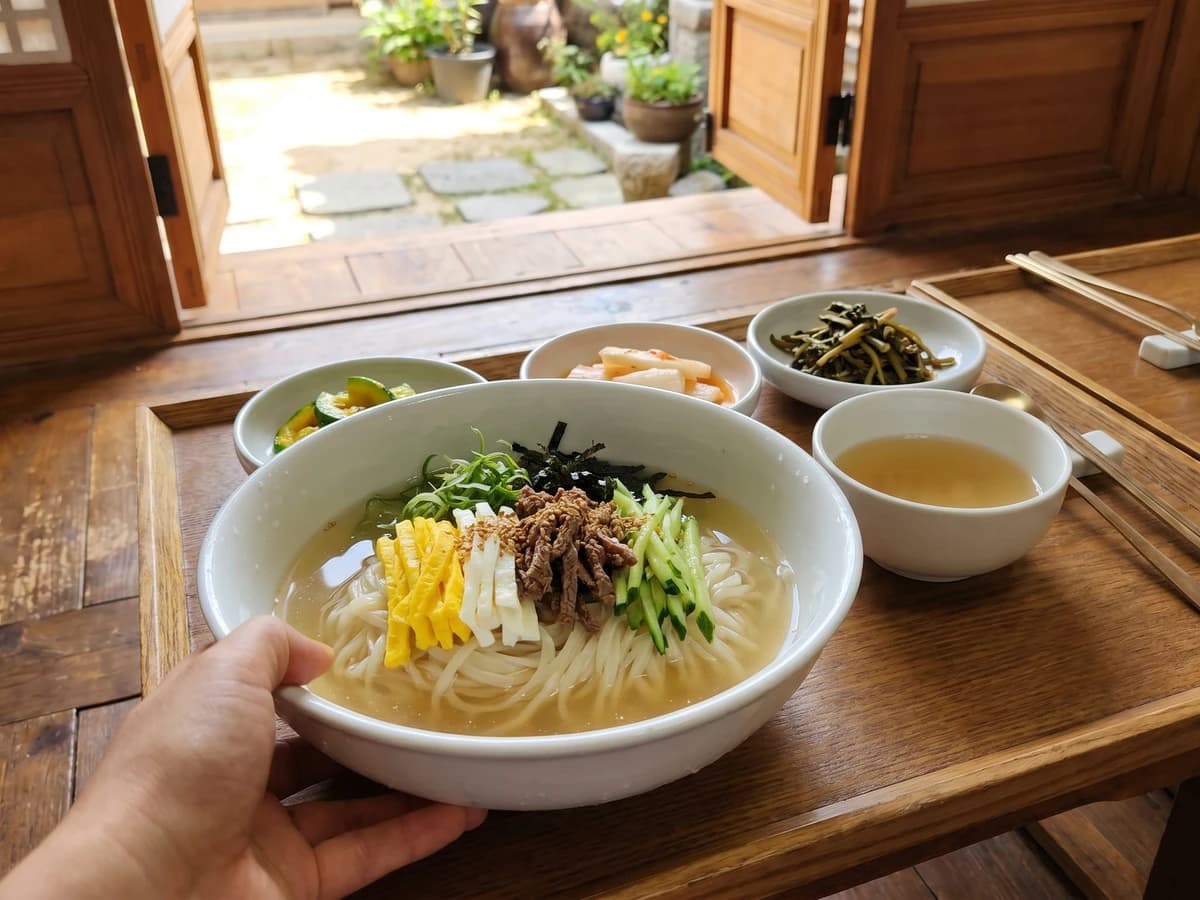
Andong's guest noodles, wheat and roasted soybean flour rolled thin, boiled and rinsed cold, then set in a clear chilled anchovy broth with careful strips of beef, egg, and cucumber.

Chef Jeong-sun
Andong's ritual-table rice served on an ordinary day: separate soy-sesame namul, warm rice, and clear radish soup, mixed without gochujang so every vegetable keeps its own voice.