
Chef Fai
Dry Egg Noodles (Ba Mee Haeng)
The four pillars live at the bottom of the bowl before the noodles ever touch it: nam pla for salt, sugar for sweet, vinegar for sour, chili for heat. Every noodle cart in Bangkok runs on this principle.
A cooking platform built around craft, culture, and the stories behind what we eat.
Created by
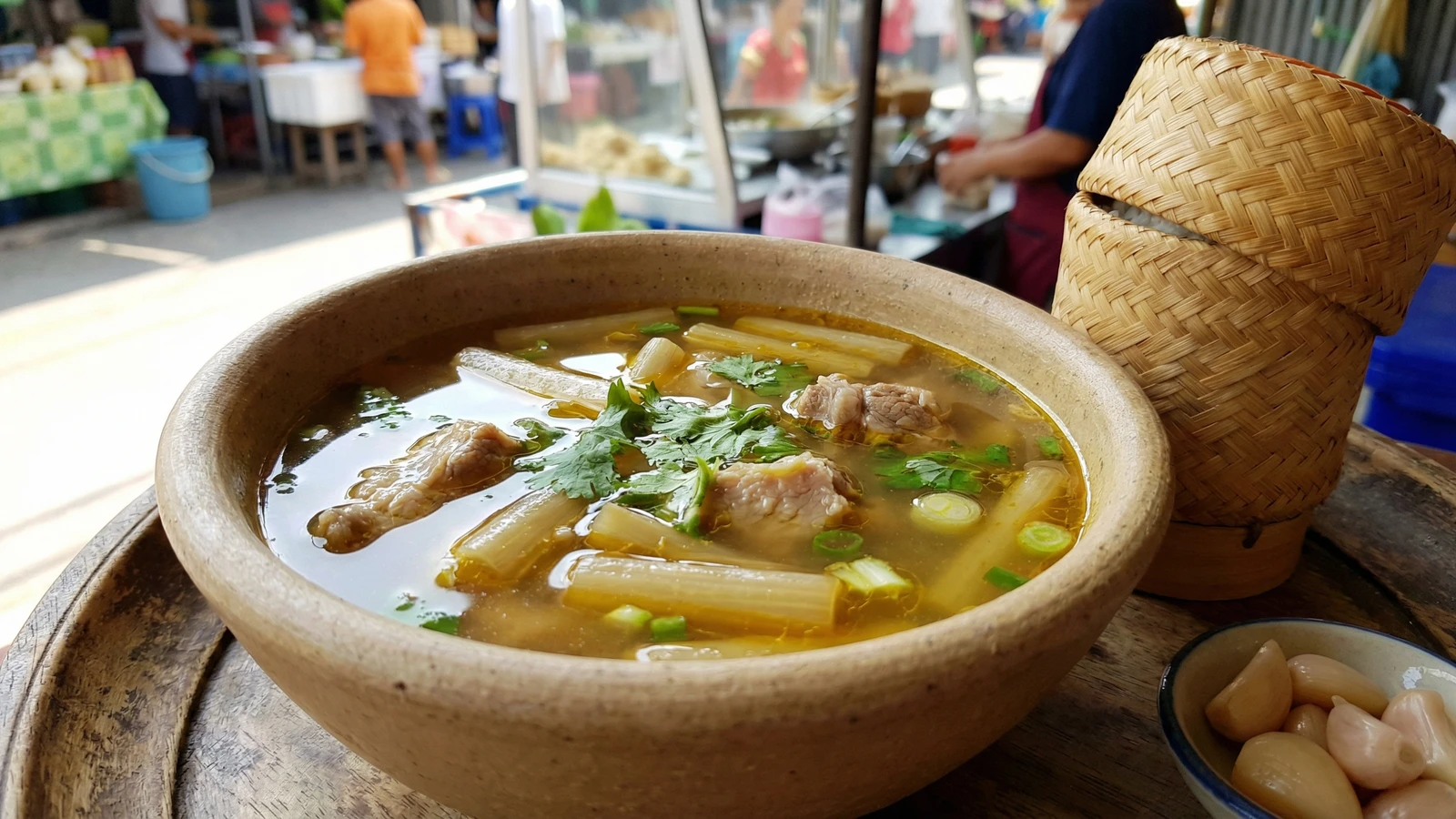
Foraged water lily stems simmered in a Lanna broth built on a kreung tam that's never seen coconut. Ginger over galangal, tua nao over shrimp paste. The mountains cook differently. This curry proves it.
Lanna curries don't use coconut milk. Full stop. Coconut palms don't grow in the northern highlands. When I first taught this at a Fai Thai workshop in Chiang Mai, half the room looked confused. They'd grown up thinking Thai curry meant coconut. That's Central Thai thinking. Up north, the broth is the dish. Water, a pounded paste, and whatever the season gives you.
Kaeng bua is what the season gives you when the highland ponds fill in the cool months. Water lily stems, sai bua (สายบัว), pulled from still water, peeled, and cut into lengths. They're hollow, slightly mucilaginous when you slice them (think okra, but milder), and they have this clean, vegetal sweetness that disappears the moment you try to overpower it. The paste has to be gentle. The broth has to be clear. You're not burying this ingredient. You're framing it.
The Lanna kreung tam tells you everything about where you are. Ginger takes the lead, not galangal. Turmeric goes in for its earthiness and color. And instead of kapi (shrimp paste), you pound in tua nao (ถั่วเน่า), the fermented soybean disc that's been traded across the northern mountains for centuries. Tua nao gives you fermented depth, umami, and a funk that's different from shrimp paste: drier, nuttier, more like miso's rough-edged cousin. Dry-roast it first. The heat wakes up the enzymes, deepens the flavor. Ajarn always said the kreung tam tells you the region before the dish does. Smell a Lanna paste and you know you're not in Bangkok anymore.
This curry is simple. Pork ribs simmered in water to build a light stock. The pounded paste stirred into the broth. The stems added and cooked just until tender. Fish sauce for salt. A whisper of palm sugar for balance. Green onion and cilantro at the end. That's it. The principle here is restraint. Not every Thai dish is a four-alarm fire of flavor. Some dishes ask you to be quiet and let the ingredient speak. Kaeng bua is one of those dishes. The kitchen uses what the water gives, and it treats the gift with respect.
Water lily stems (sai bua) have been foraged from highland ponds and waterways across Lanna (northern Thailand) for centuries, making kaeng bua one of the region's oldest seasonal preparations. The dish belongs to a family of Lanna clear-broth curries that predates coconut-based cooking entirely, reflecting the geography of a mountainous region where coconut palms cannot survive. Tua nao, the fermented soybean disc used in the paste, traces its origins along the same Burmese and Shan trade routes that brought dried spices into the Lanna mortar, distinguishing the northern kreung tam from every other regional Thai paste.
Quantity
5
soaked in warm water 15 minutes, deseeded
Quantity
4
roughly chopped
Quantity
6 cloves
Quantity
3 cm piece
sliced
Quantity
1 stalk
thinly sliced from the bottom 3 inches
Quantity
1 cm piece
sliced, or substitute 1/2 tsp ground
Quantity
1 tablespoon
dry-roasted until fragrant, crumbled
Quantity
1/2 teaspoon
Quantity
400g
peeled, cut into 3-inch lengths
Quantity
200g
cut into 2-inch pieces
Quantity
4 cups
Quantity
2 tablespoons
Quantity
1 teaspoon
Quantity
2
cut into 1-inch pieces
Quantity
small handful
roughly torn
Quantity
for serving
Quantity
for serving
| Ingredient | Quantity |
|---|---|
| dried red chilies (prik chi fa haeng)soaked in warm water 15 minutes, deseeded | 5 |
| shallots (hom daeng)roughly chopped | 4 |
| garlic (kratiam) | 6 cloves |
| fresh ginger (khing)sliced | 3 cm piece |
| lemongrass (takhrai)thinly sliced from the bottom 3 inches | 1 stalk |
| fresh turmeric (khamin)sliced, or substitute 1/2 tsp ground | 1 cm piece |
| tua nao (fermented soybean disc)dry-roasted until fragrant, crumbled | 1 tablespoon |
| salt | 1/2 teaspoon |
| water lily stems (sai bua)peeled, cut into 3-inch lengths | 400g |
| pork ribs (si khrong moo)cut into 2-inch pieces | 200g |
| water | 4 cups |
| fish sauce (nam pla) | 2 tablespoons |
| palm sugar (nam tan pip) | 1 teaspoon |
| green onions (ton hom)cut into 1-inch pieces | 2 |
| fresh cilantro (phak chi)roughly torn | small handful |
| sticky rice (khao niew) | for serving |
| pickled garlic (kratiam dong) (optional) | for serving |
Take each water lily stem and peel away the thin, fibrous outer skin. Run your thumbnail along the length and strip it off. Inside is the pale, slightly translucent flesh. Cut the peeled stems into 3-inch lengths. When you slice them, you'll notice they're hollow and release a slightly slimy liquid. That's normal. It's similar to okra, and it actually helps give the broth a subtle body. Soak the cut stems in a bowl of cold water while you prepare the paste. This keeps them crisp and rinses off excess slime.
Place the tua nao disc (or a piece of it) in a dry pan or directly over a low flame. Roast it until it darkens slightly and the smell changes from raw and funky to toasty and almost nutty. This takes about 2 minutes. Watch it. Tua nao burns fast once it commits. When it's fragrant, crumble it between your fingers or break it with the back of a spoon. It should be dry and crumbly, not sticky.
Start with the salt and soaked chilies in the granite mortar. Pound to a rough paste. Add the garlic and shallots, pound again until broken down but not perfectly smooth. Lanna pastes keep some texture. Now the ginger, in it goes. Pound it into the mixture. You'll notice the paste smells sharper and more peppery than a Central Thai paste. That's the ginger talking. No galangal in this one. Add the lemongrass, pound until fibrous bits are integrated. Then the turmeric, which stains everything golden. Finally, the crumbled tua nao. Pound until everything is a rough, fragrant paste. It should smell earthy, gingery, slightly fermented, with a low hum of chili heat. Not aggressive. Warm.
Bring 4 cups of water to a boil in a stockpot. Add the pork rib pieces. Let the water return to a boil and skim off any scum that floats to the top. Reduce to a gentle simmer and let the ribs cook for 10 minutes. The water should turn from clear to faintly cloudy with a thin layer of pork fat on the surface. That fat is flavor. Leave it. You're building a light stock here, not a consommé.
Spoon the pounded kreung tam into the simmering pork broth. Stir it in with a ladle until it dissolves into the liquid. The broth will turn golden from the turmeric and slightly opaque from the paste. Let it simmer for another 5 minutes so the aromatics infuse fully. The kitchen should smell like ginger and lemongrass, with that background note of fermented soybean. That's how you know the paste is working.
Drain the soaking water lily stems and add them to the broth. Stir gently. Simmer for 5 to 7 minutes. The stems should be tender but still have a slight bite, not mushy. They'll turn slightly translucent as they cook, and the broth will pick up a faint silkiness from their natural mucilage. That subtle thickening is part of the dish. Don't fight it.
Add the fish sauce and palm sugar. Stir once. Taste. The broth should be savory first, with ginger warmth and a gentle chili heat that builds slowly. The palm sugar isn't there to make it sweet. It's there to round the edges of the fish sauce. If the broth tastes flat, add another splash of nam pla. If it tastes sharp, a tiny pinch more sugar. Toss in the green onion pieces. Stir once more. Kill the heat. Scatter the torn cilantro over the top. Ladle into bowls. Serve with sticky rice and pickled garlic on the side. That's it. The dish is done. Don't add anything else.
1 serving (about 380g)
Culinary guides, cultural storytelling, and the editorial depth that makes cooking meaningful.
Discover Culinary ExplorerChef Fai
The four pillars live at the bottom of the bowl before the noodles ever touch it: nam pla for salt, sugar for sweet, vinegar for sour, chili for heat. Every noodle cart in Bangkok runs on this principle.

Chef Fai
The kreung tam fried in cracked coconut cream until the oil bleeds red. That's the technique. Concentrated, semi-dry, spooned thick over crispy fish. This is what happens when the four pillars meet restraint.

Chef Fai
Isan foraging in a bowl: wild taro stems stripped of their sting, simmered in padaek broth with a pounded chili paste and yanang leaf extract. The land feeds you if you know the rules.

Chef Fai
Lanna's kreung tam breaks from Central Thai rules: ginger over galangal, cumin and coriander from Burmese spice routes, tamarind for sour instead of lime. The North has its own system, and this curry is its crown.