
Chef Fai
Dry Egg Noodles (Ba Mee Haeng)
The four pillars live at the bottom of the bowl before the noodles ever touch it: nam pla for salt, sugar for sweet, vinegar for sour, chili for heat. Every noodle cart in Bangkok runs on this principle.
A cooking platform built around craft, culture, and the stories behind what we eat.
Created by
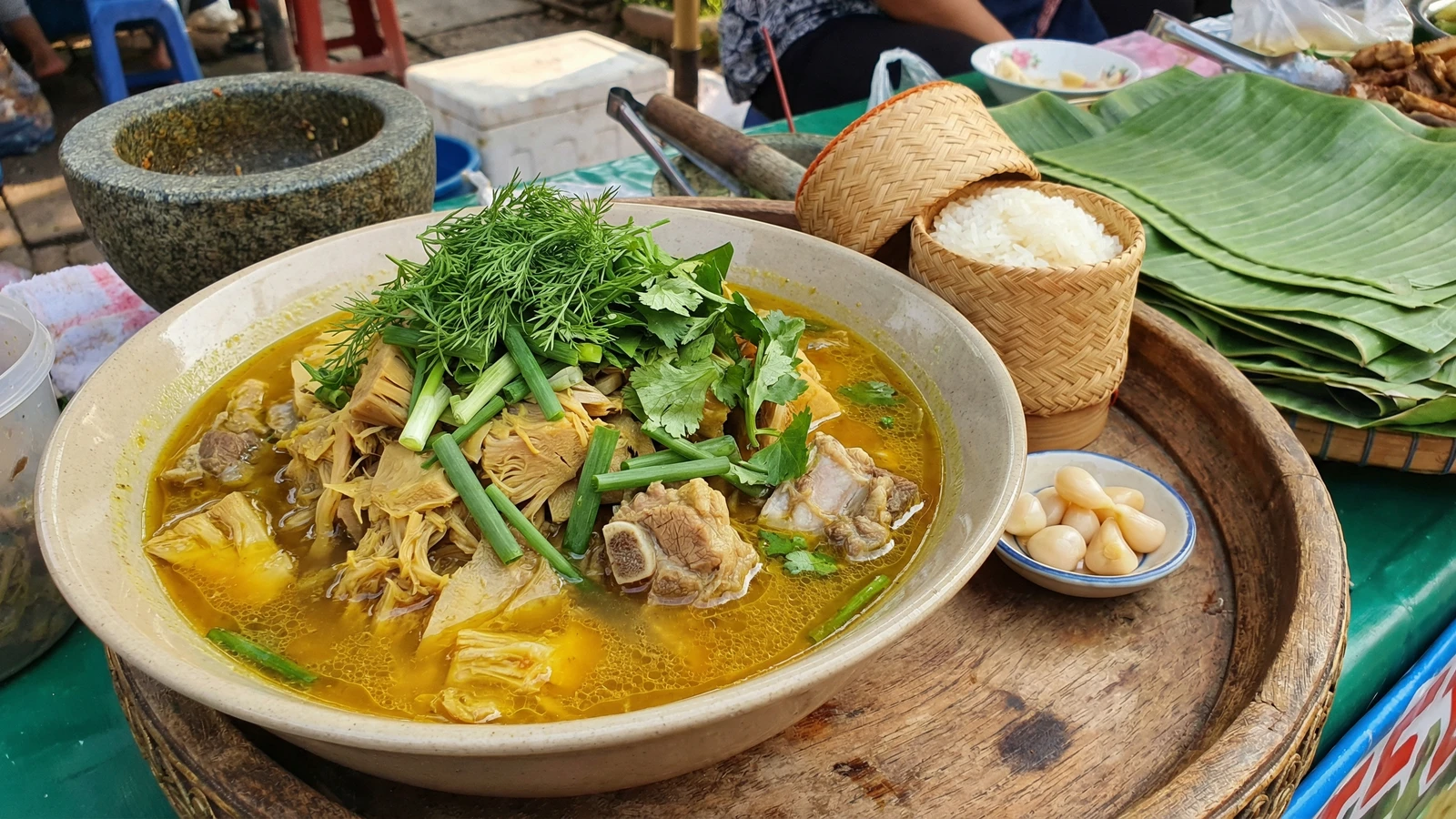
No coconut palms grow in the northern highlands, so Lanna cooks built curries on water, pork stock, and a kreung tam loaded with ginger and Burmese-route spices. The young jackfruit soaks up every drop.
Coconut milk does not belong in this dish. That's not an opinion. It's geography.
Coconut palms don't grow in the northern highlands. Chiang Mai, Chiang Rai, Lamphun, Lampang: these are mountain provinces. The soil is different, the altitude is different, the food is different. When Central Thai cooks crack coconut cream and fry their paste in the fat, Lanna cooks dissolve their kreung tam directly into water or pork stock. No fat cushion. No richness to hide behind. The paste has to be good enough to carry the entire curry on its own. That's the test.
Ajarn always said the kreung tam is the foundation of Thai cuisine. In Lanna cooking, that principle is exposed completely. You pound the paste, you drop it into simmering stock, and everything the curry will become is decided right there. The ginger (not galangal, ginger, this is the North), the turmeric, the toasted coriander seed and cumin that came up from Burma along the old trade routes. These dried spices are what separate a Lanna mortar from a Central Thai one.
Then the young jackfruit. Green, unripe, starchy, cut into chunks with the core still attached. It goes into that broth and does something remarkable: it absorbs. Every fiber of that fruit pulls in the curry like a sponge. Twenty minutes of simmering and each piece is saturated with the kreung tam, the pork stock, the fish sauce. You bite into it and the flavor is deep, herbal, almost meaty. This is Northern plant-forward cooking. It existed long before anyone in a Brooklyn restaurant started calling things "plant-based." The Lanna grandmother didn't need a trend. She had a jackfruit tree in the yard and a mortar on the floor.
Gaeng khanun is a staple of Lanna (northern Thai) home cooking, reflecting the agricultural reality that jackfruit trees (Artocarpus heterophyllus) thrive in the northern highlands and young fruit is harvested before maturity for use as a vegetable, not a sweet. The curry's water-based broth and dried-spice-heavy paste trace directly to Lanna's position on overland trade routes connecting Thailand to Myanmar and Yunnan, where cumin, coriander seed, and turmeric moved through mountain passes centuries before refrigerated trucks carried coconut milk north from the coast. In Lanna households, gaeng khanun is cool-season comfort food, made when pork is freshly butchered and the young jackfruit is firm and starchy.
Quantity
7
soaked in warm water 15 minutes, seeded
Quantity
5
roughly sliced
Quantity
8 cloves
Quantity
2 stalks
outer layers removed, thinly sliced
Quantity
3 cm piece
sliced
Quantity
2 cm piece
sliced (or 1 tsp ground turmeric)
Quantity
1 teaspoon
toasted
Quantity
1/2 teaspoon
toasted
Quantity
1/2 teaspoon
Quantity
1 teaspoon kapi or 1 small disc tua nao
Quantity
500g
cut into 3 cm chunks
Quantity
300g
cut into 2-inch pieces
Quantity
6 cups
Quantity
2-3 tablespoons
Quantity
1/2 teaspoon
Quantity
1 large handful
Quantity
3 stalks
cut into 2-inch lengths
Quantity
5 sprigs
roughly torn
Quantity
for serving
| Ingredient | Quantity |
|---|---|
| dried red chilies (prik chi fa haeng)soaked in warm water 15 minutes, seeded | 7 |
| shallots (hom daeng)roughly sliced | 5 |
| garlic (krathiam) | 8 cloves |
| lemongrass (takhrai)outer layers removed, thinly sliced | 2 stalks |
| fresh ginger (khing)sliced | 3 cm piece |
| fresh turmeric root (kha min)sliced (or 1 tsp ground turmeric) | 2 cm piece |
| coriander seeds (look pak chi)toasted | 1 teaspoon |
| cumin seeds (yira)toasted | 1/2 teaspoon |
| white peppercorns (prik thai khao) | 1/2 teaspoon |
| shrimp paste (kapi) or tua nao (fermented soybean disc) | 1 teaspoon kapi or 1 small disc tua nao |
| young green jackfruit (khanun on)cut into 3 cm chunks | 500g |
| pork spare ribs (si khrong moo)cut into 2-inch pieces | 300g |
| water | 6 cups |
| fish sauce (nam pla) | 2-3 tablespoons |
| palm sugar (nam tan pip) | 1/2 teaspoon |
| fresh dill (pak chi lao) | 1 large handful |
| green onion (ton hom)cut into 2-inch lengths | 3 stalks |
| sawtooth coriander (pak chi farang)roughly torn | 5 sprigs |
| sticky rice (khao niew) | for serving |
In a dry pan over medium-low heat, toast the coriander seeds and cumin seeds until fragrant and just starting to darken, about 2 minutes. Keep them moving. The moment you smell them, they're done. Let them cool, then grind to a powder in your mortar. Set aside. These dried spices are the fingerprint of the Lanna mortar. Central Thai paste doesn't use them. The Burmese trade routes brought cumin and coriander seed into Northern kitchens centuries ago, and they never left.
Start with the soaked, seeded dried chilies and a pinch of salt in a heavy granite mortar (krok hin). Pound to a rough paste. Add the peppercorns, lemongrass, ginger, and turmeric. Pound again. Lanna paste is ginger-forward, not galangal-forward. The ginger should hit your nose. Add the shallots and garlic, pound until everything is integrated but still has texture. Mix in the toasted coriander and cumin powder. Finally, add the shrimp paste (or crumble in the tua nao disc) and pound until the paste is cohesive and fragrant. It should be golden-orange from the turmeric, with the warm spice aroma cutting through the chili and ginger.
If using fresh young jackfruit: oil your knife and hands (the latex is sticky and relentless). Cut the jackfruit into chunks about 3 cm, keeping some of the core attached to each piece. The core holds the chunk together during simmering. Blanch the pieces in boiling water for 5 minutes to remove the latex, then drain. If using canned green jackfruit in brine: drain, rinse thoroughly, and cut any large pieces down to size. Canned works. Fresh is better. The texture of fresh young jackfruit is denser, starchier, and absorbs the broth more deeply.
Bring 6 cups of water to a boil in a stockpot. Add the pork ribs. Let it return to a boil, then skim the scum and foam from the surface. This takes patience. Skim it clean. Reduce to a steady simmer and cook for 10 minutes. The pork should be starting to tender and the water should look like a light, clean stock. This is your curry base. No coconut. Just pork bones, water, and whatever the kreung tam brings.
Spoon all of the pounded paste into the simmering pork stock. Stir to dissolve. In Central Thai curries, you'd fry the paste in cracked coconut cream. In Lanna, the paste goes straight into the broth. There's no fat to protect it. The paste has to be fully pounded and fully aromatic on its own, because the water will expose any laziness. Within two minutes the broth should turn golden from the turmeric and smell like a Chiang Mai kitchen in December: ginger, cumin, warm earth.
Add the prepared jackfruit chunks to the pot. Return to a gentle simmer. Cook for 20 to 25 minutes, stirring occasionally. The jackfruit will soften and start to pull apart slightly at the edges, and its fibers will begin absorbing the curry broth. When you press a piece with a spoon and it yields with just a little resistance, it's ready. It should hold its shape but feel saturated. That's the whole point of this dish: the fruit becomes a vessel for the kreung tam.
Add 2 tablespoons of fish sauce (nam pla) and the palm sugar. Stir. Taste. The curry should be savory first, with the warmth of ginger and cumin underneath, and a clean chili heat that builds gently. Lanna curries are milder than Central or Southern. The heat is present but not dominant. The herbs and spices lead. Add more fish sauce if it needs depth. The broth should be thin but flavorful, golden, not thick like a coconut curry. It's a broth, not a sauce.
Kill the heat. Add the green onion lengths and torn sawtooth coriander. Stir once. Ladle into bowls and pile the fresh dill (pak chi lao) on top generously. The dill is not a garnish. It's an ingredient. Its anise-like sharpness cuts through the richness of the pork stock and gives the curry its signature Lanna fragrance. Serve with sticky rice (khao niew). Only sticky rice. Scoop the rice, dip it into the broth, grab a chunk of jackfruit. That's a bite.
1 serving (about 520g)
Culinary guides, cultural storytelling, and the editorial depth that makes cooking meaningful.
Discover Culinary ExplorerChef Fai
The four pillars live at the bottom of the bowl before the noodles ever touch it: nam pla for salt, sugar for sweet, vinegar for sour, chili for heat. Every noodle cart in Bangkok runs on this principle.

Chef Fai
The kreung tam fried in cracked coconut cream until the oil bleeds red. That's the technique. Concentrated, semi-dry, spooned thick over crispy fish. This is what happens when the four pillars meet restraint.

Chef Fai
Isan foraging in a bowl: wild taro stems stripped of their sting, simmered in padaek broth with a pounded chili paste and yanang leaf extract. The land feeds you if you know the rules.

Chef Fai
Lanna's kreung tam breaks from Central Thai rules: ginger over galangal, cumin and coriander from Burmese spice routes, tamarind for sour instead of lime. The North has its own system, and this curry is its crown.