
Chef Fai
Dry Egg Noodles (Ba Mee Haeng)
The four pillars live at the bottom of the bowl before the noodles ever touch it: nam pla for salt, sugar for sweet, vinegar for sour, chili for heat. Every noodle cart in Bangkok runs on this principle.
A cooking platform built around craft, culture, and the stories behind what we eat.
Created by
The kreung tam lives twice. Yesterday's gaeng hang le hits a screaming wok with glass noodles and bamboo, and the Lanna kitchen proves that a day-old curry isn't a leftover. It's a foundation waiting for its second life.
The principle here isn't about creating. It's about transforming.
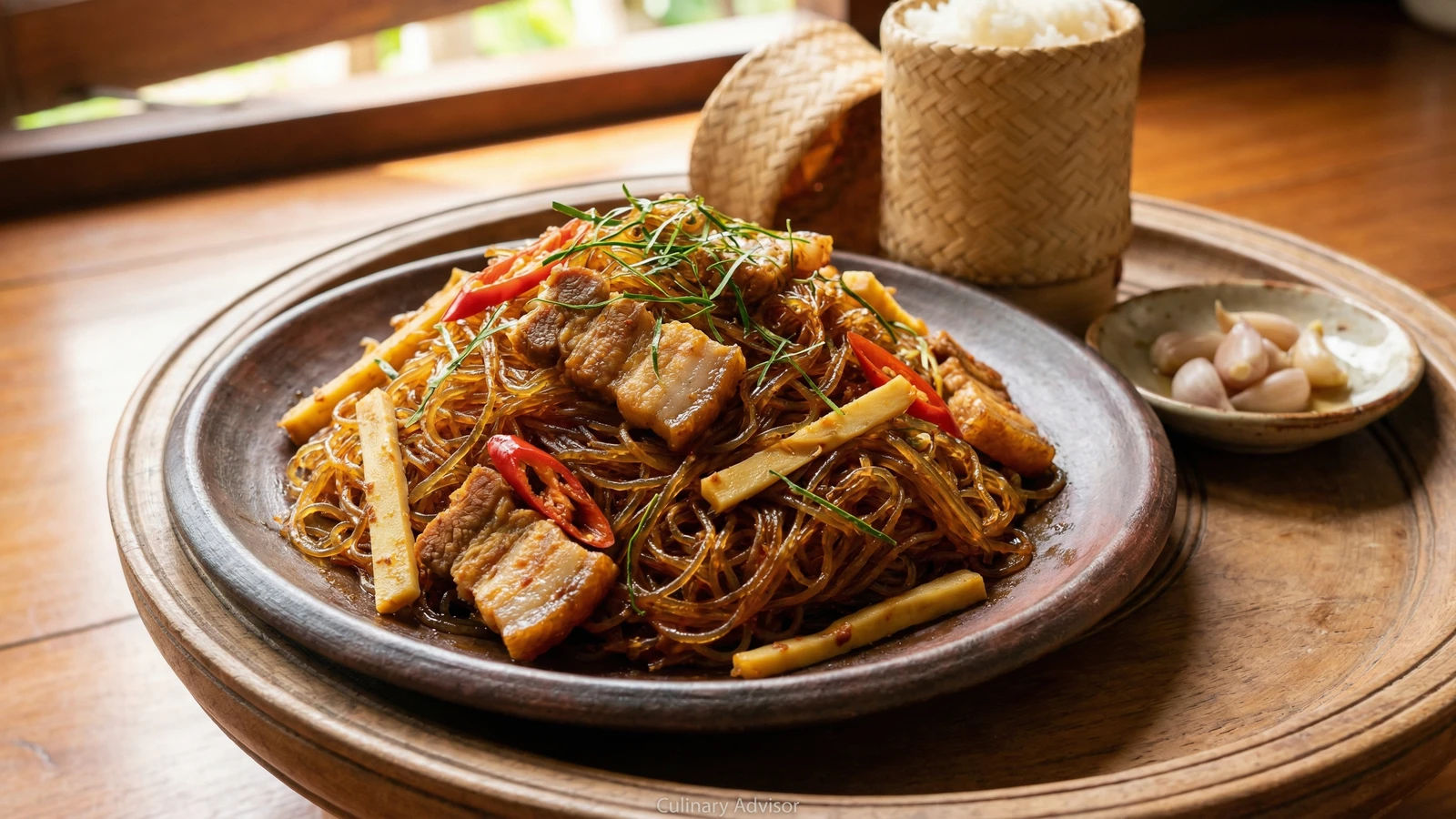
Gaeng ho is what happens when a Lanna cook looks at yesterday's pot of gaeng hang le and sees not leftovers, but a starting point. The kreung tam in that curry (ginger, lemongrass, dried chilies, cumin, coriander seed, turmeric, all that Burmese-route spice work) has been sitting overnight, concentrating, deepening. The pork belly has absorbed everything. The fat has set into the sauce. And now you throw all of it into a screaming hot wok with soaked glass noodles, sliced bamboo shoots, and handfuls of shredded kaffir lime leaf. What comes out has no equivalent in Central Thai cooking. This is pure Lanna.
"Ho" (โฮะ) means to combine in Kham Mueang, the Lanna dialect. It's temple kitchen wisdom. After a festival, monks and cooks didn't discard the surplus curries from the merit-making ceremonies. They mixed them. Added wun sen (glass noodles) to stretch the meal. Threw in bamboo for crunch, kaffir lime for a fresh high note against all that concentrated richness, and stir-fried it dry. The noodles drink up every drop of curry. The bamboo holds its bite. The lime leaves cut through the heaviness like a blade. Practical, resourceful, and better than the original if you do it right.
Ajarn always said the kreung tam is the foundation. Gaeng ho proves that foundation is indestructible. The paste pounded for yesterday's curry doesn't weaken overnight. It intensifies. The dried spices in a Lanna paste (cumin, coriander seed, star anise, things that entered the mortar through Burmese trade routes centuries ago) get deeper and rounder with time. When you hit that day-old curry with high wok heat, those spices wake up again. The second cooking is often better than the first. Waste nothing. Transform everything. Serve it with khao niew (sticky rice), always. This is the highlands, not the Central Plains. Tear off a piece, pinch some gaeng ho on top. That's a bite.
Gaeng ho (แกงโฮะ) is unique to the Lanna region of Northern Thailand, with deep roots in temple kitchens where surplus curries from Buddhist merit-making festivals were combined the following day rather than wasted. The word 'ho' (โฮะ) means 'to mix together' in Kham Mueang (the Lanna dialect), and the dish traditionally uses whatever curries are on hand, though gaeng hang le is the most common base in the Chiang Mai area. Glass noodles were a practical addition to stretch limited protein, absorbing concentrated curry and turning a cup of leftover sauce into a full communal meal shared over a khan tok tray.
Quantity
2 cups
with pork pieces and sauce
Quantity
100g
soaked in warm water 10 minutes, drained, cut into 6-inch lengths
Quantity
150g
sliced into thin strips
Quantity
80g
quartered
Quantity
5
center rib removed, very finely shredded
Quantity
2
sliced diagonally
Quantity
2 tablespoons
Quantity
1-2 tablespoons
Quantity
1 teaspoon
Quantity
for serving
Quantity
for serving
| Ingredient | Quantity |
|---|---|
| leftover gaeng hang le (Burmese-style pork belly curry)with pork pieces and sauce | 2 cups |
| glass noodles (wun sen)soaked in warm water 10 minutes, drained, cut into 6-inch lengths | 100g |
| bamboo shoots (nor mai)sliced into thin strips | 150g |
| cherry eggplant (makhuea phuang)quartered | 80g |
| kaffir lime leaves (bai makrut)center rib removed, very finely shredded | 5 |
| fresh red spur chilies (prik chi fa)sliced diagonally | 2 |
| vegetable oil | 2 tablespoons |
| fish sauce (nam pla) | 1-2 tablespoons |
| palm sugar (nam tan pip) | 1 teaspoon |
| sticky rice (khao niew) | for serving |
| pickled garlic (kratiem dong) (optional) | for serving |
Soak the glass noodles in warm (not boiling) water for 10 minutes. You want them pliable but still slightly firm. They'll finish cooking in the wok. If they're already soft and floppy, you've gone too far and they'll turn to mush. Drain them well and cut into manageable lengths with scissors. About 6 inches. If you skip this step, you'll spend the entire stir-fry wrestling a tangled mass of noodles in a hot wok. Don't do that to yourself.
Get your wok ripping hot over high heat. Add the oil. This is a stir-fry, not a reheat. You're not warming up leftovers. You're transforming them. The wok needs to be hot enough that the curry sizzles and spits the moment it hits the surface. That's the temperature where concentration happens.
Add the leftover gaeng hang le, sauce and pork and all, straight into the hot wok. Break up any large pork pieces with your spatula. Stir-fry hard for 2 to 3 minutes. Watch what happens: the sauce begins to reduce, the oil separates from the paste, the color darkens, and the aroma of those Lanna spices (cumin, coriander, ginger, turmeric) blooms through the kitchen. That's the kreung tam waking up for its second life. When the curry looks concentrated and the oil is visibly separating from the solids, you're ready.
Add the bamboo shoot strips and quartered cherry eggplant to the wok. Toss for 1 to 2 minutes. The bamboo should heat through completely and start picking up the curry color on its edges. The eggplant should soften slightly but hold its shape. If the eggplant turns to mush, you left it too long. These aren't the star of the dish. They're supporting texture: crunch from the bamboo, pop from the eggplant.
Add the drained glass noodles to the wok. Now toss vigorously. The noodles will immediately start absorbing the curry sauce. This is why you concentrated the curry first: these noodles are thirsty and they'll drink everything. Keep tossing and lifting for 2 to 3 minutes until the noodles are fully coated, stained with that deep reddish-brown curry color, and translucent. Every single strand should taste like curry. If there's loose sauce pooling at the bottom, keep going. The wok should be nearly dry when you're done.
Add the fish sauce and palm sugar. Toss once. Taste. Go carefully here. Your leftover curry already had seasoning. You're adjusting, not building from scratch. Start with one tablespoon of fish sauce and add more only if it needs it. Throw in half of the shredded kaffir lime leaves and toss once more. The aroma should hit you immediately, sharp and citrus-floral against all that warm curry spice. If it doesn't, your lime leaves aren't fresh enough.
Transfer to a plate or shallow bowl. Scatter the remaining raw shredded kaffir lime leaves and sliced red chilies across the top. Serve immediately with khao niew (sticky rice) and pickled garlic (kratiem dong) on the side. This is not a wet curry. It should be dry, intensely flavored, and concentrated. Tear off a piece of sticky rice, pinch a tangle of curry-soaked noodles and a chunk of pork on top. That's a bite. That's gaeng ho.
1 serving (about 380g)
Culinary guides, cultural storytelling, and the editorial depth that makes cooking meaningful.
Discover Culinary ExplorerChef Fai
The four pillars live at the bottom of the bowl before the noodles ever touch it: nam pla for salt, sugar for sweet, vinegar for sour, chili for heat. Every noodle cart in Bangkok runs on this principle.

Chef Fai
The kreung tam fried in cracked coconut cream until the oil bleeds red. That's the technique. Concentrated, semi-dry, spooned thick over crispy fish. This is what happens when the four pillars meet restraint.

Chef Fai
Isan foraging in a bowl: wild taro stems stripped of their sting, simmered in padaek broth with a pounded chili paste and yanang leaf extract. The land feeds you if you know the rules.

Chef Fai
Lanna's kreung tam breaks from Central Thai rules: ginger over galangal, cumin and coriander from Burmese spice routes, tamarind for sour instead of lime. The North has its own system, and this curry is its crown.