Culinary Explorer

A cooking platform built around craft, culture, and the stories behind what we eat.
Discover Culinary Explorer
Northern Pork Belly Curry (Gaeng Hang Le)

Northern Pork Belly Curry (Gaeng Hang Le)

Created by

Lanna's kreung tam breaks from Central Thai rules: ginger over galangal, cumin and coriander from Burmese spice routes, tamarind for sour instead of lime. The North has its own system, and this curry is its crown.

Main Dishes
Thai
Comfort Food
Dinner Party
Special Occasion
45 min
Active Time
1 hr 30 min cook2 hr 15 min total
Yield4 servings

Gaeng hang le is where you learn that Thai cuisine is not one system. It's several. And the North plays by different rules.

Ajarn always said the kreung tam is the foundation of everything. That's true up here too, but the Lanna mortar holds different things. Where a Central Thai green curry paste is built on galangal, lemongrass, and kaffir lime zest, the hang le paste leads with ginger (khing). Lots of it. Then dried spices walk in: cumin (yira), coriander seed (met phak chi), star anise (poy kak). These aren't Thai ingredients in the way most people think of Thai. These came over the mountains from Burma, through Chiang Mai's old trade routes, and the Lanna cooks absorbed them into their own system centuries ago. The kreung tam adapted. That's what living cuisine does.

Here's what catches people off guard: gaeng hang le has no coconut milk in the braise. Coconut palms don't grow in the northern highlands. The curry is pork belly simmered in its own rendered fat, water, and the concentrated paste until the sauce reduces and clings to every piece of meat. The richness comes from the pork itself, not from coconut cream. Some versions add a small amount of coconut milk. I've seen both in Chiang Mai. The old-school method uses none, and that's what I teach at Fai Thai workshops, because the principle is: let the meat and the paste do the work.

The sour pillar here is makham (tamarind), not manao (lime). Tamarind gives a rounder, darker acidity that holds up during long cooking. Lime would burn off and turn bitter. The principle is the same: every Thai dish needs its sour element. But the ingredient changes with the region and the method. Principles, not recipes. Tamarind for braises. Lime for raw and quick-cooked. That's the logic Ajarn drilled into me.

I first ate real gaeng hang le at a khan tok dinner in a teak house near Wat Phra Singh. An aunt of a friend, seventy-something, cooked it in a clay pot over charcoal. The pork belly was so tender it broke apart when you pressed it with sticky rice. The sauce was dark, almost caramelized, fragrant with cumin and ginger. She told me she'd been cooking this one dish for fifty years. That's the kind of knowledge I'm talking about. One dish, fifty years, no recipe written down. Just principles in her hands.

Gaeng hang le (แกงฮังเล) is widely acknowledged as Burmese in origin, the name itself likely deriving from the Burmese hin lay (หินเล). The dish traveled into Lanna (the historical kingdom centered on Chiang Mai) through centuries of cultural exchange, conflict, and trade between Burma and northern Thailand. It became a fixture of khan tok (ขันโตก) ceremonial feasts, the traditional Lanna dining format where guests sit on the floor around a low round tray. The use of dried spices like cumin, coriander seed, and star anise distinguishes Lanna curry pastes from their Central, Southern, and Isan counterparts, reflecting the overland spice trade routes that connected Chiang Mai to Mandalay and beyond.

The technique, the tradition, and the story behind every dish.

Discover Culinary Explorer

Ingredients

pork belly

Quantity

600g

skin on, cut into 2-inch chunks

tamarind paste (makham piak)

Quantity

3 tablespoons

dissolved in 1/2 cup warm water, strained

fish sauce (nam pla)

Quantity

2 tablespoons

dark soy sauce (si ew dam)

Quantity

1 tablespoon

palm sugar (nam tan pip)

Quantity

2 tablespoons

vegetable oil

Quantity

3 tablespoons

water

Quantity

1 cup

pickled garlic (kratiem dong)

Quantity

3 tablespoons

sliced, with 2 tablespoons pickling liquid reserved

roasted peanuts

Quantity

1/2 cup

lightly crushed

ginger (khing)

Quantity

1 thumb-sized piece

julienned, for garnish

dried long red chilies (prik haeng)

Quantity

7

soaked in warm water 15 minutes, seeded

shrimp paste (kapi)

Quantity

1 tablespoon

ginger (khing)

Quantity

1 large thumb-sized piece, about 30g

sliced

shallots (hom daeng)

Quantity

5

sliced

garlic (kratiem)

Quantity

8 cloves

lemongrass (takhrai)

Quantity

2 stalks

bottom 3 inches only, sliced thin

coriander seeds (met phak chi)

Quantity

1 tablespoon

toasted

cumin seeds (yira)

Quantity

1 teaspoon

toasted

star anise (poy kak)

Quantity

2 whole

white peppercorns (prik thai)

Quantity

1 teaspoon

turmeric powder (khamin)

Quantity

1 teaspoon

ground mace or nutmeg

Quantity

1/2 teaspoon

Equipment Needed

  • Heavy granite mortar and pestle (krok hin) for the kreung tam
  • Spice grinder or small mortar for toasted spices
  • Heavy-bottomed pot or Dutch oven for braising
  • Bamboo sticky rice steamer (huad) and tall steaming pot (mo neng)

Instructions

  1. 1

    Toast the dried spices

    In a dry pan over medium heat, toast the coriander seeds, cumin seeds, star anise, and white peppercorns until fragrant. Two minutes, maybe three. Shake the pan. The moment you smell the cumin open up (warm, earthy, almost smoky), they're done. Let them cool, then grind to a powder in a spice grinder or a small mortar. This is where gaeng hang le announces it's not Central Thai. These are Burmese spice-route aromatics. No green curry in Bangkok smells like this.

    Toast the whole spices, then grind. Pre-ground spices are dead spices. The volatile oils in cumin and coriander evaporate within weeks of grinding. Toast whole, grind fresh, pound immediately. That's the rule.
  2. 2

    Pound the kreung tam

    Start with the soaked, seeded dried chilies in the granite mortar. Pound them to a fibrous paste. Then add the garlic and shallots, pound again. Now the ginger and lemongrass. The ginger should break down fully. In a Central Thai paste, galangal is the rhizome. Up here, ginger leads. It's sharper, more pungent, and it holds its flavor through long braising. Add the shrimp paste and the ground toasted spices. Pound until everything is integrated into a rough, fragrant paste. The turmeric and mace go in last. The color should be dark red-brown with golden undertones from the turmeric. The aroma should hit you like walking into a spice market: warm, earthy, gingery, with that unmistakable cumin backbone.

    Ajarn always said: the kreung tam tells you when it's ready. When the aroma fills the room and nothing in the mortar looks like a distinct ingredient anymore, you're there. With hang le paste, the test is cumin. If you can smell the cumin clearly without putting your nose in the mortar, it's pounded enough.
  3. 3

    Sear the pork belly

    Heat the oil in a heavy-bottomed pot or Dutch oven over medium-high heat. Add the pork belly chunks, skin side down first. Don't move them for 3 minutes. Let the fat render and the skin get golden. Flip and brown the other sides. You're not cooking the pork through. You're building a flavor base. The Maillard reaction on that pork belly is going to deepen the entire curry. Remove the pork and set it aside.

    Keep the skin on. The collagen in pork skin breaks down during the long braise and gives the sauce its body and cling. If you remove the skin, you lose that silky texture.
  4. 4

    Fry the kreung tam

    In the same pot with the rendered pork fat, add the kreung tam paste. Fry it over medium heat, stirring constantly, for 4 to 5 minutes. The paste will darken and the oil will start to separate at the edges. That separation is critical. It means the raw flavors in the paste have cooked out and the essential oils are releasing into the fat. Your kitchen will smell like northern Thailand: cumin, ginger, toasted chili. If someone walks in, they'll ask what you're making. That's how you know it's working.

  5. 5

    Braise the pork

    Return the pork belly to the pot. Add the tamarind water, fish sauce, dark soy sauce, palm sugar, pickled garlic liquid, and the cup of water. Stir everything together. The liquid should come about two-thirds up the pork. Bring to a boil, then drop to a low simmer. Cover with a lid slightly ajar. Now you wait. Ninety minutes, minimum. Stir every 20 minutes. The sauce will reduce gradually. The pork fat will render further into the sauce, the collagen from the skin will thicken it, the tamarind will mellow, and the spices will deepen. This is a braise, not a stew. You want the liquid to reduce to a thick, clinging sauce, not a soup.

    Tamarind is doing the work of lime here. In a quick dish like som tam, lime provides the sour pillar. But lime can't survive a 90-minute braise. It turns bitter and loses all brightness. Tamarind's acidity is stable under heat. It mellows, rounds out, develops depth. The principle is the same (every Thai dish needs sour), but the ingredient changes with the cooking method. That's the system being smart.
  6. 6

    Check and adjust

    After 90 minutes, the pork should be tender enough to break apart with a spoon but still holding its shape. The sauce should be reduced, dark, glossy, clinging to the meat. Taste it. The balance should be: savory and salty first (fish sauce, shrimp paste), sour second (tamarind), sweet third (palm sugar), with the dried spice warmth underneath everything. If it needs more sour, add a splash more tamarind water. More salt, a touch more fish sauce. More sweet, a pinch of palm sugar. Pound, taste, adjust. Same principle, different stage.

    If the sauce reduces too fast before the pork is tender, add water in small amounts (a quarter cup at a time) and continue braising. The goal is tender pork in a thick sauce. Don't sacrifice one for the other.
  7. 7

    Finish and serve

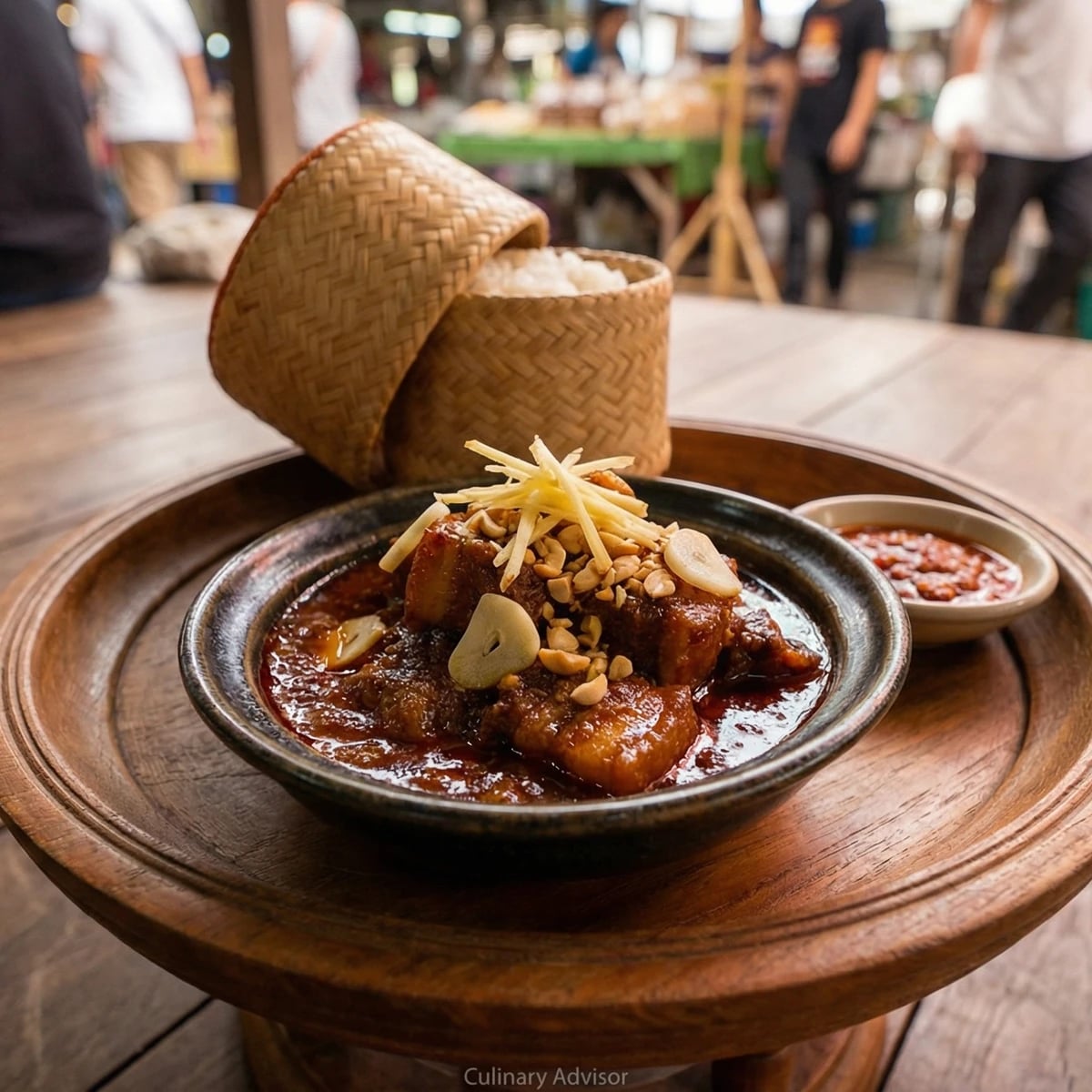
    Stir in the sliced pickled garlic (kratiem dong). This is a Lanna signature: the sharp, sweet bite of pickled garlic cutting through the rich, fatty curry. Ladle the curry into a serving bowl. Scatter the crushed roasted peanuts and julienned ginger on top. Serve with sticky rice (khao niew). Only sticky rice. This is the North. Jasmine rice doesn't exist at this table. Tear off a piece of sticky rice, pinch a chunk of pork belly with it, drag it through the sauce. That's a bite. That's gaeng hang le.

Chef Tips

  • The Lanna kreung tam is structurally different from Central Thai pastes. More ginger, less galangal (or none at all in some versions). Dried spices that you'd never see in a green or red curry: cumin, coriander seed, star anise, mace. This is the Burmese influence baked into the Lanna system. If your hang le paste smells like a Central Thai curry, you've used the wrong proportions. The cumin should be unmistakable.
  • Gaeng hang le improves overnight. The spices continue to develop and the sauce thickens further as the pork fat sets and redistributes. Make it a day ahead for a khan tok dinner. Reheat gently. The second-day version is arguably better than the first.
  • Pickled garlic (kratiem dong) is everywhere in Lanna cooking. It's garlic cloves pickled in vinegar and sugar until they turn slightly translucent and sweet-sharp. You can find it at any Thai grocery or make your own (garlic cloves, rice vinegar, sugar, salt, two weeks). The pickling liquid is a seasoning weapon. Use it in the braise.
  • Some Lanna cooks add tua nao (fermented soybean discs) to the paste instead of or alongside shrimp paste for a different fermented depth. If you can find tua nao, try replacing half the kapi with crumbled tua nao. It changes the curry's character: earthier, mustier, deeply northern. That's the Lanna identity asserting itself.
  • Sticky rice (khao niew) is the only starch at a Lanna table. Steam it in a bamboo basket (huad) over a tall pot (mo neng). Never boil sticky rice. Never serve jasmine rice with northern food. The sticky rice is part of the dish, not a side. It's your utensil, your vehicle, your textural contrast.

Advance Preparation

  • The kreung tam can be pounded a day ahead and refrigerated in a sealed container. The toasted spices should be ground fresh, but the finished paste holds well.
  • The entire curry can (and should) be made a day ahead. Cool, refrigerate, and reheat gently before serving. The flavors deepen overnight and the sauce develops a richer cling.
  • Sticky rice should be soaked in water for at least 4 hours, preferably overnight, before steaming. This is non-negotiable for proper texture.

Frequently Asked Questions

Nutrition Information

1 serving (about 275g)

Calories
695 calories
Total Fat
55 g
Saturated Fat
17 g
Trans Fat
0 g
Unsaturated Fat
34 g
Cholesterol
105 mg
Sodium
1420 mg
Total Carbohydrates
28 g
Dietary Fiber
5 g
Sugars
12 g
Protein
22 g

Note: Chef personas and recipes are created with AI assistance. Cook with care: follow safe food-handling practices, check doneness with a thermometer when needed, and adapt for allergies and your kitchen.

Where cooking meets culture.

Culinary guides, cultural storytelling, and the editorial depth that makes cooking meaningful.

Discover Culinary Explorer

More from Lanna Curries & Braised Dishes

Browse the full collection