Culinary Explorer

A cooking platform built around craft, culture, and the stories behind what we eat.
Discover Culinary Explorer
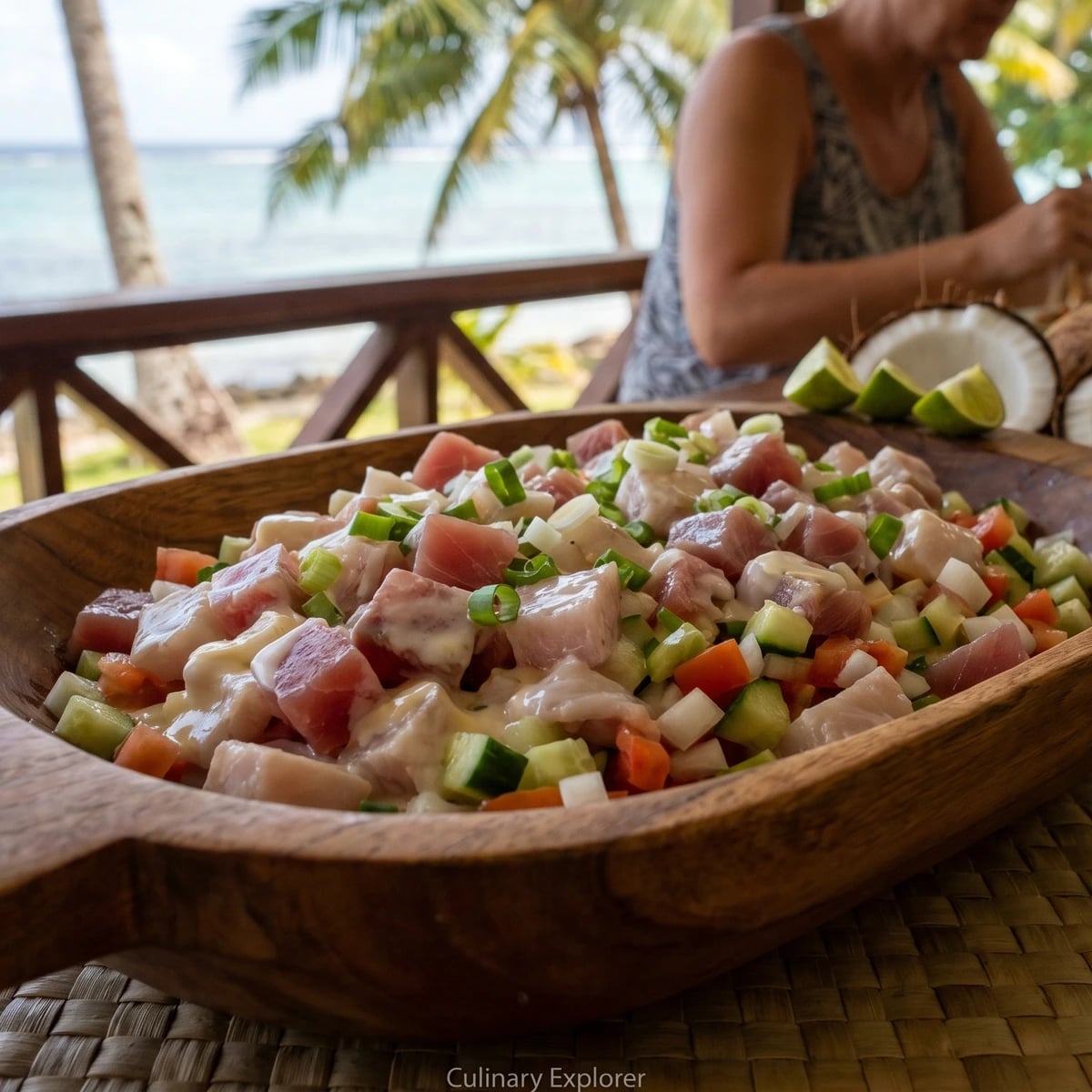
Ika Mata (Cook Islands Raw Fish in Coconut)

Ika Mata (Cook Islands Raw Fish in Coconut)

Created by

The Cook Islands bowl: fresh fish just turned in lime, softened with thick coconut cream, and kept crisp with cucumber, onion, and tomato. Same fish, different bowl.

Main Dishes
Polynesian, Cook Islands
Quick Meal
Outdoor Dining
Special Occasion
25 min
Active Time
0 min cook35 min total
Yield4 servings

The canoe teaches you this first: one ocean can feed many tables without making them the same table. This is ika mata, the Cook Islands raw fish, and in Rarotonga the bowl belongs to the reef, the lagoon, the outside water, and the hands that know when a fish is clean enough to eat almost bare.

I learned this one from the cousins, so I cook it open-handed. The old way often used maroro, flying fish, when it was running. Today you'll see tuna, mahi-mahi, wahoo, or whatever good clean fish came in that morning. The lime turns the outside just enough, the coconut cream lays over it rich and white, and the cucumber and onion keep it awake. No need make it precious. Just don't start with tired fish.

There is no plain "Polynesian" raw fish. The Cooks have ika mata. Sāmoa has oka iʻa, Tonga has ʻota ʻika, Tahiti has ʻia ota, and back home in Hawaiʻi we make poke with limu and ʻinamona. Same fish, different bowl. One ocean caught it, every island dressed it its own way.

So bring it forward into your kitchen straight and simple. Buy fish from somebody who can tell you when it came out of the water. Squeeze the coconut if you can, use a good thick can if that's what you have, and dress it close to the table. Raw fish waits for nobody, yeah? Eat what you have, but eat it with care.

Ika mata means raw fish in Cook Islands Māori, and in the southern Cook Islands it is tied to lagoon life, fishing knowledge, and the coconut palms that make the cream. Older bowls often used maroro, flying fish, when the season and the sea gave it, while contemporary Cook Islands kitchens commonly use tuna and other firm ocean fish. Across the Triangle, oka iʻa in Sāmoa, ʻota ʻika in Tonga, ʻia ota in Tahiti, ika mata in the Cooks, and poke in Hawaiʻi show one shared raw-fish grammar without erasing the island hands that carry each dish.

The technique, the tradition, and the story behind every dish.

Discover Culinary Explorer

Ingredients

very fresh sushi-grade tuna, mahi-mahi, wahoo, or other firm ocean fish safe for raw eating

Quantity

1 pound

cut into 3/4-inch cubes

fresh lime juice

Quantity

1/2 cup

from 4 to 6 limes

sea salt

Quantity

1 teaspoon

plus more to taste

thick fresh coconut cream

Quantity

1 cup

or good canned coconut cream, stirred smooth

cucumber

Quantity

1 small

seeded and diced

tomato

Quantity

1 medium

seeded and diced

sweet onion

Quantity

1/2 small

thinly sliced or finely diced

green onions

Quantity

2

thinly sliced

fresh chile (optional)

Quantity

1 small

seeded and finely sliced

lime wedges (optional)

Quantity

for serving

Equipment Needed

  • Chilled nonreactive mixing bowl, glass or stainless steel
  • Fine citrus juicer
  • Small strainer for draining lime juice

Instructions

  1. 1

    Choose the fish

    Start with fish fresh enough you'd happily eat it with nothing at all. It should smell like clean ocean and almost nothing else, with flesh that looks glossy, firm, and bright. If it smells strong or looks tired, no make it raw. Cook it instead and nobody loses face.

    Lime does not make unsafe fish safe. Buy from a trusted fishmonger and ask for fish handled for raw eating.
  2. 2

    Cube it clean

    Keep the fish cold and cut it into even 3/4-inch cubes with a sharp knife. Clean cuts matter here because ragged fish drinks too much lime and turns soft. Set the cubes in a chilled bowl.

  3. 3

    Turn with lime

    Toss the fish with the lime juice and salt. Let it sit 8 to 10 minutes, just until the outside turns pale and opaque while the center stays tender. Don't walk away for an hour. Acid keeps working, and good fish can go rubbery fast.

  4. 4

    Drain the sharpness

    Pour off most of the lime juice, leaving only a spoonful or two clinging to the fish. This keeps the ika mata bright instead of sour. Taste one piece. It should be clean, lightly tangy, and still taste like fish from the sea.

  5. 5

    Fold in coconut

    Add the coconut cream and fold gently until every piece is coated in a white, glossy bath. Fresh-squeezed cream carries the soul of the dish, but a thick canned cream does honest work on a weeknight. Stir, don't beat it.

  6. 6

    Add the crunch

    Fold in the cucumber, tomato, sweet onion, green onion, and chile if you're using it. The vegetables go in last so they stay crisp and clean. Taste for salt and lime, then serve right away while the fish still looks dewy and fresh.

Chef Tips

  • Same fish, different bowl. Cook Islands ika mata leans on lime, coconut cream, and crisp vegetables; Sāmoan oka iʻa often carries more coconut cream; Tahitian ʻia ota runs close with tomato and cucumber; Hawaiian poke stays with limu, ʻinamona, and the way Hawaiʻi eats now.
  • If fresh coconut is within reach, grate mature coconut and squeeze the first pressing thick. If not, buy full-fat coconut cream with no sugar added, chill it, and stir the thick cream smooth before using.
  • Keep everything cold until the moment you mix, but don't use a sweating glass bowl as the showpiece. The freshness should read from glossy fish and coconut sheen, not from condensation.
  • Pregnant people, elders with fragile immunity, and anyone told to avoid raw seafood should skip the raw version. Cook the fish gently, cool it, and dress it with the same coconut, lime, and vegetables.

Advance Preparation

  • Dice the cucumber, tomato, onion, green onion, and chile up to 4 hours ahead and keep them covered in the fridge.
  • Squeeze the lime up to 2 hours ahead, but keep it separate from the fish until serving time.
  • Cube the fish no more than 1 hour ahead, keep it very cold, and dress it only 10 to 15 minutes before the table.

Frequently Asked Questions

Nutrition Information

1 serving (about 245g)

Calories
310 calories
Total Fat
19 g
Saturated Fat
17 g
Trans Fat
0 g
Unsaturated Fat
1 g
Cholesterol
45 mg
Sodium
640 mg
Total Carbohydrates
11 g
Dietary Fiber
2 g
Sugars
4 g
Protein
29 g

Note: Chef personas and recipes are created with AI assistance. Cook with care: follow safe food-handling practices, check doneness with a thermometer when needed, and adapt for allergies and your kitchen.

Where cooking meets culture.

Culinary guides, cultural storytelling, and the editorial depth that makes cooking meaningful.

Discover Culinary Explorer

More from Same Fish, Different Bowl: Raw Fish in Coconut & Citrus

Browse the full collection