Culinary Explorer

A cooking platform built around craft, culture, and the stories behind what we eat.
Discover Culinary Explorer
Ika i te Lolo (Tokelauan Fish Simmered in Coconut Cream)

Ika i te Lolo (Tokelauan Fish Simmered in Coconut Cream)

Created by

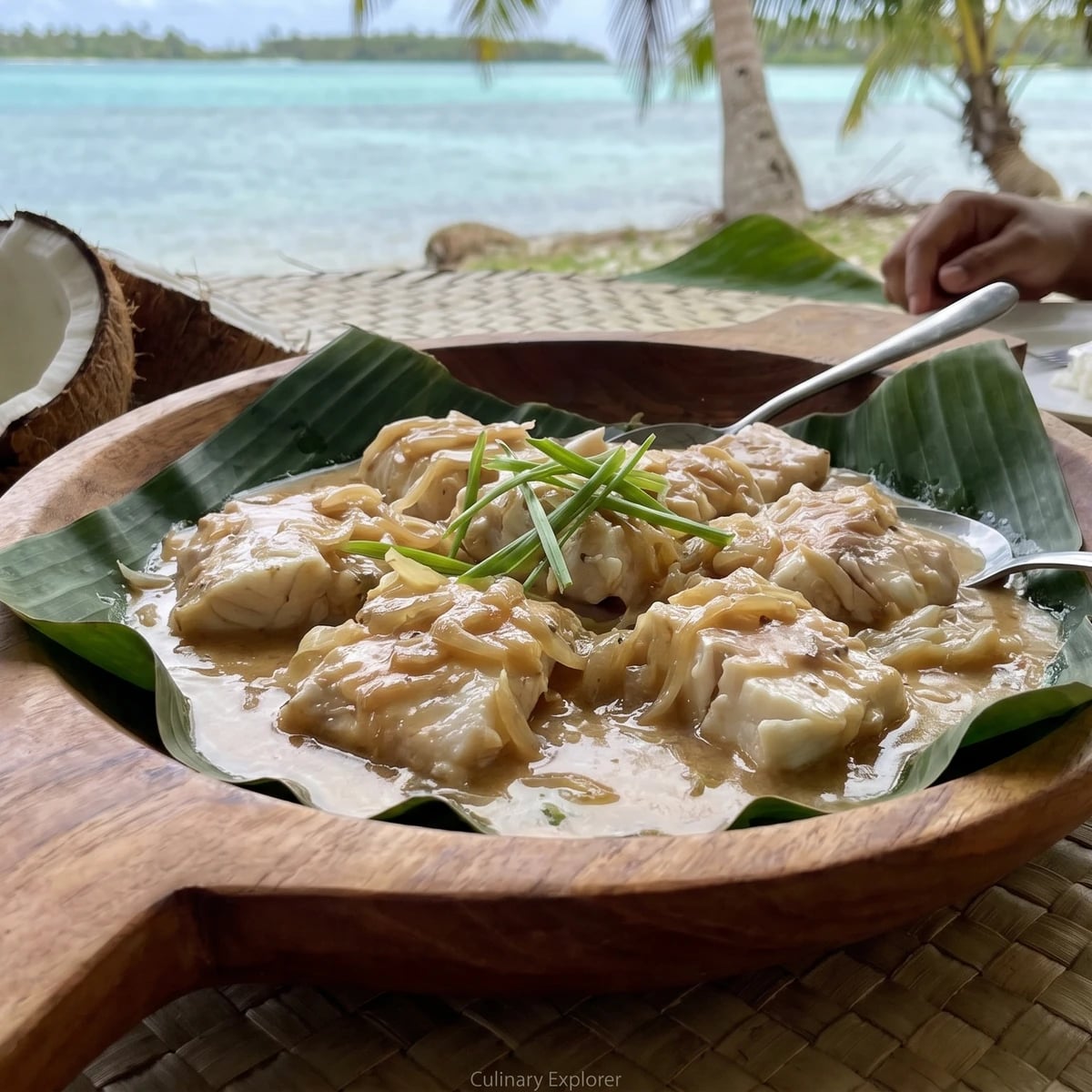
Tokelau's ika i te lolo, reef fish held gently in coconut cream and onion until the sauce turns rich and the fish flakes soft. Lagoon food, coral-soil food, weeknight food.

Main Dishes
Polynesian, Tokelauan
Weeknight
Comfort Food
15 min
Active Time
20 min cook35 min total
Yield4 servings

The first relative on a Tokelauan table might be pulaka, the giant swamp taro hauled from pits dug down into coral, and I want you to hear that before you hear the fish. Tokelau is low to the sea, three small atolls with the lagoon as larder and the pulaka pit as anchor. When those pits go salty, when the barge food gets louder than the food from the ground, everybody feels it. Food on a barge is the wound. Feeding the island from its own ground and water is the repair.

This dish belongs to Tokelau: ika i te lolo, fish in coconut cream. Ika is fish, lolo is coconut cream, and the old hand here is plain in the best way. Fresh fish, onion, coconut, salt, slow heat. No need make it precious. The sauce should thicken until it shines around the fish, the onion softens into the cream, and the flakes lift apart without breaking into mush.

Across the Triangle, the cousins know this same law in their own bowls. Sāmoa has oka iʻa when the fish stays raw in coconut and lemon, Tonga has ʻota ʻika, Tahiti has ʻia ota, the Cook Islands have ika mata, and back home in Hawaiʻi we make poke with limu and ʻinamona. Same fish, different bowl. Tokelau cooks this one warm, close to the lagoon and the coconut tree, with pulaka or rice beside it depending what the day gives.

Squeeze the coconut cream fresh if you can. That's where the food breathes. But if tonight is a can of coconut cream, a frozen fillet, and rice because the week went sideways, eat what you have. No shame. Just don't forget whose table this is, and don't blur Tokelau into some nameless ocean plate.

Tokelau's food world is shaped by coral soil, lagoon, coconut, pandanus, breadfruit, and pulaka, the giant swamp taro grown in carefully dug pits where fresh water sits under the atoll surface. As sea level rise and saltwater intrusion threaten those pits, dishes like ika i te lolo sit beside corned beef and rice from the supply ship as part of the real modern table: one side the deep food, one side the wound of import dependence. Tuvalu shares a related coral-atoll food ecology with pulaka and coconut, but Tokelau's ika i te lolo belongs to Tokelau's own people and their elders should carry the deeper story.

The technique, the tradition, and the story behind every dish.

Discover Culinary Explorer

Ingredients

firm reef fish or firm white fish

Quantity

1 1/2 pounds

cut into large pieces

fresh coconut cream (lolo)

Quantity

1 1/2 cups

or one 13.5-ounce can thick coconut cream

onion

Quantity

1 medium

thinly sliced

garlic (optional)

Quantity

2 cloves

lightly crushed

fresh chile (optional)

Quantity

1 small

split

sea salt

Quantity

1 teaspoon

plus more to taste

water (optional)

Quantity

1/2 cup

only if needed to loosen the sauce

green onions (optional)

Quantity

2

thinly sliced

cooked pulaka, taro, breadfruit, or rice

Quantity

for serving

Equipment Needed

  • Wide 12-inch covered saute pan or shallow Dutch oven
  • Fine grater or coconut scraper if squeezing fresh coconut cream
  • Clean kitchen towel or nut-milk bag for pressing lolo

Instructions

  1. 1

    Salt the fish

    Pat the fish dry and season it with the sea salt. Let it sit while you slice the onion, just ten minutes, enough for the salt to wake the flesh up. Fresh fish should smell like the sea and almost nothing else. If it smells tired, no make excuses for it; cook it harder in another dish.

  2. 2

    Start the lolo

    Set a wide, heavy pan over medium-low heat and add the coconut cream, onion, garlic if using, and chile if using. Stir gently until the cream loosens and the onion begins to soften, about 5 minutes. Keep it below a hard boil. Coconut cream can split when you bully it, and this dish wants a gentle hand.

    Fresh lolo is best squeezed from grated mature coconut close to cooking time. A thick can is fine on a weeknight; shake it hard or stir it smooth before it goes in.
  3. 3

    Lay in the ika

    Nestle the fish pieces into the coconut cream in one layer. Spoon a little sauce over the top, cover the pan, and keep the heat low so the surface barely trembles. The fish should poach, not thrash around in bubbles. That is how it stays whole.

  4. 4

    Simmer until tender

    Cook for 10 to 14 minutes, depending on thickness, until the fish turns opaque and flakes when pressed with a spoon. If the sauce gets too thick before the fish is done, add a splash of water. If it looks thin, uncover for the last few minutes and let it tighten until it coats the spoon with a glossy white sheen.

  5. 5

    Taste and rest

    Turn off the heat and let the pan sit 3 minutes. Taste the sauce and correct the salt. Pull out the chile if you only wanted its warmth. The onion should be soft, the lolo rich, and the fish loose enough to flake apart but still sitting in proud pieces.

  6. 6

    Serve the table

    Spoon the fish and coconut sauce over cooked pulaka if you can get it, or taro, breadfruit, or rice if that's what you have. Scatter green onion only if you like. This is comfort food, not a showpiece. Put the pan down family-style and let the sauce find everybody's plate.

Chef Tips

  • Ask when the fish came out of the water. That matters more than the species. Snapper, grouper, sea bass, cod, or any firm clean white fish will do the work.
  • Do not hard-boil coconut cream. Low heat keeps the sauce smooth and lets the fish stay tender. If it splits a little, no panic; stir gently and serve it anyway.
  • Pulaka is the Tokelauan anchor here, but most of us outside the atolls won't find it. Taro, breadfruit, green banana, or rice can carry the sauce. Eat what you have.
  • Corned beef and rice off the barge are part of the modern truth in Tokelau and Tuvalu, not something to sneer at. Still, when fish, coconut, and pulaka feed the island from its own place, that is repair you can taste.

Advance Preparation

  • Slice the onion and portion the fish up to 8 hours ahead, then keep the fish cold and covered until cooking.
  • Squeeze fresh coconut cream the same day you cook. It separates and can sour if it sits too long.
  • This dish is best served just cooked, but leftovers keep 1 day refrigerated. Warm gently over low heat so the fish doesn't toughen.

Frequently Asked Questions

Nutrition Information

1 serving (about 400g)

Calories
635 calories
Total Fat
36 g
Saturated Fat
30 g
Trans Fat
0 g
Unsaturated Fat
6 g
Cholesterol
65 mg
Sodium
700 mg
Total Carbohydrates
41 g
Dietary Fiber
6 g
Sugars
7 g
Protein
40 g

Note: Chef personas and recipes are created with AI assistance. Cook with care: follow safe food-handling practices, check doneness with a thermometer when needed, and adapt for allergies and your kitchen.

Where cooking meets culture.

Culinary guides, cultural storytelling, and the editorial depth that makes cooking meaningful.

Discover Culinary Explorer

More from The Atoll Table: Tuvalu & Tokelau

Browse the full collection