Chef Makoa
Chinese Almond Cookies (Hawaiʻi Local Red-Dot Cookies)
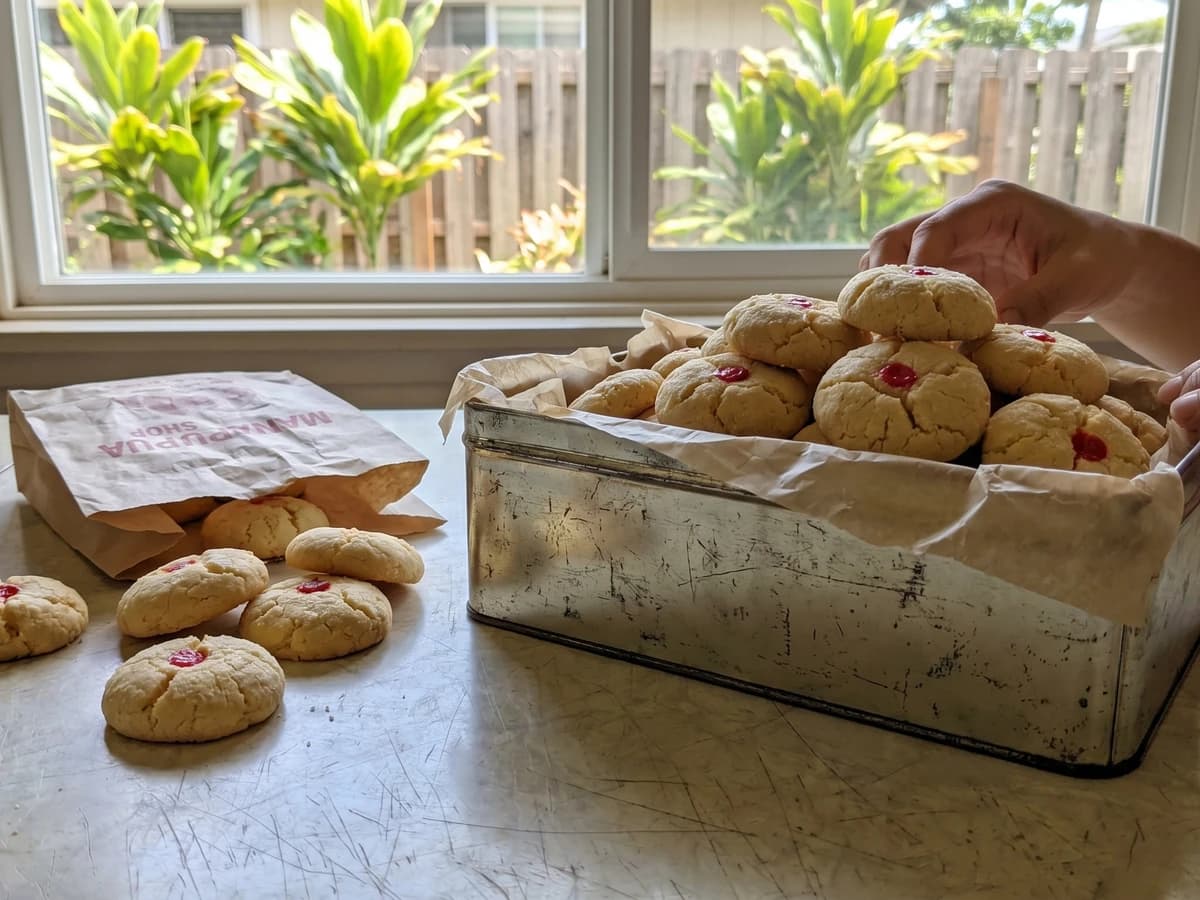
Buttery, sandy Chinese almond cookies from Hawaiʻi's Local table, marked with the lucky red dot, the kind you found in a bakery case, a manapua man's box, or a holiday tin.
A cooking platform built around craft, culture, and the stories behind what we eat.
Created by
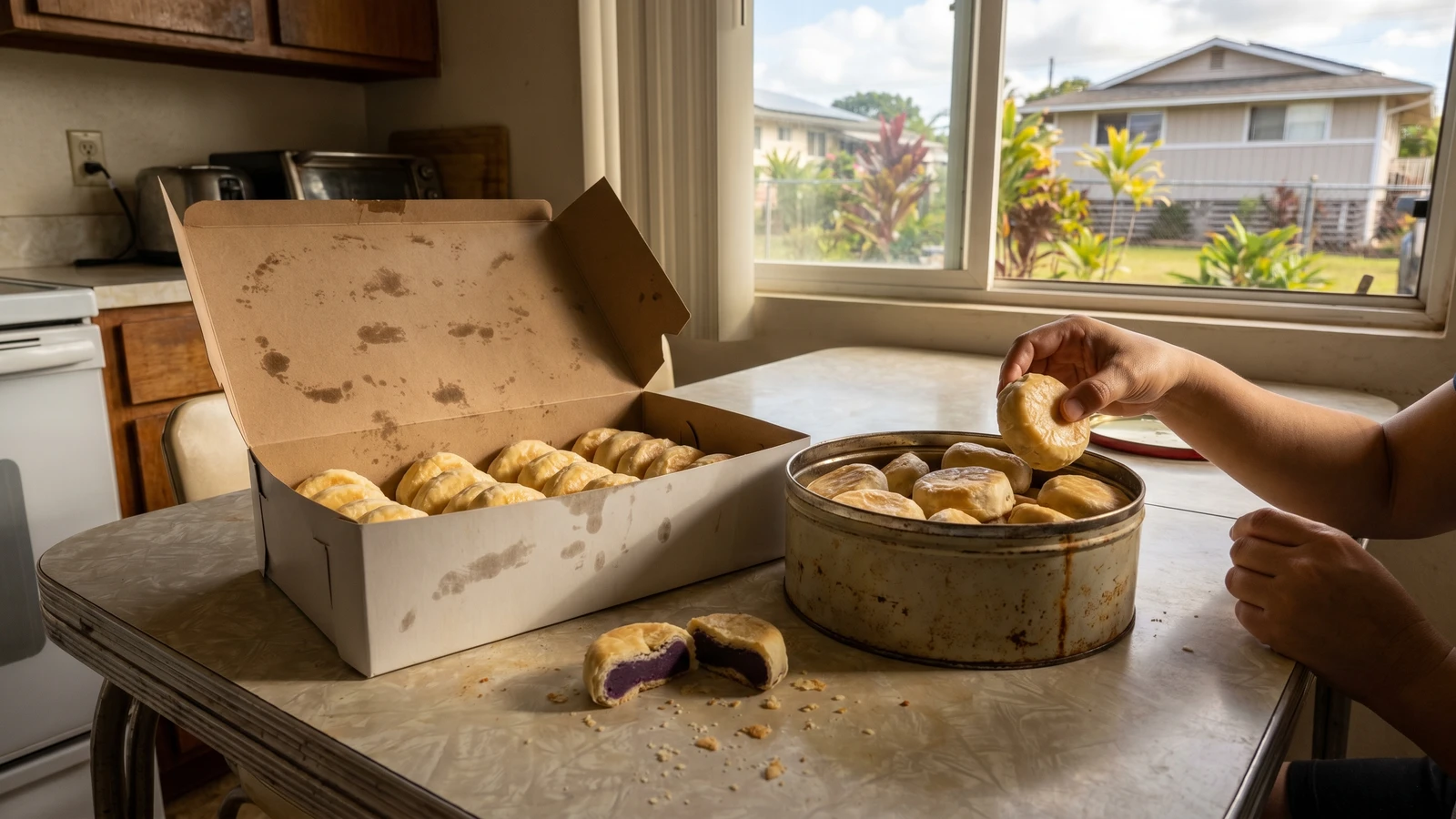
A Filipino gift pastry made Local in Hawaiʻi, flaky and soft around sweet mung bean or ube, the kind you tuck in a cookie tin and pass hand to hand.
Some food came to Hawaiʻi in canoes. Some came in lunch tins, in plantation camps, in the hands of people who crossed the ocean because the sugar fields were calling for labor. Hopia is that second kind of food, Filipino in its hand, Hawaiʻi Local in the way we love it now, passed across bakery counters and kitchen tables until everybody knows the box by sight.
This is not the food of the loʻi, not kalo pounded on the board, not Hāloa our elder brother. I keep that line clear because respect needs names. The hopia belongs to Filipino families, especially the sakada, the contracted workers who came from the Philippines to Hawaiʻi in the early 1900s and built a whole life under hard plantation rules. They brought food that could travel, food that could be gifted, food that made a small sweetness at the end of a long day.
The dough is humble but a little sly: one layer with water, one layer with fat, folded together so it flakes under your teeth. The filling is sweet mung bean, mongo, or ube if that's the box your auntie always bought. No need make it precious. Cook the beans soft, mash them patient, fold the pastry clean, and give plenty away. That's the Local table, yeah? Filipino hand, Hawaiʻi home, enough for one more.
Hopia is a Filipino pastry with roots in Chinese-Filipino baking, commonly filled with sweet mung bean paste and later with ube, and it came into Hawaiʻi's everyday food life through Filipino plantation families. The sakada, contract laborers from the Philippines, began arriving in Hawaiʻi in 1906 to work the sugar plantations, joining Japanese, Portuguese, Chinese, Korean, Puerto Rican, and Native Hawaiian communities in the camps. This is Hawaiʻi Local food, not Kanaka Maoli deep food: the immigrant-bakery side of the table, where what arrived by ship became part of how the islands eat now.
Quantity
1 cup
rinsed
Quantity
3 cups
plus more as needed
Quantity
3/4 cup
Quantity
1/4 teaspoon
for filling
Quantity
2 tablespoons
Quantity
1 teaspoon
Quantity
2 1/4 cups
divided
Quantity
1/2 teaspoon
divided for dough
Quantity
1/2 cup
for water dough
Quantity
1/2 cup
for water dough
Quantity
1/2 cup
for fat dough
Quantity
1
beaten, for brushing
| Ingredient | Quantity |
|---|---|
| dried split mung beansrinsed | 1 cup |
| waterplus more as needed | 3 cups |
| sugar | 3/4 cup |
| fine saltfor filling | 1/4 teaspoon |
| unsalted butter or neutral oil | 2 tablespoons |
| vanilla extract (optional) | 1 teaspoon |
| all-purpose flourdivided | 2 1/4 cups |
| fine saltdivided for dough | 1/2 teaspoon |
| waterfor water dough | 1/2 cup |
| neutral oilfor water dough | 1/2 cup |
| lard, shortening, or softened unsalted butterfor fat dough | 1/2 cup |
| eggbeaten, for brushing | 1 |
Put the rinsed mung beans and 3 cups water in a saucepan and simmer gently until the beans collapse soft, 25 to 30 minutes. Stir near the end so they don't catch. If the pot goes dry before the beans give up, add a splash more water. No blame the bean. It just needs time.
Mash the soft beans smooth, then stir in the sugar, salt, butter, and vanilla if using. Cook over low heat, stirring, until the paste pulls from the sides of the pan and holds its shape like soft clay, 8 to 12 minutes. Cool completely, then divide into 24 small balls.
In a bowl, mix 1 1/2 cups flour with 1/4 teaspoon salt. Stir in the water and neutral oil until a soft dough forms, then knead just until smooth. Cover and rest 15 minutes so it relaxes.
In another bowl, mash together the remaining 3/4 cup flour, remaining 1/4 teaspoon salt, and the lard, shortening, or butter until it becomes a soft paste. This is the little trick that makes the hopia flake, one dough wrapped around another.
Divide both doughs into 24 pieces. Flatten one water-dough piece, set one fat-dough piece inside, and pinch it closed. Roll into a small oval, roll it up like a jelly roll, turn it seam-side down, then roll it out once more. Keep the touch light. You want layers, not toughness.
Flatten each rolled piece into a round, set a ball of filling in the center, and gather the edges closed. Pinch tight, then set seam-side down and press gently into a squat cake. If a little filling shows, no panic, just patch it and keep moving.
Heat the oven to 375F. Set the hopia on a parchment-lined baking sheet, brush lightly with beaten egg, and bake 18 to 22 minutes, until pale golden with deeper color at the edges. The tops should look satin-glossed from the egg, the sides faintly layered.
Let the hopia cool until warm or room temperature before eating, because the filling settles as it rests. Pack some in a tin or a paper bakery box. This is gift food. It wants another hand to receive it.
1 serving (about 45g)
Culinary guides, cultural storytelling, and the editorial depth that makes cooking meaningful.
Discover Culinary ExplorerChef Makoa
Buttery, sandy Chinese almond cookies from Hawaiʻi's Local table, marked with the lucky red dot, the kind you found in a bakery case, a manapua man's box, or a holiday tin.

Chef Makoa
A Hawaiʻi Local bakery pie from Oʻahu: firm coconut haupia over chocolate cream in a flaky shell, chilled clean, topped with soft whipped cream.

Chef Makoa
Honolulu bakery-case comfort: crisp choux puffs filled with soft chocolate pudding and capped with Hawaiʻi-style Chantilly, the buttery cooked frosting that belongs to Oʻahu birthdays, office boxes, and after-school hands.

Chef Makoa
The Oʻahu home-tin cookie, buttery and crackly with cornflakes and rice cereal, baked by aunties for Christmas exchanges, church potlucks, and one more cousin reaching across the table.