
Chef Klaus
Allgäuer Krautkrapfen
The Allgäu pan dish that makes a meal from noodle dough, winter kraut, onion, and fat: brown the cut sides first, then cook gently so the rolls hold.
A cooking platform built around craft, culture, and the stories behind what we eat.
Created by
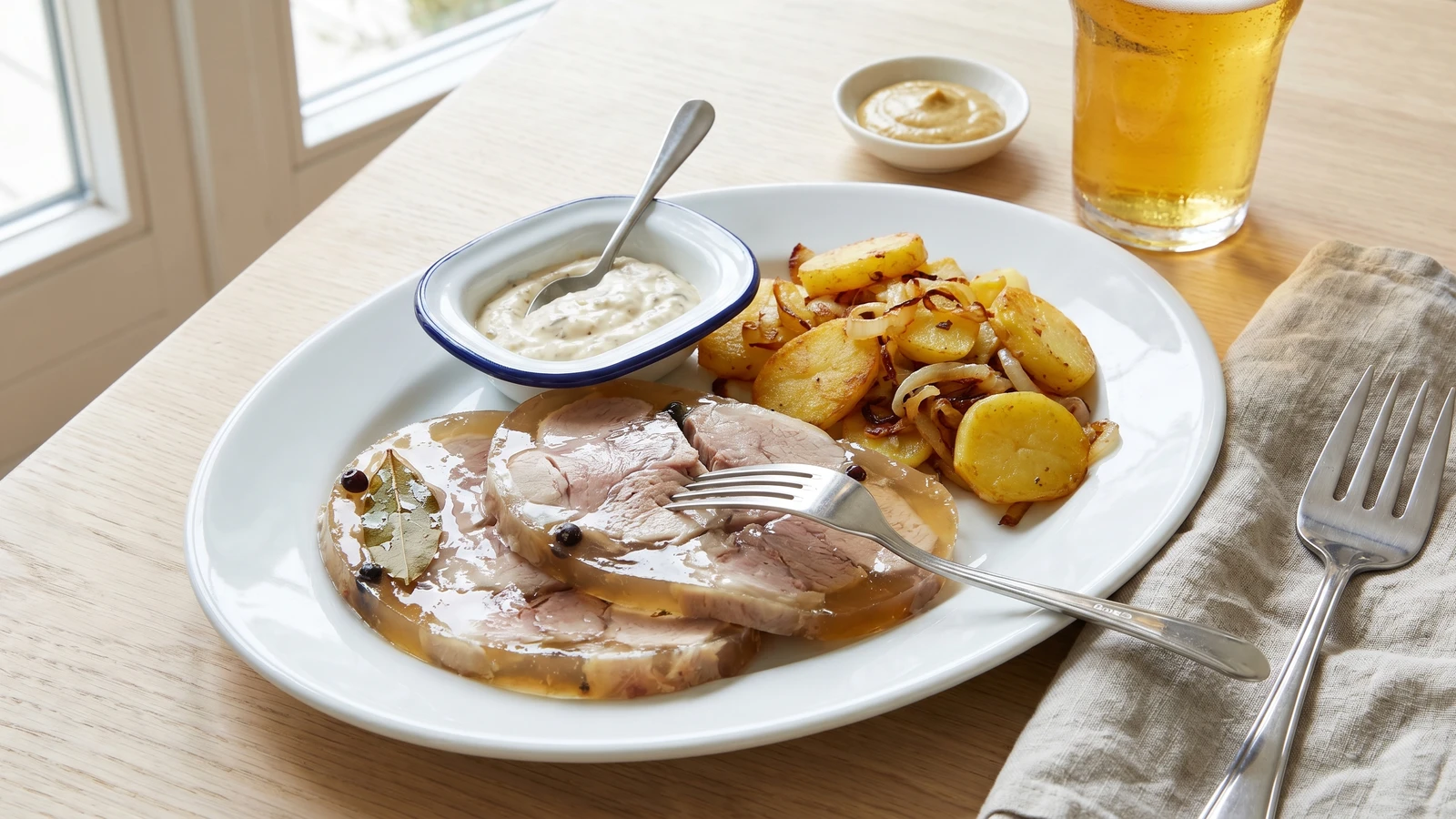
The Schleswig-Holstein cold table done properly: pork cooked gently in a sharp-sweet broth, set in its own clear jelly, then sliced with fried potatoes and remoulade.
Holsteiner Sauerfleisch belongs to Schleswig-Holstein, to the cold table, to make-ahead cooking, and to the north that knows what vinegar and time can do. You cook the pork with bay, onion, pepper, and vinegar, then set it cold in a clear aspic, a Sülze, jelly, firm enough to slice and bright enough to wake up a plate of Bratkartoffeln, fried potatoes.
The regions disagree because they should. In the north, the balance runs söötsuur, sweet-sour, and the meat is served cold with remoulade. In Swabia you find Sulz with more pork rind and sometimes darker seasoning; in Bavaria the Presssack line is closer to sausage than to this clean northern jelly. Im Norden anders, im Süden anders. Das ist kein Bierzelt.
The technique that decides it is the simmer. Keep the pot at a tremble, never a hard boil, because a rolling boil clouds the broth, tightens the pork, and breaks the clean jelly you want later. The rind, bones, and pig's foot give collagen to the liquid, so Weggeworfen wird nichts, nothing gets thrown away. Strain carefully, taste sharply, and test a spoonful cold before you pour. If it doesn't set, you add gelatine and get on with dinner.
I serve it cold, sliced thick, with hot fried potatoes and a spoon of remoulade. The hot potatoes, cold sour pork, and creamy sauce do the work. Schön ist, was schmeckt.
Sauerfleisch sits in the Schleswig-Holstein and northern German Sülze tradition, where cooked meat was preserved for several days under an acidulated jelly before household refrigeration made that less necessary. The sweet-sour seasoning, called söötsuur in Low German, belongs to the coastal and Hanseatic north, where vinegar, onions, bay, pepper, and stored winter roots shaped everyday meat cookery as much as fresh herbs did further south. Its usual pairing with Bratkartoffeln and remoulade marks it as a cold-table dish, closer to a northern Gasthof plate than to the roast-and-dumpling cooking of the Alpine south.
Quantity
1.2kg
trimmed but not lean
Quantity
500g rind or 1 pig's foot
Quantity
1 large
halved
Quantity
2
roughly chopped
Quantity
1 small piece or 2 stalks
chopped
Quantity
2
Quantity
10
Quantity
6
Quantity
4
lightly crushed
Quantity
1 teaspoon
Quantity
750ml
Quantity
300ml
Quantity
2 teaspoons, plus more to taste
Quantity
1 tablespoon, plus more to taste
Quantity
8 sheets or 16g
Quantity
2 tablespoons
chopped
Quantity
to serve
Quantity
to serve
| Ingredient | Quantity |
|---|---|
| boneless pork shoulder or necktrimmed but not lean | 1.2kg |
| pork rind or split pig's foot | 500g rind or 1 pig's foot |
| onionhalved | 1 large |
| carrotsroughly chopped | 2 |
| celeriac or celery stalkschopped | 1 small piece or 2 stalks |
| bay leaves | 2 |
| black peppercorns | 10 |
| allspice berries | 6 |
| juniper berrieslightly crushed | 4 |
| yellow mustard seeds | 1 teaspoon |
| water | 750ml |
| white wine vinegar | 300ml |
| fine sea salt | 2 teaspoons, plus more to taste |
| sugar | 1 tablespoon, plus more to taste |
| leaf gelatine or powdered gelatine (optional) | 8 sheets or 16g |
| gherkins (optional)chopped | 2 tablespoons |
| remoulade | to serve |
| Bratkartoffeln, fried potatoes | to serve |
Put the pork, rind or pig's foot, onion, carrots, celeriac, bay, peppercorns, allspice, juniper, mustard seeds, water, vinegar, salt, and sugar into a heavy pot. The rind and foot are not decoration; they give the broth the collagen it needs to set, so you don't have to build the whole dish out of a packet.
Bring the pot just to a bare simmer, skim the grey foam as it rises, then runter mit der Temperatur, down with the temperature. Keep the surface trembling for about 1 hour 45 minutes, until a skewer slides into the pork with little resistance. A hard boil makes cloudy jelly and dry meat, and cloudy Sauerfleisch looks like you stopped paying attention.
Lift the pork out onto a board and cover it loosely while you strain the broth. Let the meat cool until you can handle it, because hot pork tears into fibers and cold pork slices cleanly. Remove the rind or foot, picking off any useful soft bits if you like; Weggeworfen wird nichts, but gristle goes in the bin.
Strain the broth through a fine sieve lined with a clean cloth, then skim the fat from the surface. Taste it while it is still warm and make it brighter than you think it should be, with more vinegar, salt, or a pinch of sugar as needed. Cold dulls seasoning, so a timid warm broth becomes flat aspic.
Spoon a little broth onto a cold plate and put it in the freezer for 5 minutes. If it sets softly but cleanly, the rind has done its work. If it stays loose, soak the gelatine in cold water, squeeze it dry if using sheets, and dissolve it into the warm strained broth. Nicht aus dem Glas, and not blind from the packet either; test first, then fix what the pot needs.
Slice the pork into thick, even pieces and pack it into a loaf tin, terrine, or shallow dish. Pour over enough warm broth to cover the meat by a finger's width, tapping the dish gently so liquid runs between the slices. Meat left sticking above the jelly dries out, and this is a cold dish, not a punishment.
Cover the dish and chill it at least 8 hours, overnight if you've got sense. Das braucht seine Zeit. The aspic firms as it cools, and the vinegar settles into the pork instead of sitting sharp on the surface.
Dip the mould briefly in warm water, turn out the Sauerfleisch, and slice it with a sharp knife. Serve it cold with hot Bratkartoffeln, remoulade, and chopped gherkins if you want the bite. The plate should be clean, sharp, and a little glossy from the jelly. That's the north doing its work.
1 serving (about 470g)
Culinary guides, cultural storytelling, and the editorial depth that makes cooking meaningful.
Discover Culinary ExplorerChef Klaus
The Allgäu pan dish that makes a meal from noodle dough, winter kraut, onion, and fat: brown the cut sides first, then cook gently so the rolls hold.

Chef Klaus
Swabian egg pasta turned toward the apple cellar: fresh Spätzle tossed with browned butter, tart apples, cinnamon, and enough restraint to stay supper, not cake.

Chef Klaus
Hesse's pork goulash belongs to Apfelwein country: shoulder, onions, and tart cider cooked low until the cheap cut turns soft and the sauce lands sweet-sour, not sour-sweet.

Chef Klaus
The old sweet supper that saves yesterday's loaf: stale bread drinks eggy milk, the pan stays moderate, and butter browns the outside only after the centre has set.