
Chef Klaus
Allgäuer Krautkrapfen
The Allgäu pan dish that makes a meal from noodle dough, winter kraut, onion, and fat: brown the cut sides first, then cook gently so the rolls hold.
A cooking platform built around craft, culture, and the stories behind what we eat.
Created by
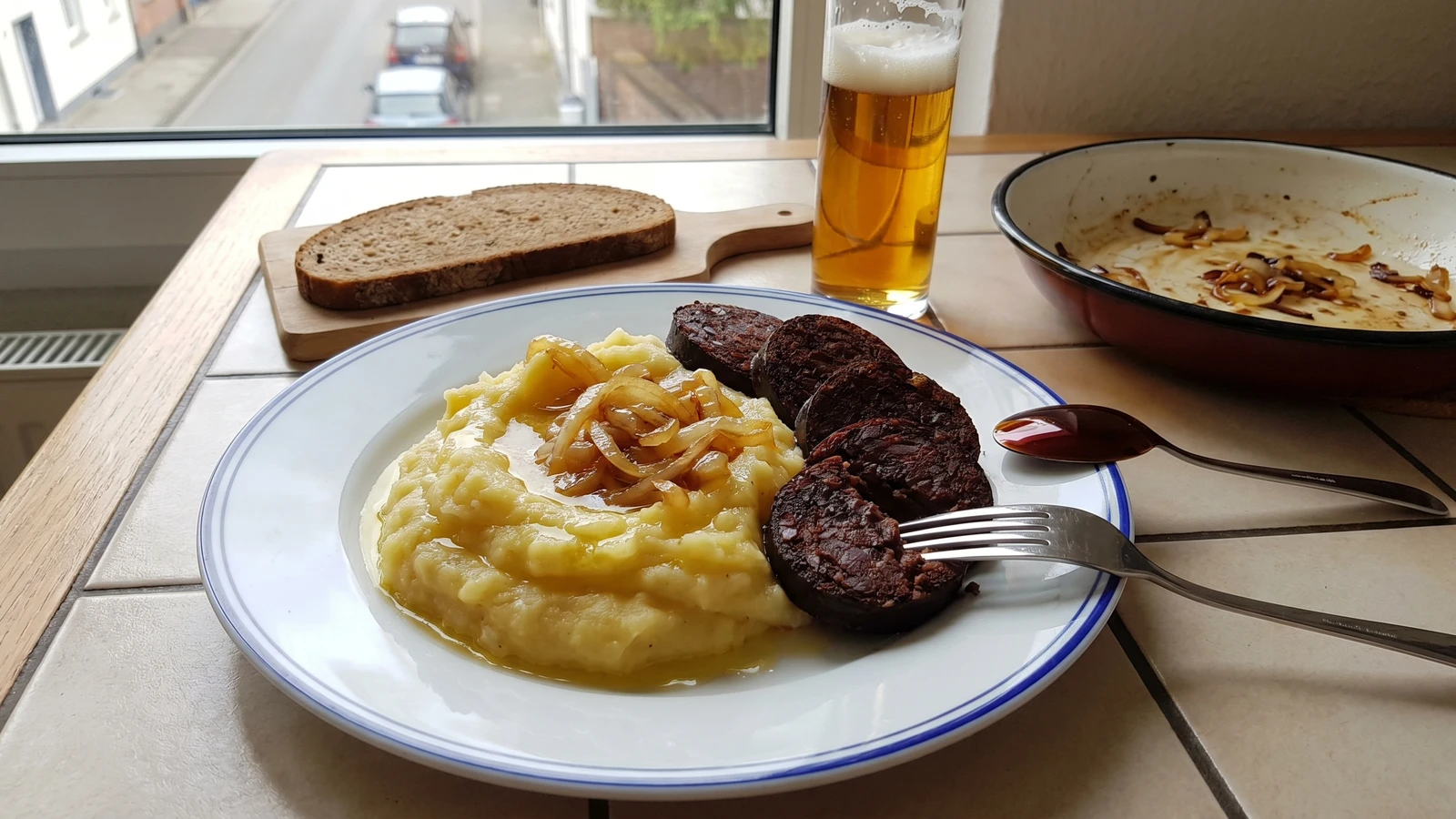
Köln's sweet-savoury plate lives on balance: floury potatoes, tart apples, onions cooked slow, and Flönz fried gently so the casing crisps before the middle bursts.
Himmel un Ääd belongs to the Rhineland, strongest around Köln and Düsseldorf, and it sits on the table when the larder is doing its work: stored potatoes, winter apples, onions, and blood sausage from the butcher's careful end of the pig. Heaven is the apple. Earth is the potato. Then comes Flönz, the Rhenish black pudding, fried beside it until the outside catches and the inside stays soft.
The regions don't agree, good. In Köln you want Flönz with onions and often a dark spoon of Rübenkraut, sugar beet syrup, on the side. Westphalia may make it sturdier, with coarser blood sausage and a sharper apple note. Further south, they know blood sausage, but this plate is not theirs in the same way. Im Norden anders, im Süden anders. German cooking has borders inside it.
The technique that decides the dish is heat. Fry the Flönz too hard and the casing splits, the filling runs, and you've made a pan of black pudding crumbs. Keep the pan moderate, flour the slices lightly, and let the fat work slowly until the surface is crisp and the middle is just hot. Runter mit der Temperatur. The onions get the same patience, because fast onions are sharp and pale, and slow onions turn sweet enough to stand with the apple.
Mash the potatoes while hot because hot potato breaks cleanly and drinks butter. Fold in the apple last so it stays bright against the earthiness. Weggeworfen wird nichts: a spoon of the onion fat goes through the mash, and the pan is wiped with a piece of rye if nobody is looking. Schön ist, was schmeckt.
Himmel und Erde became possible as a common Rhenish and Westphalian dish after the potato spread through German kitchens in the eighteenth century; in Prussia, Frederick II pushed potato cultivation with orders in 1746 and again in 1756. The name is plain kitchen poetry: apples from above, potatoes from below, cooked together or folded together depending on the household. Köln's version is tied to Flönz, the local blood sausage whose name and production are protected in the European Union as Kölsche Flönz, registered as a protected geographical indication in 2016.
Quantity
900g
peeled and cut into chunks
Quantity
600g
peeled, cored, and cut into wedges
Quantity
2
sliced into half-moons
Quantity
500g
cut into thick slices
Quantity
3 tablespoons
for dusting
Quantity
60g
Quantity
2 tablespoons
Quantity
120ml
warmed
Quantity
1 teaspoon
Quantity
1 pinch
Quantity
to taste
Quantity
to taste
Quantity
2 tablespoons
to serve
Quantity
to serve
| Ingredient | Quantity |
|---|---|
| floury potatoespeeled and cut into chunks | 900g |
| tart applespeeled, cored, and cut into wedges | 600g |
| large onionssliced into half-moons | 2 |
| Flönz or good blood sausagecut into thick slices | 500g |
| plain flourfor dusting | 3 tablespoons |
| butter | 60g |
| neutral oil or lard | 2 tablespoons |
| whole milkwarmed | 120ml |
| apple cider vinegar | 1 teaspoon |
| sugar (optional) | 1 pinch |
| freshly grated nutmeg | to taste |
| salt and black pepper | to taste |
| Rübenkraut (sugar beet syrup)to serve | 2 tablespoons |
| dark rye bread (optional) | to serve |
Melt 20g butter with 1 tablespoon oil or lard in a wide frying pan, add the sliced onions and a pinch of salt, and cook them over medium-low heat for 25 to 30 minutes until soft, golden, and sweet. Don't rush them. Fast heat browns the edges while the middle stays sharp, and this dish needs onion sweetness to stand against the blood sausage.
Put the potatoes in salted cold water, bring them to a steady simmer, and cook until almost tender, about 15 minutes. Add the apples for the last 6 to 8 minutes, just until they soften. Potatoes start cold so they cook through evenly; apples go in late because they collapse faster and should bring brightness, not disappear into paste.
Drain the potatoes and apples very well, then return them to the warm pot for a minute so surface moisture dries off. Mash with the warm milk, 40g butter, nutmeg, black pepper, the vinegar, and a spoon of the onion fat. Taste before you salt hard, because the Flönz brings salt of its own. If the apples are fierce, add the pinch of sugar, not more. Balance, not pudding.
Pat the Flönz slices dry and dust them lightly with flour, shaking off the excess. The flour is not breading. It gives the soft sausage a dry skin so it can crisp in the pan before the filling warms and loosens.
Heat the remaining 1 tablespoon oil or lard in a clean pan over medium heat, then lay in the Flönz slices and fry 2 to 3 minutes per side until the outside is crisp and dark and the centre is hot. Runter mit der Temperatur if the casing starts to split. Blood sausage is already cooked; you're crisping and warming it, not punishing it.
Spoon the apple-potato mash onto warm plates, lay the fried Flönz against it, and heap the onions over the sausage and mash so their fat runs where it should. Add a small spoon of Rübenkraut on the side if you like the Köln sweetness, and serve rye bread for the last streaks on the plate. Nicht aus dem Glas, not a bought sauce. The pan gave you enough.
1 serving (about 615g)
Culinary guides, cultural storytelling, and the editorial depth that makes cooking meaningful.
Discover Culinary ExplorerChef Klaus
The Allgäu pan dish that makes a meal from noodle dough, winter kraut, onion, and fat: brown the cut sides first, then cook gently so the rolls hold.

Chef Klaus
Swabian egg pasta turned toward the apple cellar: fresh Spätzle tossed with browned butter, tart apples, cinnamon, and enough restraint to stay supper, not cake.

Chef Klaus
Hesse's pork goulash belongs to Apfelwein country: shoulder, onions, and tart cider cooked low until the cheap cut turns soft and the sauce lands sweet-sour, not sour-sweet.

Chef Klaus
The old sweet supper that saves yesterday's loaf: stale bread drinks eggy milk, the pan stays moderate, and butter browns the outside only after the centre has set.