
Chef Jeong-sun
Agwi-jjim (Braised Monkfish with Bean Sprouts)
Firm monkfish buried under crisp soybean sprouts, minari, and a red gochugaru sauce thickened at the end; Masan's market dish asks for heat, timing, and a steady hand.
A cooking platform built around craft, culture, and the stories behind what we eat.
Created by
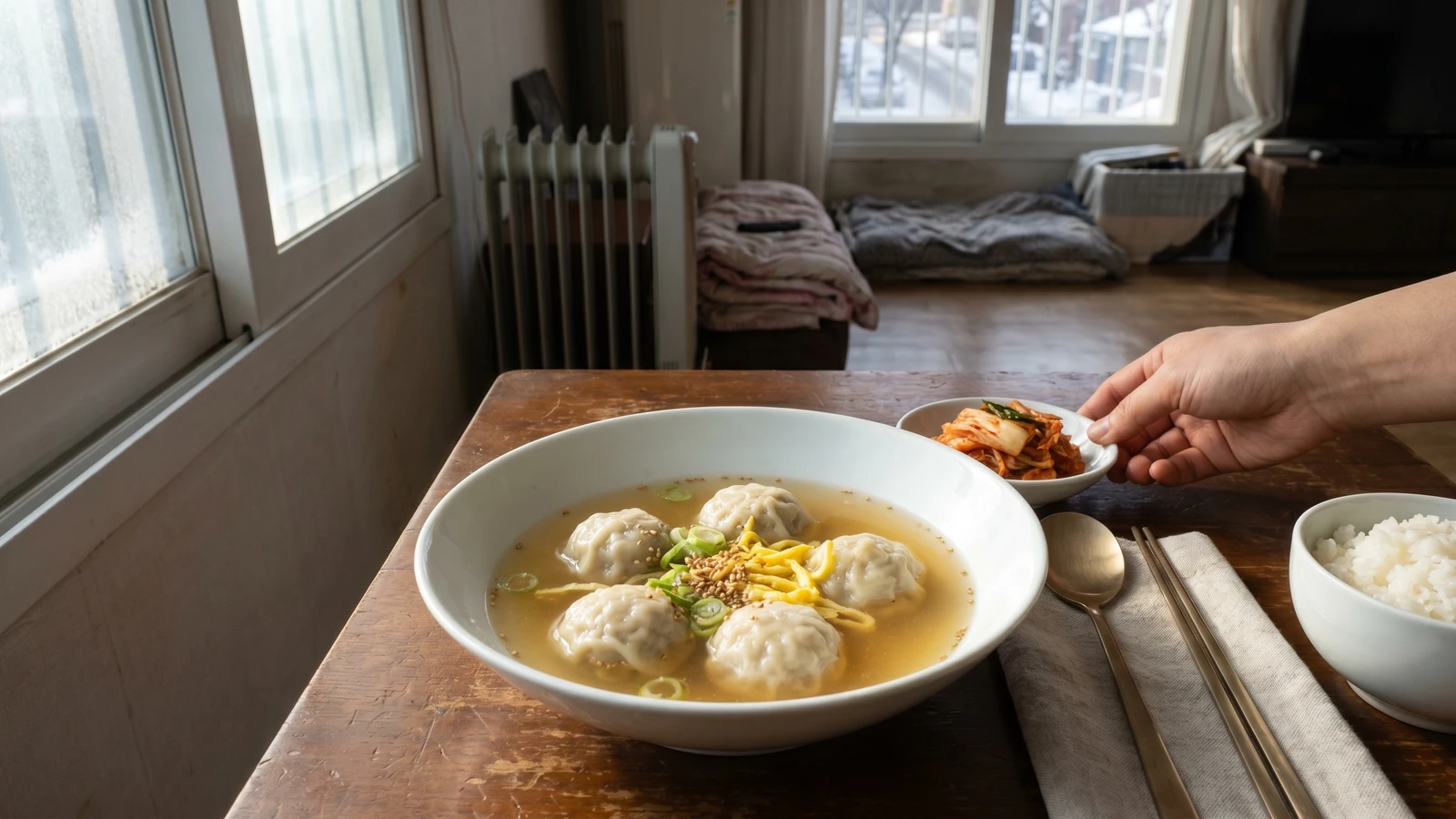
The wrapper that never was: northern dumpling filling rolled into tender balls, dusted with flour, dipped in egg, and simmered until a thin skin forms in the broth.
Gullim-mandu lives or dies by the rolling. Not the filling, though the filling must be seasoned correctly. Not the broth, though a clean broth makes it worth eating. The dish asks your hands to make a dumpling without giving you a wrapper, and that is why people either remember it with affection or avoid it entirely.
My teacher called this the honest dumpling of scarcity. Wheat flour was not always something a household could spend freely on sheets of mandu skin, so the filling was rolled, dusted, dipped, and simmered until a wrapper appeared where there had not been one. It is a northern dish, plain and clever, meant for a bowl of broth and a cold evening when the table needs filling food more than decoration.
Do not make the balls too large. A walnut is enough, about 28 grams each. Bigger ones split, and then you have pork and tofu floating in broth, which is soup with regrets. Press the tofu dry, squeeze the kimchi hard, and blanch the sprouts before chopping. Water is the enemy here. 손맛 is real; I measure it anyway, because a dumpling this simple has nowhere to hide a careless hand.
Gullim-mandu is recorded as a regional mandu of Pyeongan Province in Korea's northwest, and its name comes from gullida, meaning to roll. Unlike wrapped mandu, it reflects a household method from places and periods when wheat flour was too valuable to spend heavily on wrappers, so a thin coating of flour and egg stood in for the skin. Northern mandu traditions traveled south with displaced families after division and the Korean War, which is why dishes like this often survive most clearly in family kitchens rather than restaurant menus.
Quantity
250g
Quantity
200g
pressed and crumbled
Quantity
120g
squeezed dry and finely chopped
Quantity
100g
blanched, squeezed dry, and chopped
Quantity
60g
finely minced
Quantity
2
finely chopped
Quantity
2 cloves
minced
Quantity
1 teaspoon
Quantity
1 tablespoon
Quantity
1 tablespoon
Quantity
1 teaspoon
crushed
Quantity
1/4 teaspoon
Quantity
1 large
Quantity
1/2 cup
for rolling
Quantity
2 large
beaten
Quantity
6 cups
Quantity
1 tablespoon
Quantity
1/2 teaspoon, plus more as needed
Quantity
1
thinly sliced
Quantity
1 egg
separated, pan-cooked, and thinly sliced
Quantity
to finish
| Ingredient | Quantity |
|---|---|
| ground pork | 250g |
| firm tofupressed and crumbled | 200g |
| napa cabbage kimchisqueezed dry and finely chopped | 120g |
| mung bean sproutsblanched, squeezed dry, and chopped | 100g |
| onionfinely minced | 60g |
| scallionsfinely chopped | 2 |
| garlicminced | 2 cloves |
| fine sea salt | 1 teaspoon |
| soy sauce | 1 tablespoon |
| toasted sesame oil | 1 tablespoon |
| toasted sesame seedscrushed | 1 teaspoon |
| ground black pepper | 1/4 teaspoon |
| egg for filling | 1 large |
| all-purpose flourfor rolling | 1/2 cup |
| eggs for coatingbeaten | 2 large |
| beef broth or anchovy-kelp broth | 6 cups |
| soup soy sauce (guk-ganjang) | 1 tablespoon |
| fine sea salt for broth | 1/2 teaspoon, plus more as needed |
| scallion for garnish (optional)thinly sliced | 1 |
| jidan egg garnish (optional)separated, pan-cooked, and thinly sliced | 1 egg |
| extra toasted sesame seeds (optional) | to finish |
Press the tofu under a plate for 15 minutes, then wrap it in a clean towel and squeeze until it no longer drips. Squeeze the chopped kimchi hard in your fist. Blanch the mung bean sprouts for 2 minutes, rinse briefly, squeeze dry, and chop. This drying is not fussing. If the filling is wet, the dumplings crack in the broth.
In a bowl, combine the pork, tofu, kimchi, sprouts, onion, scallions, garlic, salt, soy sauce, sesame oil, crushed sesame seeds, pepper, and 1 egg. Mix with your hand in one direction for 2 full minutes, until the mixture turns sticky and holds together. That stickiness is the binder; without it, the coating has nothing to cling to.
Pinch off 1 tablespoon of filling and cook it in a small skillet or in simmering broth until done. Taste it before you roll the whole batch. It should be savory but not salty, because the broth will season it again. Add up to 1/4 teaspoon more salt only if it tastes flat.
Portion the filling into 24 balls, about 28g each, the size of a small walnut. Roll each one between damp palms until smooth and tight. Set them on a tray. Keep the size even so they cook at the same pace; this is where a scale does the work that old recipes leave to guessing.
Put the flour in a shallow bowl and the beaten eggs in another. Roll each ball lightly in flour, shake off the excess, dip it in egg, then roll it in flour once more for a thin, even coat. Do not pack flour onto it like armor. The coating should become a tender skin, not a paste.
Bring the broth to a steady simmer in a wide pot. Season with the soup soy sauce and 1/2 teaspoon salt, then taste. It should be clean and lightly seasoned, because the dumplings carry salt too. Keep it at a simmer, not a hard boil, or the coating tears before it sets.
Lower the dumplings into the broth one by one, leaving space between them. Simmer 8 to 10 minutes, turning them once with a spoon after the coating sets. They are done when they float, feel firm, and the center reaches 71 C or 160 F. Skim any foam from the surface so the broth stays clear.
Divide the dumplings among warm bowls and ladle the clear broth over them. Finish with sliced scallion, jidan if you made it, and a few sesame seeds. Serve with rice if the table is hungry, or with baechu-kimchi and one sharp namul if you want the bowl to stand on its own.
1 serving (about 610g)
Culinary guides, cultural storytelling, and the editorial depth that makes cooking meaningful.
Discover Culinary ExplorerChef Jeong-sun
Firm monkfish buried under crisp soybean sprouts, minari, and a red gochugaru sauce thickened at the end; Masan's market dish asks for heat, timing, and a steady hand.

Chef Jeong-sun
A quick Korean rice bowl built on contrast: warm rice, cold popping flying-fish roe, chopped vegetables, gim, sesame oil, and the crisp rice bottom a hot stone bowl gives you.
Chef Jeong-sun
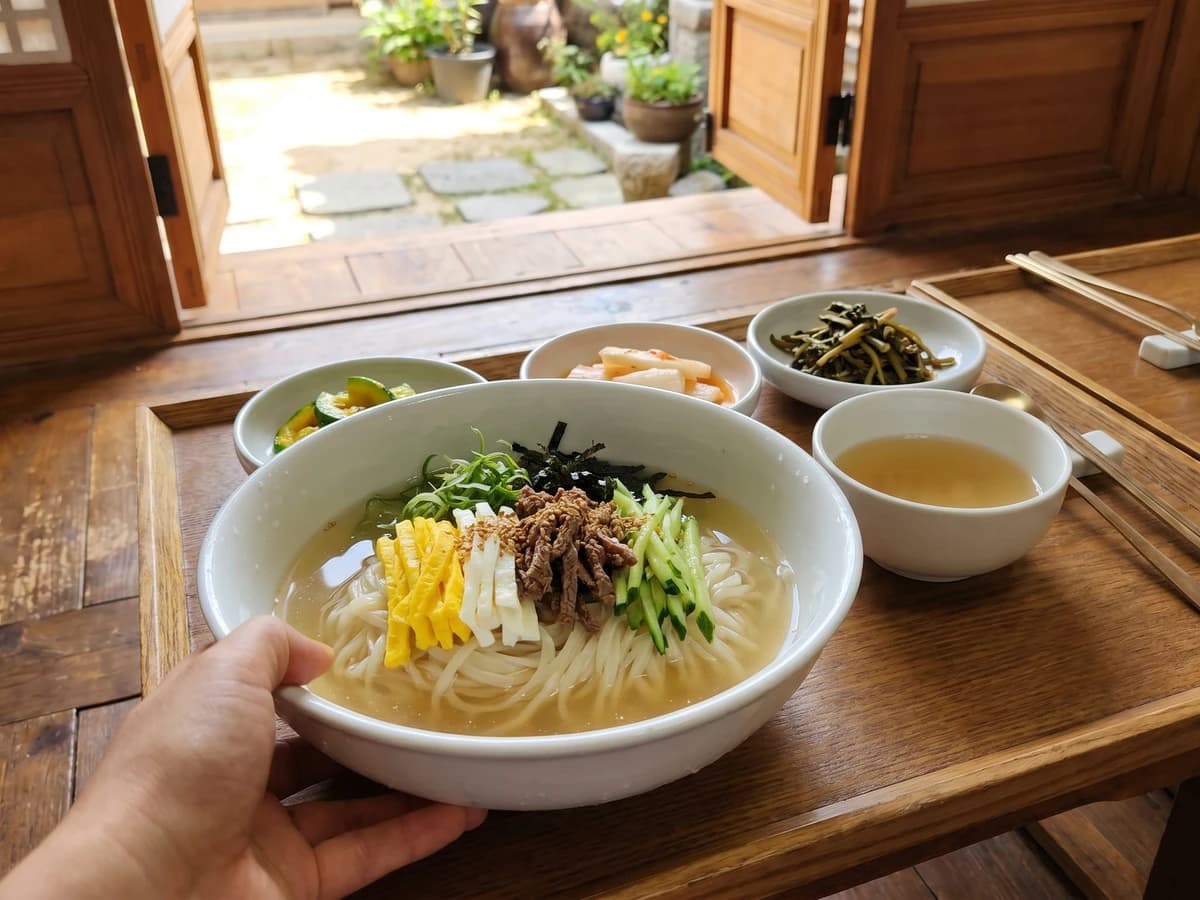
Andong's guest noodles, wheat and roasted soybean flour rolled thin, boiled and rinsed cold, then set in a clear chilled anchovy broth with careful strips of beef, egg, and cucumber.

Chef Jeong-sun
Andong's ritual-table rice served on an ordinary day: separate soy-sesame namul, warm rice, and clear radish soup, mixed without gochujang so every vegetable keeps its own voice.