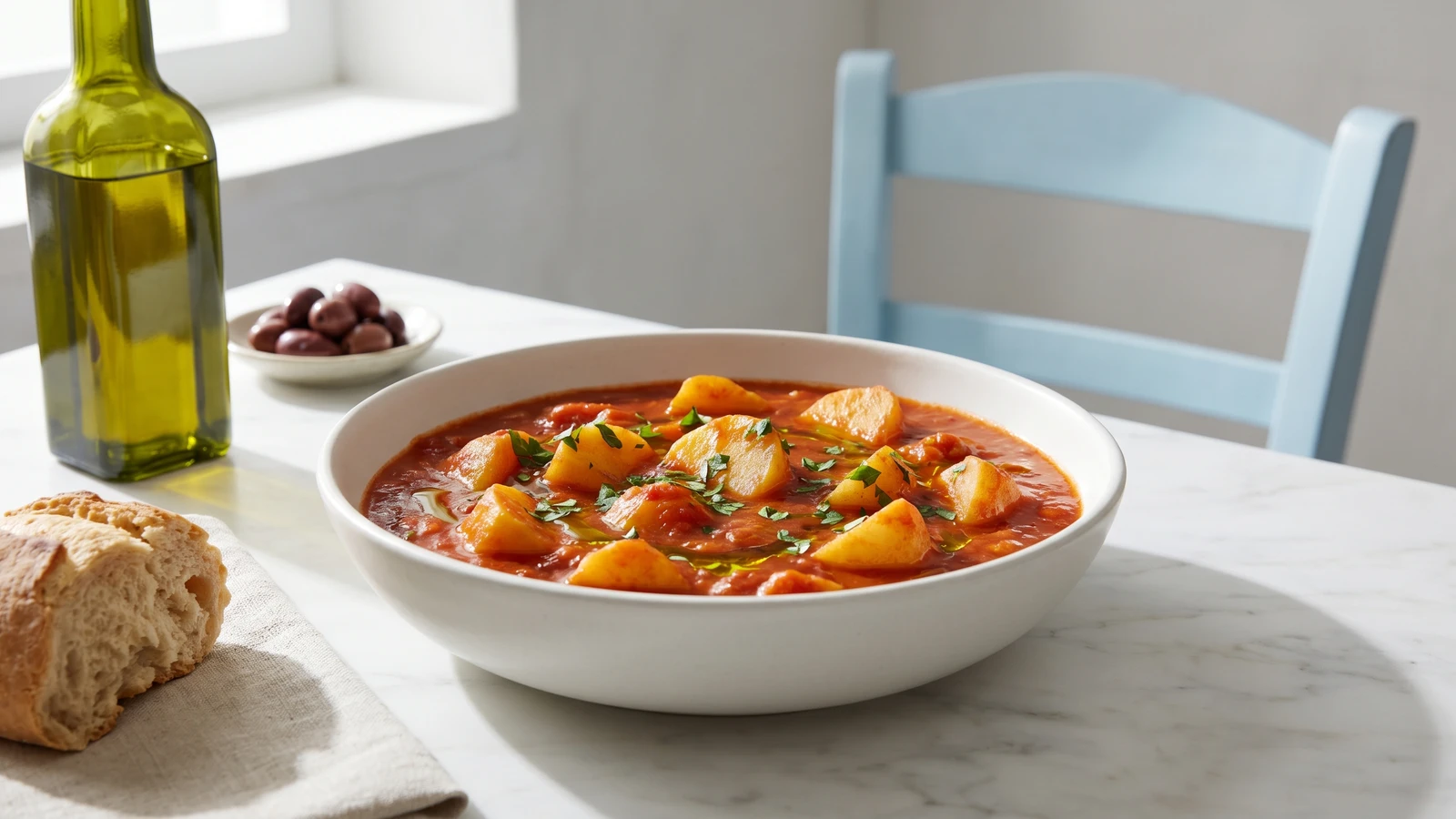
Greek mainland patates yahni is the plain potato pot that proves ladera cooking: browned onion, ripe tomato, and good olive oil, simmered until the sauce clings to every edge.
Side Dishes
Greek
Budget Friendly
Comfort Food
One Pot
15 min
Active Time
55 min cook•1 hr 10 min total
Yield4 servings as a main or 6 as a side
On the Greek mainland, patates yahni is the potato pot of the fasting table: potatoes stewed in tomato, onion, and olive oil until their edges soften and the sauce turns red and glossy. It is ladero, one of the olive-oil dishes, and it feeds a family with bread, olives, and whatever greens the season gives.
The one step that decides it is the onion. Brown it patiently in the oil before the tomato goes in. If the onion only sweats, its raw sweetness follows the whole pot; once it takes a little color, the sauce tastes cooked before the potatoes ever enter. That's the whole trick.
Cut the potatoes large, keep the water just shy of covering, and don't stir them to pieces. Shake the pot and let the starch thicken the tomato into a sauce that clings. I keep this version plain in my notebook because that is how the dish earns its place: Λίγα και καλά, a few things, and good ones.
Yahni entered Greek through Ottoman Turkish yahni, a word for a stewed dish, and in Greek homes it became a method as much as a recipe. The potato was promoted in the new Greek state under Ioannis Kapodistrias in the late 1820s, then settled into mainland ladera, olive-oil vegetable cooking, as a cheap and filling pot. Patates yahni belongs to the nistisima table, the Orthodox fasting repertoire where tomato and olive oil carry the work that meat usually would.
The technique, the tradition, and the story behind every dish.
grated, or use 400g canned whole tomatoes, crushed
hot water
Quantity
500ml
plus more as needed
bay leaf
Quantity
1
fine sea salt
Quantity
7g, about 1 1/4 teaspoons
plus more to taste
freshly ground black pepper
Quantity
1/2 teaspoon
flat-leaf parsley (optional)
Quantity
10g
chopped
Ingredient
Quantity
yellow potatoespeeled and cut into 4cm chunks
1kg
extra virgin Koroneiki olive oildivided
80ml
yellow onionfinely chopped
1 large, about 200g
garlic clovesthinly sliced
2
tomato paste
20g
ripe tomatoesgrated, or use 400g canned whole tomatoes, crushed
450g
hot waterplus more as needed
500ml
bay leaf
1
fine sea saltplus more to taste
7g, about 1 1/4 teaspoons
freshly ground black pepper
1/2 teaspoon
flat-leaf parsley (optional)chopped
10g
Equipment Needed
•wide heavy pot with lid, 28cm
•box grater for fresh tomatoes
Instructions
1
Prepare Potatoes
Peel the potatoes and cut them into large 4cm chunks. Keep them chunky, because small pieces collapse before the sauce has time to thicken. If they sit while you start the pot, cover them with cold water, then drain them well before they go in.
2
Brown Onion
Warm 70ml of the olive oil in a wide heavy pot over medium heat. Add the onion and a pinch of the measured salt, then cook for 10 to 12 minutes, stirring often, until it is soft and golden at the edges. This is the step that gives the pot depth: brown the onion first, or the tomato and water trap it pale and the yahni tastes flat and raw.
If the onion catches too fast, lower the heat. Add a spoonful of water only after it has taken color, not before.
3
Cook Tomato
Stir in the garlic for 30 seconds. Add the tomato paste and cook for 1 minute, then add the grated tomatoes, bay leaf, remaining salt, and black pepper. Let the tomato bubble for 6 to 8 minutes, until it darkens a little and the oil gathers in red-gold beads around the edge.
4
Add Potatoes
Add the drained potatoes and turn them gently through the tomato base so every side is stained red. Pour in about 450ml hot water, enough to come just below the top of the potatoes. Do not drown them. Yahni should finish with sauce, not broth.
Keep the water line low. Too much water gives you potato soup, and the olive oil cannot bind the sauce properly.
5
Simmer Gently
Bring the pot to a low bubble, cover, and cook for 25 minutes. Uncover and cook for 15 to 20 minutes more, shaking the pot once or twice, until a knife slides through the potatoes and the sauce coats a spoon. Stir only from underneath if you must, because rough stirring breaks the potatoes before the sauce is ready.
6
Rest and Serve
Take the pot off the heat and let it rest for 10 minutes. Discard the bay leaf, taste for salt, and spoon over the remaining 10ml olive oil. Finish with parsley if using. Serve warm or at room temperature with bread and olives; feta belongs beside it only when you are not keeping the fast.
Chef Tips
•Use yellow potatoes that hold their shape, not floury baking potatoes. You want the edges to soften into the sauce while the centers stay whole.
•Fresh tomato is for summer. In winter, use canned whole tomatoes with their juice and crush them by hand; a hard pale tomato has no duty in this pot.
•For a fasting table, serve it with bread, olives, and horta, boiled greens with lemon and oil. Outside the fast, feta on the side is honest, but don't cook it into the yahni. The pot is already complete.
Advance Preparation
•Peel and cut the potatoes up to 2 hours ahead, then keep them covered in cold water. Drain well before cooking.
•Grate ripe tomatoes up to 1 day ahead and keep them chilled. In winter, use good canned whole tomatoes instead of hard fresh ones.
•The finished yahni can be made 1 day ahead. Rewarm it gently with a splash of hot water and add the parsley after reheating.
Frequently Asked Questions
Nutrition Information
1 serving (about 400g)
Calories
410 calories
Total Fat
19 g
Saturated Fat
3 g
Trans Fat
0 g
Unsaturated Fat
15 g
Cholesterol
0 mg
Sodium
690 mg
Total Carbohydrates
55 g
Dietary Fiber
8 g
Sugars
9 g
Protein
7 g
Where cooking meets culture.
Culinary guides, cultural storytelling, and the editorial depth that makes cooking meaningful.