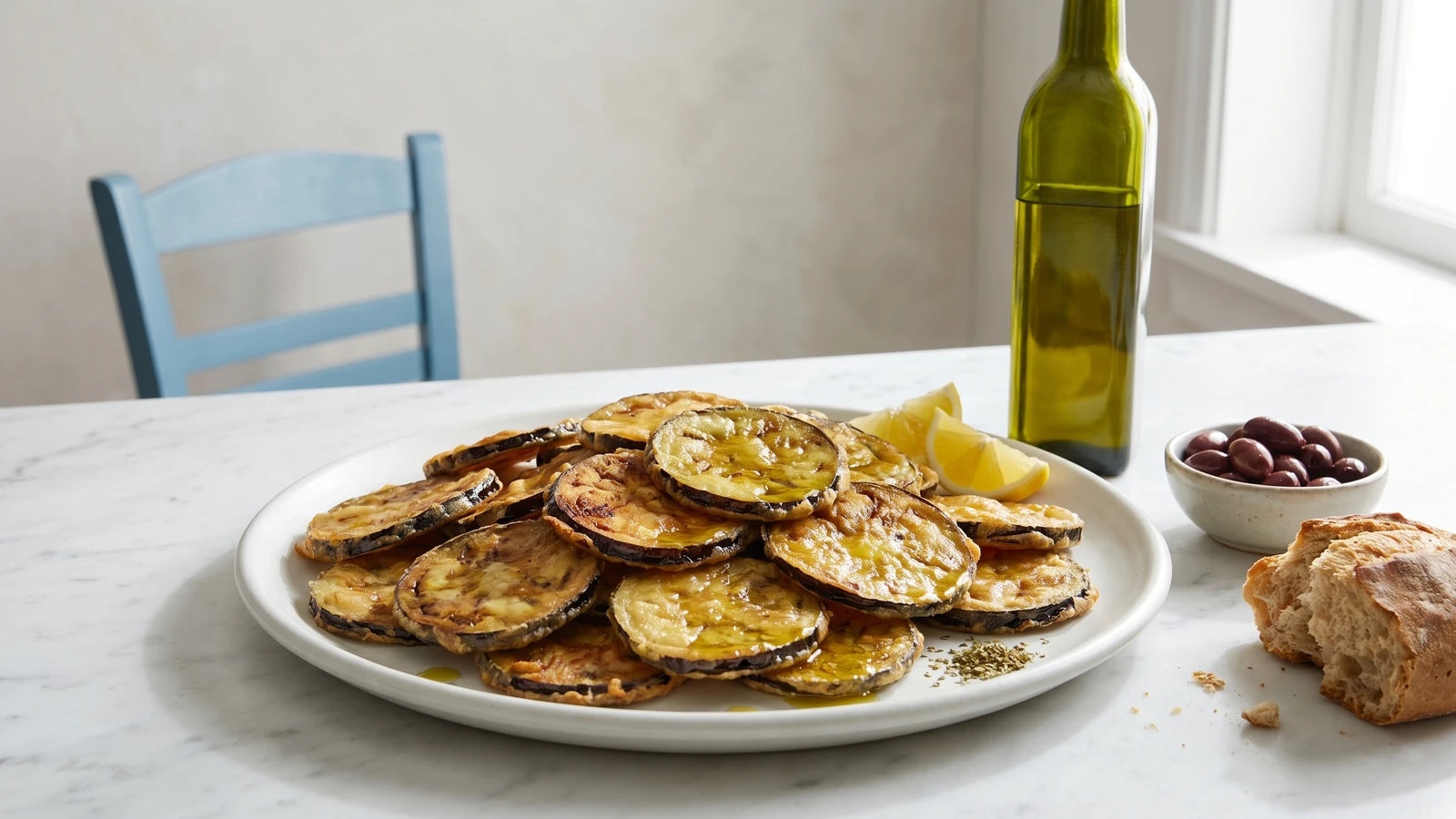
Cretan melitzanes tiganites are summer eggplant rounds, salted first, flour-dusted, and fried gold in olive oil until the edges crisp and the middle stays tender.
Side Dishes
Greek
Comfort Food
Budget Friendly
Outdoor Dining
35 min
Active Time
15 min cook•50 min total
Yield4 servings as a side
Cretan melitzanes tiganites are summer eggplant at its plainest and best: thin rounds, salted, dusted with flour, fried gold, and sent to the table with lemon. You see them from Crete across the islands, beside a plate of tomatoes, a little feta, and bread ready for the oil.
The method is not the frying. It is the salting and drying before the pan. Eggplant holds water like a sponge, and if you skip that first rest, the slices take too long to color and drink more oil than they should. Salt them, let them weep, dry them well, and the flour clings in a light coat instead of turning pasty.
This is budget food, fasting food when served without cheese beside it, and outdoor food because it wants to be eaten hot, by hand if nobody is pretending. I don't invent it. I find it, I test it, I write it down. Here the numbers only keep you from guessing at the pan.
Fried eggplant became a familiar summer meze in Crete and the Aegean islands as eggplant settled deeply into Greek cooking under Ottoman rule and local garden agriculture. The dish remained simple because it belonged to the household pan and the taverna table, not to feast cooking: salt, flour, olive oil, and the vegetable in season. In many island homes it also fits the nistisima table, since the basic version contains no egg, milk, or cheese.
The technique, the tradition, and the story behind every dish.
Cut the eggplants into rounds 5mm thick. Lay them in a colander, sprinkle with the 10g salt, and toss gently so the salt reaches both sides. Leave them for 25 minutes, until beads of moisture rise on the surface.
2
Dry the Slices
Rinse the slices quickly under cold water, then dry them very well between clean kitchen towels. This is the step that decides the dish. Salt pulls out excess moisture, and a dry surface fries crisp and drinks less oil. Wet eggplant steams first, then sulks in the pan.
Press without crushing. You want the slices dry on the outside, not broken.
3
Flour Lightly
Mix the flour with oregano and black pepper in a shallow dish. Dredge each slice on both sides, then shake off the extra flour. The coating should look thin and dusty, not thick.
4
Fry in Batches
Heat the olive oil in a wide frying pan over medium-high heat. When a pinch of flour sizzles at once, add the eggplant in a single layer. Fry 2 to 3 minutes per side, turning once, until the slices are deep gold with darker edges.
5
Drain and Serve
Lift the slices to a rack or paper-lined plate and salt them while hot. Serve at once with lemon wedges. They should be crisp at the rim, soft in the middle, and good enough to make you reach for bread.
Chef Tips
•Choose firm, glossy eggplants that feel heavy for their size. If the skin is dull or the flesh feels spongy under your thumb, cook something else today. Λίγα και καλά.
•Keep the oil hot enough that the flour sizzles at contact. If the pan cools down, stop adding slices and let it recover, or the eggplant will soak instead of fry.
•Serve these with horiatiki, skordalia, plain yogurt if you're not keeping the fast, or just bread and lemon. They don't need decoration. They need eating.
Advance Preparation
•Slice and salt the eggplant up to 1 hour before frying, but dry it only when you are ready to flour and cook.
•Fried eggplant is best fresh from the pan. If you must hold it, keep it on a rack in a low oven for no more than 20 minutes.
Frequently Asked Questions
Nutrition Information
1 serving (about 150g)
Calories
300 calories
Total Fat
22 g
Saturated Fat
3 g
Trans Fat
0 g
Unsaturated Fat
18 g
Cholesterol
0 mg
Sodium
550 mg
Total Carbohydrates
24 g
Dietary Fiber
5 g
Sugars
6 g
Protein
4 g
Where cooking meets culture.
Culinary guides, cultural storytelling, and the editorial depth that makes cooking meaningful.