
Chef Jeong-sun
Agwi-jjim (Braised Monkfish with Bean Sprouts)
Firm monkfish buried under crisp soybean sprouts, minari, and a red gochugaru sauce thickened at the end; Masan's market dish asks for heat, timing, and a steady hand.
A cooking platform built around craft, culture, and the stories behind what we eat.

Created by
Oily mackerel braised over sweet Korean radish, or with sour aged kimchi beside it, until the red sauce reduces down and clings to every piece.
Mackerel tells you the truth at the market. The skin should shine blue and silver, the flesh should push back under your finger, and the smell should be clean, like the sea before anyone has bothered it. Buy it tired and no amount of chili will save you. Cook the month you're standing in: autumn and winter mackerel are fattier, and Korean radish is sweeter then too, so this pot knows its season well.
Godeungeo-jorim is a weeknight main, not a grand dish, which means it has to work hard. One fish, a piece of radish, a bowl of rice, and the table is fed. The radish sits under the mackerel and drinks what the fish gives; the sauce reduces from thin and red to glossy and clingy. If you add sour kimchi, use old kimchi with real bite. It cuts the oil of the fish, and that is why the kimchi version belongs at the home table.
The mistake is burying mackerel under gochujang and sugar because people are afraid of its strength. Don't do that. Blue-backed fish has character. Clean it well, season it firmly, and let it taste like itself. Notebook 41 says 4 tablespoons soy sauce, 2 tablespoons gochugaru, 1 tablespoon gochujang, and 1 tablespoon doenjang for two medium fish. 손맛 is real. I still measure it, so it can be handed on.
Mackerel, one of Korea's common blue-backed fish, has long been eaten along the southern and eastern coasts and salted for inland markets before refrigeration made fresh fish easier to move. Andong's famous gan-godeungeo (salted mackerel) grew from those older trade routes from the East Sea, where fish were salted enough to survive the trip inland. Godeungeo-jorim belongs to the home table that came from that economy: a modest fish braised with radish, soy, chile, and sometimes aged kimchi so one pot could season a whole meal of rice.
Quantity
2 fish, about 700g total
cut crosswise into 2-inch pieces
Quantity
1 tablespoon
for rinsing the fish
Quantity
450g
peeled and cut into 1/2-inch thick half-moons
Quantity
1 cup
cut into wide pieces
Quantity
1/2 medium
sliced 1/2-inch thick
Quantity
2
cut into 2-inch lengths
Quantity
1
sliced on the diagonal
Quantity
1
sliced on the diagonal
Quantity
1 1/2 cups
Quantity
4 tablespoons
Quantity
2 tablespoons
Quantity
1 tablespoon
Quantity
1 tablespoon
Quantity
1 tablespoon
Quantity
2 teaspoons
Quantity
5 cloves
minced
Quantity
1 teaspoon
grated
Quantity
1 teaspoon
Quantity
1/4 teaspoon
| Ingredient | Quantity |
|---|---|
| whole cleaned mackerelcut crosswise into 2-inch pieces | 2 fish, about 700g total |
| coarse saltfor rinsing the fish | 1 tablespoon |
| Korean radish (mu)peeled and cut into 1/2-inch thick half-moons | 450g |
| sour napa cabbage kimchi (optional)cut into wide pieces | 1 cup |
| onionsliced 1/2-inch thick | 1/2 medium |
| scallionscut into 2-inch lengths | 2 |
| green chilisliced on the diagonal | 1 |
| red chili (optional)sliced on the diagonal | 1 |
| anchovy-kelp broth or water | 1 1/2 cups |
| soy sauce | 4 tablespoons |
| gochugaru (Korean chili flakes) | 2 tablespoons |
| gochujang (Korean chili paste) | 1 tablespoon |
| doenjang (fermented soybean paste) | 1 tablespoon |
| mirim or rice wine | 1 tablespoon |
| sugar | 2 teaspoons |
| garlicminced | 5 cloves |
| fresh gingergrated | 1 teaspoon |
| toasted sesame oil | 1 teaspoon |
| black pepper | 1/4 teaspoon |
Rub the mackerel pieces lightly with the coarse salt, especially inside the belly, then rinse under cold water and pat very dry. This is not to season the fish deeply. It tightens the surface and washes away the blood that makes blue-backed fish taste muddy.
In a bowl, stir together the soy sauce, gochugaru, gochujang, doenjang, mirim, sugar, garlic, ginger, sesame oil, black pepper, and 2 tablespoons of the broth. The doenjang is small but important; it rounds the mackerel's oil without making the pot taste like soybean paste stew. Measure it. Too much and the fish disappears.
Lay the radish across the bottom of a wide shallow pot and pour in the remaining broth. Bring to a boil, then cover and simmer 10 minutes. Radish goes under the fish because it needs time, and because it keeps the mackerel from scorching before the sauce reduces.
Set the mackerel pieces over the radish in one layer, skin side up when possible. Add the kimchi now if you are using it, tucking it beside the fish rather than burying the pieces. Spoon the sauce over everything and scatter the onion on top. Do not stir hard after this point; mackerel is rich but fragile.
Bring the pot back to a lively simmer over medium-high heat. Cook uncovered for 8 minutes, spooning sauce over the fish every few minutes. Then lower to medium, cover halfway, and simmer 15 minutes more. The uncovered start drives off the sharp edge of the fish, and the half-covered simmer cooks the radish through without breaking the mackerel.
Uncover the pot and simmer 7 to 10 minutes, basting often, until the sauce is glossy and thick enough to cling to the fish and radish. This is the step people stop too early. Watery godeungeo-jorim tastes like boiled fish in red broth. Reduced properly, the sauce enters the flesh and the radish turns sweet and red at the edges.
Add the scallions and sliced chilies for the last 2 minutes, just long enough to soften them. Taste the sauce from the edge of the pot. If your kimchi was very sour, add 1/2 teaspoon sugar; if your mackerel was large and mild, add 1 teaspoon soy sauce. Serve from the pot with hot rice, spooning plenty of sauce over each piece.
1 serving (about 360g)
Culinary guides, cultural storytelling, and the editorial depth that makes cooking meaningful.
Discover Culinary ExplorerChef Jeong-sun
Firm monkfish buried under crisp soybean sprouts, minari, and a red gochugaru sauce thickened at the end; Masan's market dish asks for heat, timing, and a steady hand.

Chef Jeong-sun
A quick Korean rice bowl built on contrast: warm rice, cold popping flying-fish roe, chopped vegetables, gim, sesame oil, and the crisp rice bottom a hot stone bowl gives you.
Chef Jeong-sun
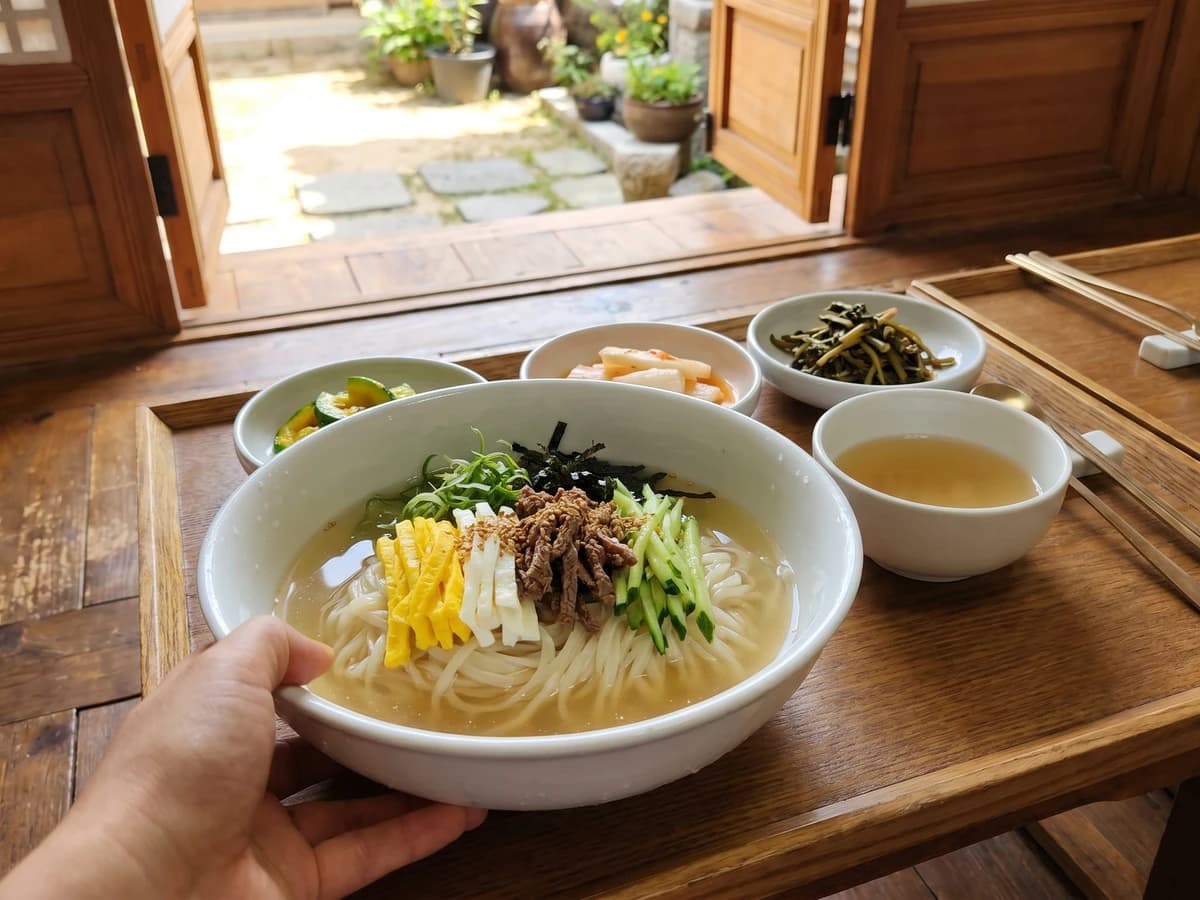
Andong's guest noodles, wheat and roasted soybean flour rolled thin, boiled and rinsed cold, then set in a clear chilled anchovy broth with careful strips of beef, egg, and cucumber.

Chef Jeong-sun
Andong's ritual-table rice served on an ordinary day: separate soy-sesame namul, warm rice, and clear radish soup, mixed without gochujang so every vegetable keeps its own voice.