
Chef Jeong-sun
Agwi-jjigae (Monkfish Stew)
A Masan coast monkfish stew with firm white meat, gelatin at the bones, soybean sprouts for crunch, and a red broth seasoned to carry the fish, not bury it.
A cooking platform built around craft, culture, and the stories behind what we eat.
Created by
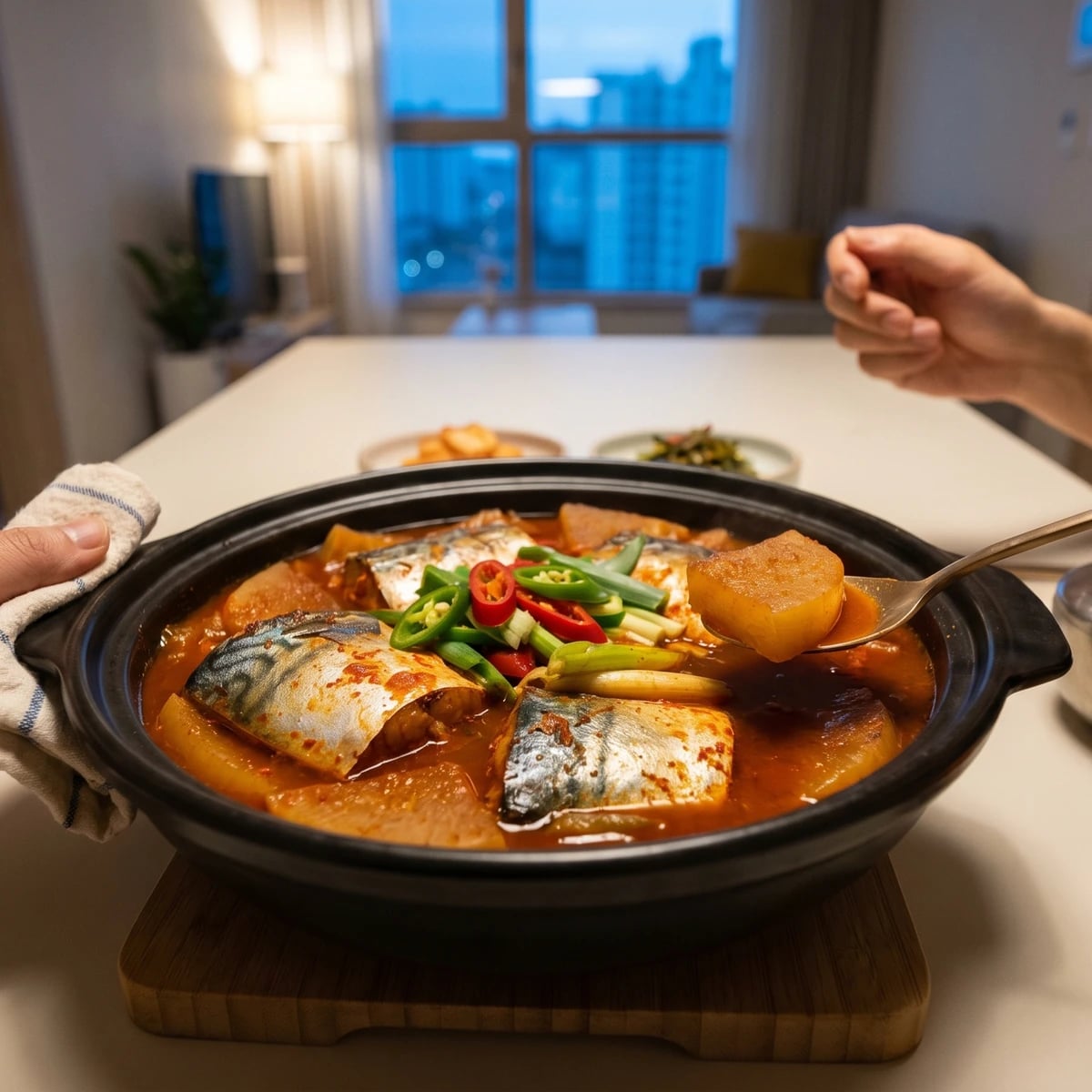
A weeknight mackerel stew built on thick Korean radish, spicy gochugaru broth, and a fish strong enough to carry chili without disappearing under it.
Autumn mackerel is the one to buy, when the fish has fed well and the flesh is rich enough to stand up to chili, garlic, and a pot of rice. At the market I look for clear eyes, tight skin, and a clean sea smell. If the fish smells tired, don't argue with it. Cook the month you're standing in, and choose another dish.
Godeungeo-jjigae lives or dies by the order of the pot. Radish goes underneath, cut thick, because it needs time to soften and it protects the fish from direct heat. The mackerel goes on top and is simmered, not stirred to pieces. The broth is bold with gochugaru (Korean chili flakes), ganjang (soy sauce), garlic, ginger, and a spoon of gochujang if you want depth, but not so much that every bite tastes only red.
My teacher Master Seong-nyeo made us ladle broth over the fish instead of turning it. She said a broken fish teaches the cook impatience. I wrote that down in Notebook 19 with the measure beside it: 2 cups broth for 700 grams fish, enough to cook the radish and baste the mackerel without drowning it. 손맛 is real. I measure it anyway, so it can be handed on.
Godeungeo, mackerel, has long been one of Korea's most practical blue-backed fish, abundant around southern and eastern waters and preserved by salting when fresh transport was limited. Godeungeo-jjigae and its thicker cousin godeungeo-mu-jorim belong to the everyday home table rather than court cooking, especially in port cities and markets where inexpensive oily fish could feed a family well. The radish is not filler; it reflects the Korean habit of using sturdy vegetables to absorb fish broth, chili, and soy so the pot becomes a full meal with rice.
Quantity
700g
cleaned and cut crosswise into 2-inch pieces
Quantity
1 teaspoon
for rinsing and seasoning the fish
Quantity
1 tablespoon
Quantity
450g
peeled and cut into 3/4-inch half-moons
Quantity
1/2 medium
sliced thick
Quantity
2 cups
Quantity
3 tablespoons
Quantity
2 tablespoons
Quantity
1 tablespoon
Quantity
1 tablespoon
Quantity
1 tablespoon
minced
Quantity
1 teaspoon
minced
Quantity
1 teaspoon
Quantity
1 tablespoon
Quantity
1
sliced on the diagonal
Quantity
1
sliced on the diagonal
Quantity
2
cut into 2-inch lengths
Quantity
1 teaspoon
Quantity
1 cup
cut into bite-size pieces
| Ingredient | Quantity |
|---|---|
| fresh mackerelcleaned and cut crosswise into 2-inch pieces | 700g |
| coarse sea saltfor rinsing and seasoning the fish | 1 teaspoon |
| rice wine or soju | 1 tablespoon |
| Korean radish (mu)peeled and cut into 3/4-inch half-moons | 450g |
| onionsliced thick | 1/2 medium |
| anchovy-kelp broth or water | 2 cups |
| gochugaru (Korean chili flakes) | 3 tablespoons |
| soy sauce (ganjang) | 2 tablespoons |
| fish sauce or soup soy sauce (guk-ganjang) | 1 tablespoon |
| gochujang (Korean chili paste) (optional) | 1 tablespoon |
| garlicminced | 1 tablespoon |
| gingerminced | 1 teaspoon |
| sugar | 1 teaspoon |
| doenjang (fermented soybean paste) (optional) | 1 tablespoon |
| green chilisliced on the diagonal | 1 |
| red chili (optional)sliced on the diagonal | 1 |
| scallionscut into 2-inch lengths | 2 |
| toasted sesame oil (optional) | 1 teaspoon |
| ripe napa cabbage kimchi (optional)cut into bite-size pieces | 1 cup |
Rinse the mackerel pieces under cold water, rubbing away any dark blood along the backbone. Sprinkle with 1 teaspoon coarse sea salt and 1 tablespoon rice wine or soju, then let sit 10 minutes. Rinse lightly and pat dry. This is not for perfume; it pulls away the stale fishiness that would muddy the broth.
In a small bowl, stir together the gochugaru, soy sauce, fish sauce or soup soy sauce, gochujang if using, garlic, ginger, sugar, and doenjang if using. Add 3 tablespoons of the broth to loosen it into a paste. Measure this. Too much gochujang makes the stew sweet and heavy; the clean heat should come mostly from gochugaru.
Lay the radish in the bottom of a wide shallow pot, then scatter the onion over it. Pour in the 2 cups broth and spoon half the seasoning paste over the vegetables. Bring to a boil over medium-high heat, then lower to a steady simmer and cook 12 minutes, until the radish edges begin to turn translucent. The radish must start first because it takes longer than the fish and becomes the best part of the pot.
Lay the mackerel pieces skin side up over the radish in one layer. Spoon the remaining seasoning paste over the fish. Do not bury the fish and do not stir. Cover and simmer 10 minutes, spooning broth over the top once or twice so the seasoning settles without breaking the flesh.
Uncover the pot and simmer another 8 to 10 minutes, basting the fish with the broth every few minutes. The liquid should reduce to a spicy, glossy broth that comes halfway up the fish, not a dry glaze and not a soup. Taste the radish, not just the broth; when the radish is tender and seasoned through, the stew is ready.
Scatter the green chili, red chili if using, and scallions over the top. Simmer 1 more minute, then turn off the heat. Add the sesame oil only if the fish is very lean; oily autumn mackerel does not need help. Rest 5 minutes before serving so the broth settles into the radish.
Carry the pot to the table with hot rice. Give each person one piece of fish and several pieces of radish, then spoon broth over the rice. Watch for bones, especially with children or elders at the table. This is a weeknight stew, but it asks you to eat carefully.
1 serving (about 445g)
Culinary guides, cultural storytelling, and the editorial depth that makes cooking meaningful.
Discover Culinary Explorer
Chef Jeong-sun
A Masan coast monkfish stew with firm white meat, gelatin at the bones, soybean sprouts for crunch, and a red broth seasoned to carry the fish, not bury it.

Chef Jeong-sun
A Uijeongbu-born pot of sour kimchi, Spam, sausage, tofu, beans, and ramen, held together by anchovy-kelp broth and a measured seasoning paste so the stew tastes like more than salt.

Chef Jeong-sun
Thin brisket seared until the edges brown, then simmered with doenjang, tofu, zucchini, and chilies; a weeknight soybean paste stew made richer by beef fat, not heavier.

Chef Jeong-sun
A loud, nutty soybean stew for weeknights, built on anchovy-kelp broth, sour kimchi, tofu, and cheonggukjang stirred in off the boil so its fast-fermented character stays clear.