
Chef Jeong-sun
Aehobak-guk (애호박국, Korean Zucchini Soup)
A clean summer soup of Korean zucchini and salted shrimp, built on quick anchovy-kelp broth and finished before the half-moons lose their shape on a weeknight table.
A cooking platform built around craft, culture, and the stories behind what we eat.
Created by
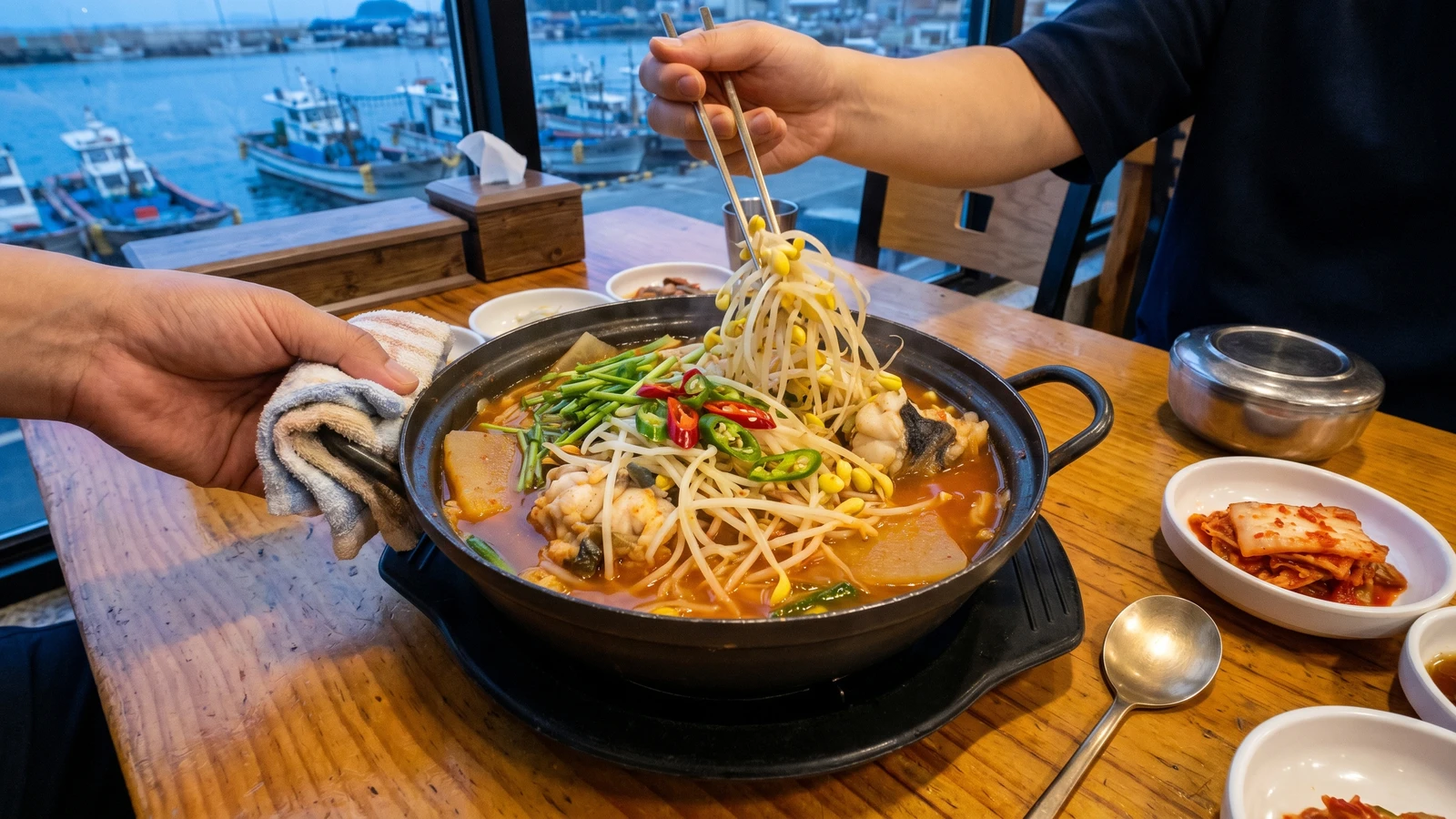
A Masan coast monkfish stew with firm white meat, gelatin at the bones, soybean sprouts for crunch, and a red broth seasoned to carry the fish, not bury it.
At the fish market, agwi looks like a joke someone played on a cook: broad mouth, loose skin, not much beauty. Then you put it in a pot and it gives you firm tail meat, sweet broth, and gelatin that makes the spoon feel rich. The ugly fish earns its place honestly.
This stew lives or dies by cleaning and timing. Rinse the monkfish well, blanch it briefly, and skim the broth so the pot tastes clean, not muddy. Soybean sprouts go in late enough to keep their crunch. Minari (water dropwort) goes in at the end, because its green bitterness is a finish, not a vegetable to punish.
Do not turn this into a pot of chili paste. Gochugaru gives the stew its color and lift; a small spoon of gochujang rounds the broth, but too much makes every fish stew taste the same. Let it taste like itself. Notebook 41 says the first bowl is for rice, the second is for arguing over the last piece of tail.
Masan, now part of Changwon in South Gyeongsang Province, is closely tied to agwi cooking, especially the spicy braised agwi-jjim that took shape around the port neighborhoods in the 1960s. Monkfish had once been treated as low-value bycatch, but Masan cooks turned its firm meat and collagen-rich bones into a local specialty. Agwi-jjigae keeps the same coastal logic in soup form: a spicy, generous pot built around an overlooked fish, soybean sprouts, and a broth strong enough for rice.
Quantity
800g
tail, bone, and skin pieces cleaned
Quantity
1 tablespoon
for washing
Quantity
6 cups
Quantity
1 piece, about 4 inches square
Quantity
10 large
heads and guts removed
Quantity
200g
cut into 1/4-inch half-moons
Quantity
300g
rinsed and drained
Quantity
1/2 medium
sliced
Quantity
120g
cut into wide pieces
Quantity
80g
cut into 2-inch lengths
Quantity
2
cut into 2-inch lengths
Quantity
1
sliced on the diagonal
Quantity
1
sliced on the diagonal
Quantity
3 tablespoons
Quantity
1 tablespoon
Quantity
1 tablespoon
Quantity
1 tablespoon
Quantity
1 tablespoon
minced
Quantity
1 teaspoon
minced
Quantity
1 teaspoon
Quantity
1 teaspoon
for finishing
Quantity
1/2 teaspoon
| Ingredient | Quantity |
|---|---|
| monkfish piecestail, bone, and skin pieces cleaned | 800g |
| coarse saltfor washing | 1 tablespoon |
| water | 6 cups |
| dried kelp (dasima) | 1 piece, about 4 inches square |
| dried anchovies (myeolchi)heads and guts removed | 10 large |
| Korean radish (mu)cut into 1/4-inch half-moons | 200g |
| soybean sprouts (kongnamul)rinsed and drained | 300g |
| onionsliced | 1/2 medium |
| napa cabbage leaves (optional)cut into wide pieces | 120g |
| minari (water dropwort)cut into 2-inch lengths | 80g |
| scallionscut into 2-inch lengths | 2 |
| green chilisliced on the diagonal | 1 |
| red chili (optional)sliced on the diagonal | 1 |
| gochugaru (Korean chili flakes) | 3 tablespoons |
| gochujang (Korean chili paste) | 1 tablespoon |
| soup soy sauce (guk-ganjang) | 1 tablespoon |
| fish sauce or salted shrimp liquid | 1 tablespoon |
| garlicminced | 1 tablespoon |
| gingerminced | 1 teaspoon |
| doenjang (fermented soybean paste) | 1 teaspoon |
| toasted sesame oil (optional)for finishing | 1 teaspoon |
| black pepper | 1/2 teaspoon |
Rub the monkfish pieces with the coarse salt, especially around the skin and bone, then rinse under cold water until the water runs clear. Bring a small pot of water to a boil, blanch the fish for 45 seconds, and rinse again. This is not fussing. Monkfish carries slime on the skin, and if you skip this, the stew tastes cloudy before it ever has a chance.
Put 6 cups water, the kelp, and the prepared anchovies in a wide pot. Bring to a gentle simmer over medium heat. Pull the kelp out as soon as the water simmers, because kelp left too long turns the broth slick and bitter. Simmer the anchovies 10 minutes more, then remove them. Add the radish and simmer 6 minutes, until the edges begin to turn translucent.
In a small bowl, stir together the gochugaru, gochujang, soup soy sauce, fish sauce or salted shrimp liquid, garlic, ginger, doenjang, and black pepper. Use only 1 tablespoon gochujang. It gives body, but more than that makes the stew sweet and heavy, and the monkfish disappears.
Stir the seasoning paste into the radish broth until it loosens. Add the monkfish pieces and onion, spooning broth over the fish so the seasoning reaches every piece. Simmer uncovered for 12 to 14 minutes, skimming once or twice. The fish is ready when the thickest piece turns opaque and firm, and the flesh pulls cleanly from the bone.
Pile the soybean sprouts and napa cabbage, if using, over the fish. Cover the pot and cook 5 minutes without lifting the lid. Soybean sprouts have a temper: cook them covered the whole time or uncovered the whole time. Halfway checking gives them that raw bean smell everyone remembers for the wrong reason.
Uncover the pot, fold the sprouts gently into the broth, and taste. Add a teaspoon or two of soup soy sauce only if the broth needs salt. Scatter in the minari, scallions, green chili, and red chili, then simmer 1 minute. The minari should bend and stay green. Turn off the heat and add the sesame oil only if your fish is very lean.
Carry the pot to the table with rice and mild banchan. Give each bowl broth, sprouts, radish, and a piece of fish, not just the pretty tail pieces. The gelatin near the bone is part of the dish, and someone at the table knows to look for it.
1 serving (about 650g)
Culinary guides, cultural storytelling, and the editorial depth that makes cooking meaningful.
Discover Culinary ExplorerChef Jeong-sun
A clean summer soup of Korean zucchini and salted shrimp, built on quick anchovy-kelp broth and finished before the half-moons lose their shape on a weeknight table.

Chef Jeong-sun
A weeknight fish roe stew with radish and crown daisy in a clean spicy broth, where the whole success depends on adding the roe late enough that it sets tender, not chalky.

Chef Jeong-sun
Late-summer mallow leaves rubbed with salt until the bitter green water runs off, then simmered in a clean doenjang broth with dried shrimp, the quiet soup a Korean weeknight deserves.

Chef Jeong-sun
A wide shallow pot of autumn mushrooms, thin beef, tofu, and clear anchovy-kelp broth, arranged by color first and simmered at the table so every mushroom still tastes like itself.