Chef Elsa
Almjause (Alpine Hut Snack Board)
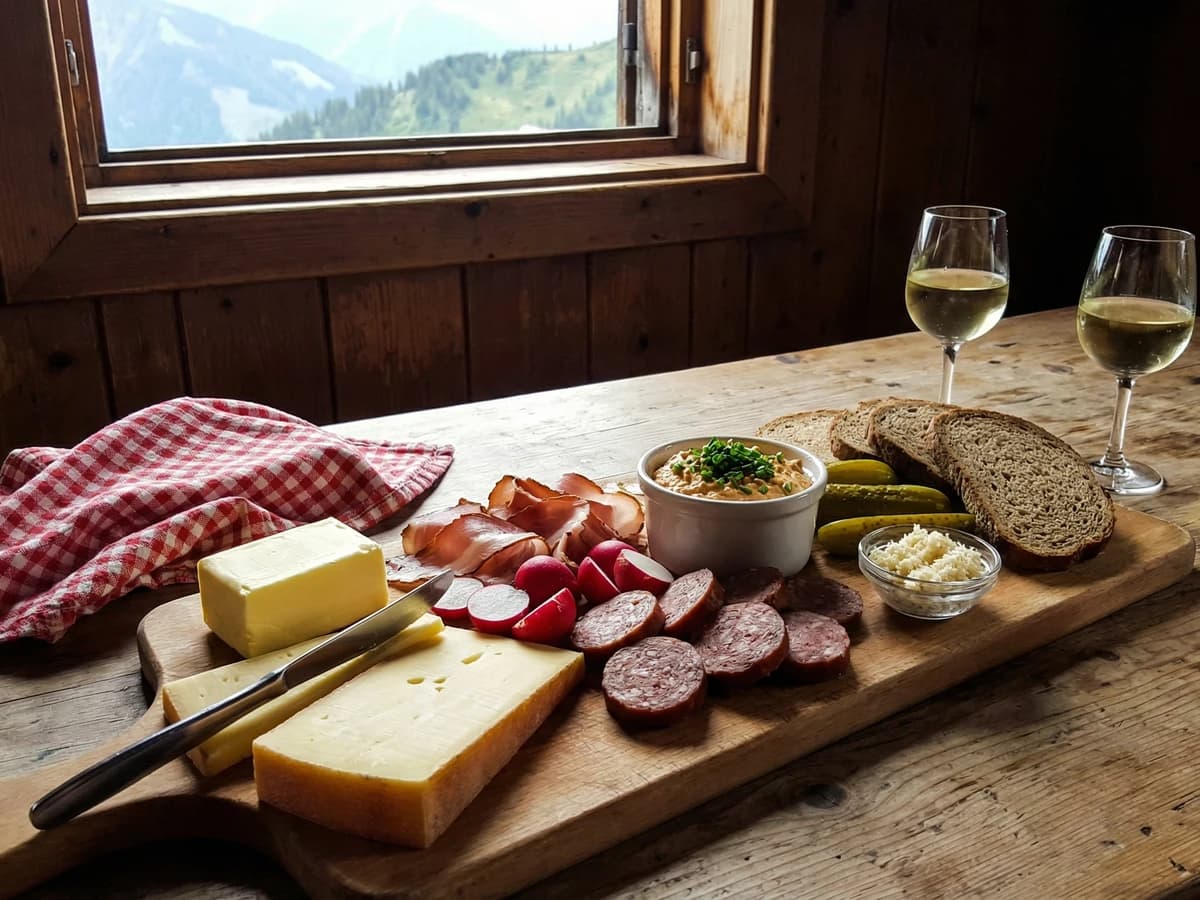
A wooden board loaded with mountain cheese, juniper-smoked Speck, air-dried Hauswürstel, handmade Liptauer, fresh Kren, and thick-cut Bauernbrot, the way Austrian Almhütten have fed hikers for generations.
A cooking platform built around craft, culture, and the stories behind what we eat.

Created by
Salt-cured, hot-smoked Austrian pork sliced thin as a promise and served cold on dark bread with freshly grated Apfelkren that bites back. The anchor of every Brettljause worth sitting down to.
On the childhood trips to Austria with Gretel and my grandmother Eva, the first thing we'd eat after arriving was always a Brettljause. Not at a restaurant. At a Heuriger or a Buschenschank, somewhere with wooden benches and grape vines growing overhead, where a woman in an apron would carry out a board so loaded with smoked meat and pickles and bread that the table groaned under it. The Geselchtes was always the centerpiece. Thin slices of cold smoked pork, pink and glistening, with a pile of freshly grated Kren so sharp it made your eyes water before you'd even tasted it.
Geselchtes is one of those Austrian preparations that lives or dies on the quality of what you start with. The word itself comes from Selchen, to smoke, and it describes pork that has been salt-cured and then hot-smoked, usually over beechwood. The process takes days at the butcher's. Your job at home is simpler: you simmer the whole piece gently, let it cool in its own liquid, then slice it thin and serve it cold with Apfelkren, dark bread, and sweet mustard. That's the whole recipe. The skill is in understanding why each of those steps matters.
I serve a version of this at my restaurant in Salzburg as the opening to our Brettljause board, and people always ask what's in the horseradish. It's Apfelkren, horseradish mixed with grated apple, and it's a trick as old as the hills around the Salzkammergut. The apple softens the raw heat of the Kren just enough that you can taste the floral sharpness underneath instead of just feeling the burn. Good Geselchtes with good Apfelkren and a slab of Bauernbrot is honest food. It doesn't need anything else.
Selchen, the practice of smoking pork to preserve it through Alpine winters, is one of Austria's oldest food traditions. Every farming region had its own Selchkammer, a smoking chamber built into the farmhouse, where pork from the autumn slaughter was cured in salt and smoked slowly over weeks. The tradition survives commercially today in Austrian butcher shops and Fleischhauereien, where Geselchtes remains a staple you can buy by the piece. The Brettljause, the cold board of smoked meats, cheeses, spreads, and pickles served at Heurigen and Buschenschanken, became formalized in the 18th century when Emperor Josef II granted Austrian vintners the right to sell their own wine and serve simple food alongside it.
Quantity
800g
in one piece
Quantity
2
Quantity
6
Quantity
4
lightly crushed
Quantity
1 medium
halved
Quantity
1 piece, about 15cm
Quantity
1
Quantity
1 tablespoon
Quantity
pinch
Quantity
pinch
Quantity
for serving
thickly sliced
Quantity
for serving
Quantity
for serving
| Ingredient | Quantity |
|---|---|
| Geselchtes (Austrian smoked pork loin or leg)in one piece | 800g |
| bay leaves | 2 |
| whole black peppercorns | 6 |
| juniper berrieslightly crushed | 4 |
| onionhalved | 1 medium |
| fresh horseradish root | 1 piece, about 15cm |
| tart apple (Boskop or Granny Smith) | 1 |
| lemon juice | 1 tablespoon |
| sugar | pinch |
| salt | pinch |
| dark rye bread (Bauernbrot)thickly sliced | for serving |
| cornichons or pickled gherkins | for serving |
| Kremser Senf (sweet Austrian mustard) | for serving |
Place the whole piece of Geselchtes in a pot just large enough to hold it comfortably. Cover with cold water by about three centimeters. Add the bay leaves, peppercorns, crushed juniper berries, and halved onion. Don't add salt. The meat is already cured and salted, and you'll only make it tough and overseasoned. Bring to a gentle simmer over medium heat. The moment you see lazy bubbles, lower the flame. You want a bare tremor on the surface, not a rolling boil.
Let the Geselchtes simmer gently for about an hour and a half. The timing depends on the thickness of your piece, not the weight. A flat piece from the leg will cook faster than a thick rolled loin. You'll know it's done when a skewer slides into the center with almost no resistance. The meat should feel yielding but not falling apart. If you have a thermometer, you're looking for 72°C at the center.
Turn off the heat and let the Geselchtes cool in its cooking liquid. This is not a shortcut you can skip. As the meat cools slowly, it reabsorbs some of the liquid it released during cooking. Pull it out hot and it dries out on your cutting board. Leave it in the pot for at least two hours, or better, let it sit overnight in the fridge. The flavor deepens and the texture sets properly for clean slicing.
Peel the horseradish root and grate it finely. Do this near an open window or you'll find out fast why Austrian cooks call Kren the vegetable that bites back. The fumes are sharper than any onion. Peel and coarsely grate the apple. Mix the horseradish and apple together immediately with the lemon juice, a pinch of sugar, and a pinch of salt. The apple tames the horseradish just enough to let the flavor through without taking the top of your head off. The lemon keeps it bright and stops the apple browning.
Remove the Geselchtes from its liquid and pat it dry. With a sharp knife, slice it against the grain as thinly as you can manage. Three to four millimeters is ideal. The slices should be translucent at the edges, with a rosy pink center and a darker, smoky ring near the outside where the cure and smoke penetrated deepest. If the slices are thick and ragged, your knife is dull. Sharpen it before you start.
Lay the sliced Geselchtes across a wooden board, overlapping the slices slightly so the rosy color fans out. Place a generous mound of Apfelkren beside it. Add thick slices of dark Bauernbrot, a few cornichons, and a small dish of Kremser Senf. That's it. No decoration, no garnish, no fuss. The Austrians call this a Brettljause, a board snack, and it's meant to look like someone who knows good food laid it out for friends. Mahlzeit!
1 serving (about 280g)
Culinary guides, cultural storytelling, and the editorial depth that makes cooking meaningful.
Discover Culinary ExplorerChef Elsa
A wooden board loaded with mountain cheese, juniper-smoked Speck, air-dried Hauswürstel, handmade Liptauer, fresh Kren, and thick-cut Bauernbrot, the way Austrian Almhütten have fed hikers for generations.

Chef Elsa
Dark, spiced, and wickedly good: Blunzn mashed with onion, mustard, and marjoram into the kind of spread that disappears first from every Heuriger Brettl, scooped up on torn hunks of dark bread.

Chef Elsa
A silky potato and sour cream spread with raw onion and paprika, piled onto dark rye bread the way they serve it at every Heuriger in Lower Austria. No cheese, despite the name. Just good potatoes and honest cooking.
Chef Elsa
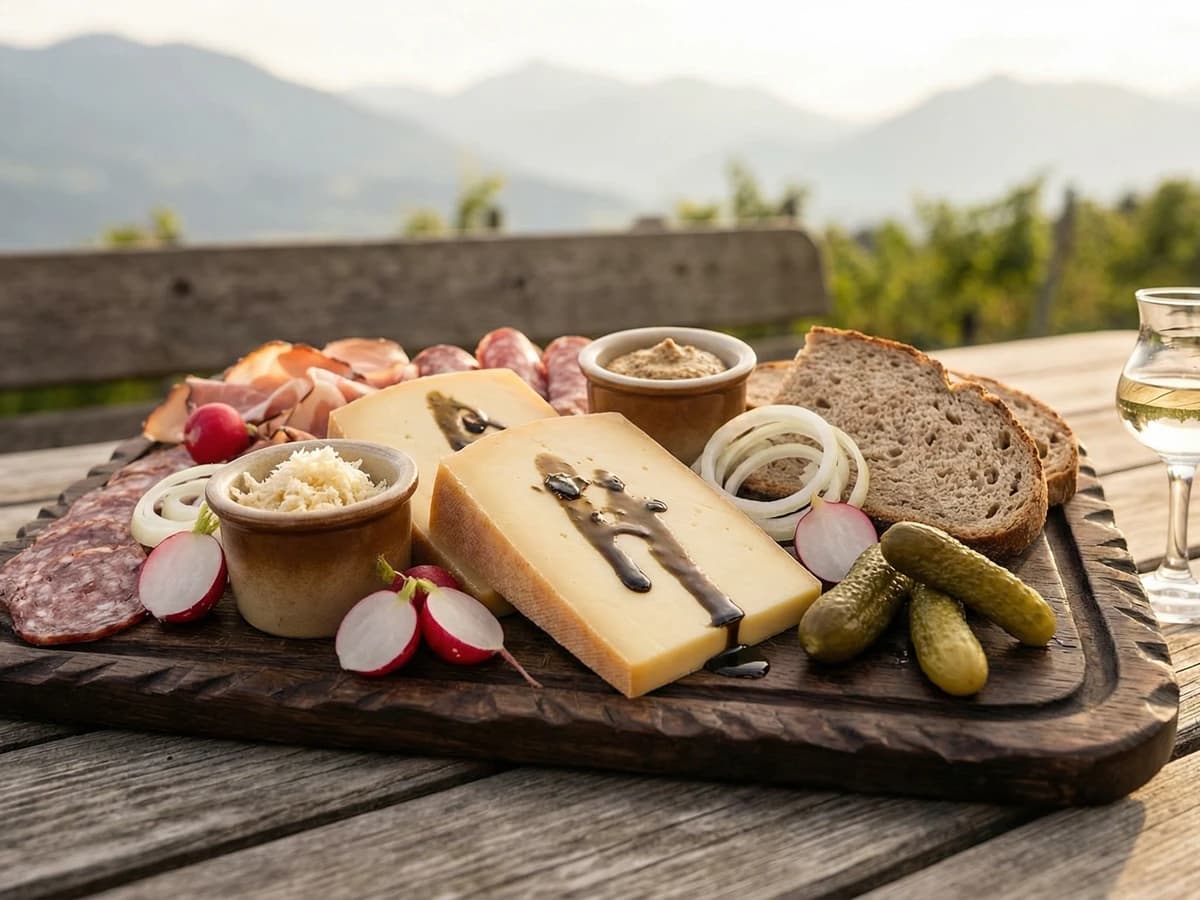
A proper Carinthian Brettljause built around PDO Gailtaler Almkäse, nutty raw-milk alpine cheese served with Speck, dark Bauernbrot, pickles, fresh horseradish, and everything you need for an afternoon on an Almhütte terrace.