Culinary Explorer

A cooking platform built around craft, culture, and the stories behind what we eat.
Discover Culinary Explorer
Gebackene Champignons

Gebackene Champignons

Created by

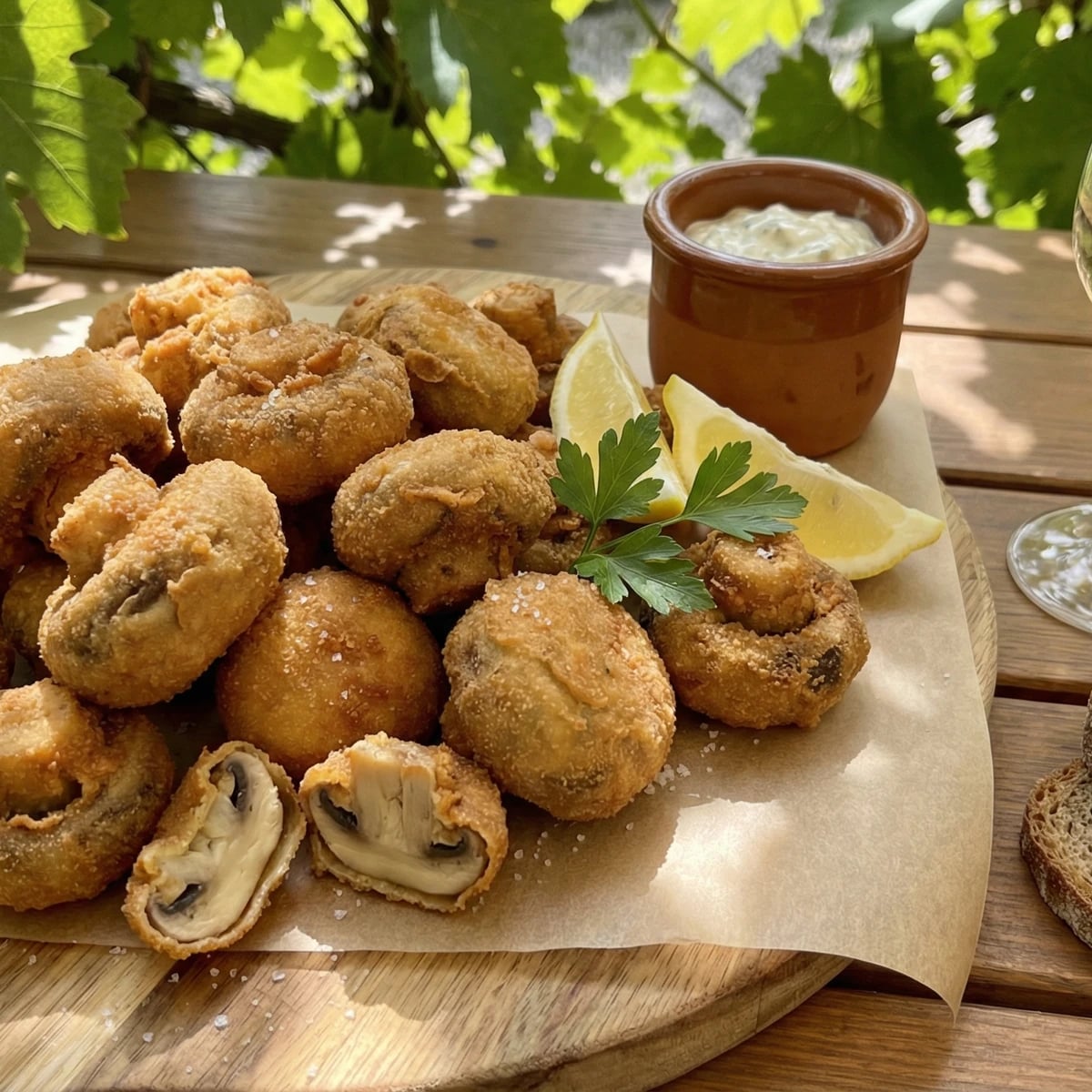
Whole mushrooms breaded in the Viennese way and fried until the crust shatters and the inside stays tender and juicy. The same Panier that makes Schnitzel famous, put to work on a humble champignon.

Appetizers & Snacks
Austrian
Dinner Party
Comfort Food
25 min
Active Time
15 min cook40 min total
Yield4 servings

Every Austrian Beisl has a version of this on the menu, and every regular has an opinion about whose is best. Gebackene Champignons are the quiet proof that the Wiener Panier, that sacred three-step breading of flour, egg, and breadcrumbs, doesn't belong to Schnitzel alone. It belongs to anything brave enough to be fried in hot fat and eaten with your fingers at a Heuriger table while the wine is still cold.

I first had these as a child at a Buschenschank outside Vienna, one of those annual trips with Gretel and my grandmother Eva. The mushrooms arrived on a wooden board, golden and piled high, with a little bowl of tartare sauce and a wedge of lemon. I remember being amazed that something so simple could taste that good. The crust crackled when you bit through it and the mushroom inside was soft and almost creamy, having steamed gently inside its breadcrumb shell. Gretel always said the Viennese figured out long ago that if you bread something properly and fry it in enough fat, you can make anything taste like a celebration.

The technique is identical to Wiener Schnitzel. Flour first, to give the egg something to grip. Egg next, to glue the breadcrumbs on. Fine breadcrumbs last, pressed gently, never packed. Then into hot fat, enough that the mushrooms float and the crust puffs away from the surface. If the breading lies flat and greasy against the mushroom, your oil wasn't hot enough or you didn't use enough of it. This is not health food. This is good Austrian cooking, honest about what it is.

The Wiener Panier, Austria's signature breading technique, traces its origins to the Milanese cotoletta brought north through Habsburg-controlled Lombardy in the 19th century, though Viennese cooks will argue their version came first. Once the technique took hold in Vienna, it spread beyond veal to fish, vegetables, and cheese. Gebackene Champignons became a staple of Beisl and Heuriger menus in the mid-20th century, part of the Viennese tradition of gebackene Speisen, fried dishes served as appetizers or light meals alongside white wine and bread.

The technique, the tradition, and the story behind every dish.

Discover Culinary Explorer

Ingredients

white button mushrooms

Quantity

500g

whole, medium-sized (3-4cm)

plain flour

Quantity

100g

eggs

Quantity

3 large

beaten

fine dry breadcrumbs (Semmelbrösel)

Quantity

150g

salt

Quantity

to taste

freshly ground black pepper

Quantity

to taste

vegetable oil or clarified butter

Quantity

about 1 liter

for deep-frying

lemon

Quantity

1

cut into wedges

mayonnaise

Quantity

200g

cornichons

Quantity

2 tablespoons

finely chopped

capers

Quantity

1 tablespoon

drained and finely chopped

fresh flat-leaf parsley

Quantity

1 tablespoon

finely chopped

Dijon mustard

Quantity

1 teaspoon

lemon juice

Quantity

1 teaspoon

salt and white pepper

Quantity

to taste

Equipment Needed

  • Deep heavy-bottomed pot or deep-fryer
  • Kitchen thermometer
  • Slotted spoon or spider strainer
  • Wire cooling rack
  • Three shallow bowls for breading station

Instructions

  1. 1

    Prepare the mushrooms

    Clean the mushrooms with a dry brush or a lightly damp cloth. Do not wash them under running water. Mushrooms are little sponges and if they absorb water, the breading will slide off in the pan and you'll be left standing there wondering what went wrong. Trim the very end of each stem but leave the stems attached. You want whole mushrooms, not caps. The stem gives you something to hold when you eat them and it keeps the mushroom's shape intact during frying. Pat them completely dry with kitchen paper.

    Choose mushrooms that are firm and tightly closed, with no dark gills showing underneath the cap. Open, flat mushrooms have too much moisture and won't fry cleanly.
  2. 2

    Make the tartare sauce

    Stir together the mayonnaise, chopped cornichons, capers, parsley, mustard, and lemon juice. Season with salt and a little white pepper. Taste it. The sauce should be sharp and tangy, a proper counterpoint to the rich fried mushrooms. If it tastes bland, add more cornichon or a second squeeze of lemon. Cover and refrigerate until serving. It's better after thirty minutes in the fridge, when the flavors have had time to settle into each other.

    Some Austrian cooks add a clove of finely grated garlic to the sauce. If you love garlic, go ahead. If you're serving these at a dinner party, let your guests decide for themselves.
  3. 3

    Set up the breading station

    Line up three shallow bowls. Flour in the first, seasoned with a good pinch of salt and pepper. Beaten eggs in the second. Fine breadcrumbs in the third. This is the Wiener Panier, the same three-step breading used for Schnitzel, and the order matters. The flour creates a dry surface for the egg to cling to. The egg acts as glue for the breadcrumbs. Skip a step and the whole coating falls apart in the oil.

    Use Semmelbrösel, the fine dry breadcrumbs made from stale Semmeln (Austrian bread rolls), if you can find them. They fry up lighter and crispier than the coarse breadcrumbs sold in most supermarkets. If you can't find them, blitz regular dry breadcrumbs in a food processor until fine.
  4. 4

    Bread the mushrooms

    Take each mushroom and roll it in the flour, shaking off the excess. Then dip it into the beaten egg, letting any extra drip away. Finally, roll it gently through the breadcrumbs, turning to coat evenly. Press the crumbs on lightly with your fingertips but don't pack them tight. You want a coating that will puff and lift away from the mushroom in the hot oil, not a compressed shell that clings and goes heavy. Set the breaded mushrooms on a wire rack as you go. They can sit for up to twenty minutes before frying, which actually helps the coating set.

  5. 5

    Heat the oil

    Pour the oil into a deep, heavy-bottomed pot or a deep-fryer and heat it to 170°C (340°F). Use a thermometer. Guessing the temperature is how people end up with greasy, pale mushrooms or burnt ones. The oil needs to be deep enough that the mushrooms can float freely. If they sit on the bottom of the pot, the underside goes flat and you lose that beautiful all-around golden crust.

    170°C is slightly lower than you'd use for Schnitzel. Mushrooms are smaller and denser, and the breading browns faster at high heat before the inside has a chance to cook through. A little patience here gives you a better result.
  6. 6

    Fry until golden

    Lower the mushrooms into the hot oil in batches of six or seven. Don't crowd the pot. Too many mushrooms at once drops the oil temperature and you end up with soggy, oil-logged breading instead of crisp. Fry for three to four minutes, turning them gently with a slotted spoon if they don't roll on their own. When the crust is an even, deep golden brown all over and the surface looks dry and crisp, lift them out and drain on kitchen paper. Season with a light sprinkle of fine salt while they're still hot. The salt sticks better on a hot surface.

    Let the oil come back to 170°C between batches. This takes a minute or two. Rushing the next batch in while the oil is recovering is the most common mistake.
  7. 7

    Serve immediately

    Pile the fried mushrooms onto a wooden board or a warm plate lined with a paper napkin. Tuck lemon wedges around the edges and set the tartare sauce alongside in a small bowl. Serve while the crust is still crackling. These wait for nobody. The moment they cool, the trapped moisture inside the mushroom softens the breading, and you lose that shattering first bite. Get them to the table fast. Mahlzeit!

Chef Tips

  • Buy your mushrooms the day you make this. Fresh, firm mushrooms with tightly closed caps are the difference between a crisp result and a soggy one. If the gills are showing underneath, the mushroom has too much moisture and the breading won't hold.
  • One hand for dry ingredients, one hand for wet. Use your left hand for flour and breadcrumbs, your right hand for egg. Otherwise you end up with enormous lumpy gloves of breading on your fingers and nothing on the mushrooms. Gretel always said this is the only real technique in Austrian breading: managing your hands.
  • If you want to be truly Austrian about it, serve these with a cold Achterl of Grüner Veltliner. The wine's crisp acidity cuts right through the richness of the fried breading. That combination is why Heuriger food exists.
  • Leftover tartare sauce keeps in the fridge for three days and goes beautifully with cold cuts, boiled eggs, or spread on dark bread. Don't throw it away.

Advance Preparation

  • The tartare sauce can be made a day ahead and refrigerated. The flavor improves overnight as the cornichons and capers season the mayonnaise.
  • Mushrooms can be breaded up to twenty minutes before frying. Set them on a wire rack so the coating doesn't go soggy on the bottom. Do not bread them further ahead than that, or the moisture from the mushrooms will work through the flour layer.
  • Gebackene Champignons cannot be reheated successfully. Fry them and eat them. That's the deal.

Frequently Asked Questions

Nutrition Information

1 serving (about 220g)

Calories
840 calories
Total Fat
64 g
Saturated Fat
10 g
Trans Fat
0 g
Unsaturated Fat
53 g
Cholesterol
160 mg
Sodium
1300 mg
Total Carbohydrates
51 g
Dietary Fiber
4 g
Sugars
5 g
Protein
17 g

Note: Chef personas and recipes are created with AI assistance. Cook with care: follow safe food-handling practices, check doneness with a thermometer when needed, and adapt for allergies and your kitchen.

Where cooking meets culture.

Culinary guides, cultural storytelling, and the editorial depth that makes cooking meaningful.

Discover Culinary Explorer

More from Austrian Jause & Brettljause

Browse the full collection