Culinary Explorer
A cooking platform built around craft, culture, and the stories behind what we eat.
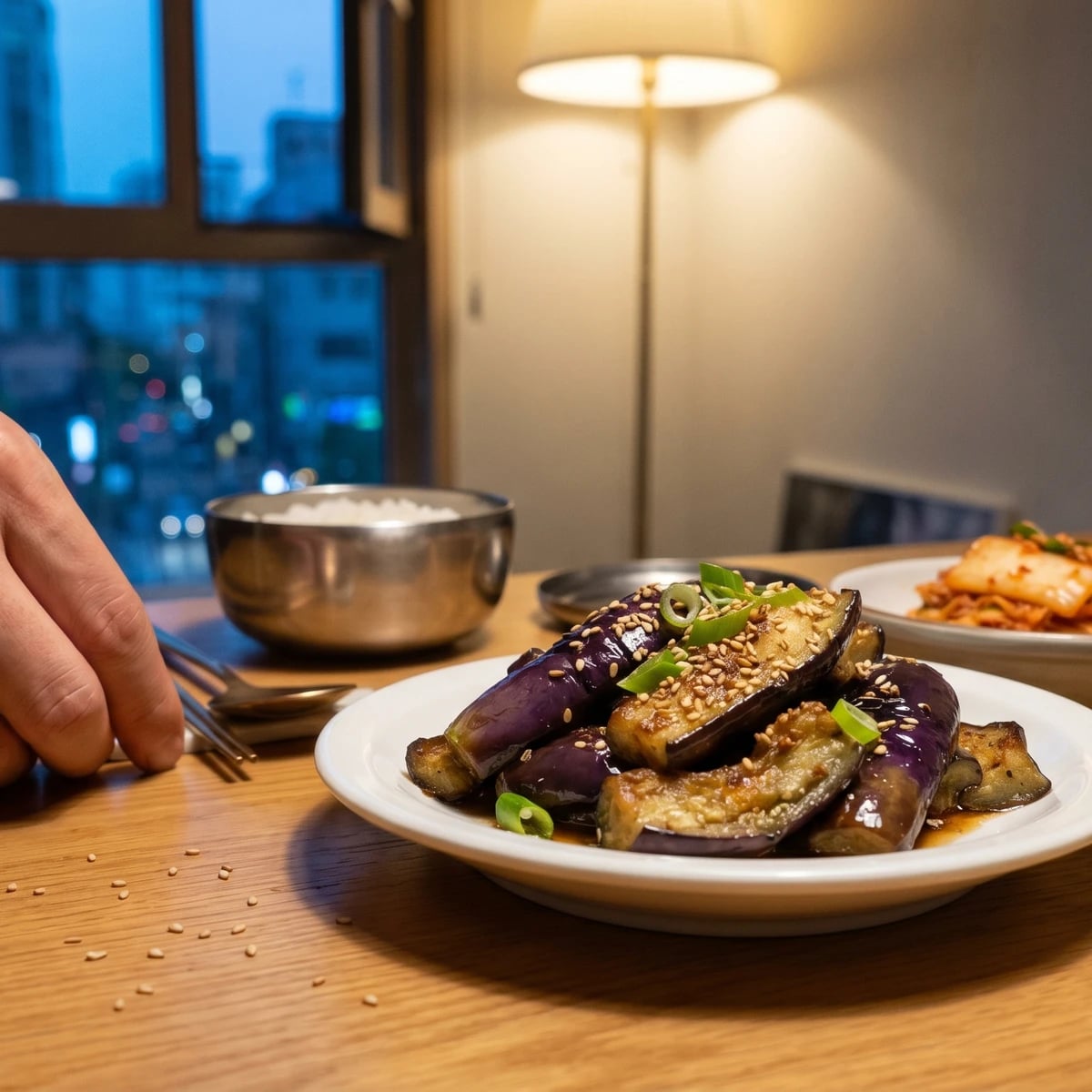
Gaji-bokkeum (Stir-Fried Eggplant)
Created by Chef Jeong-sun
Silky summer eggplant browned in a hot pan, seasoned with soy, garlic, scallion, and sesame so it stays clearly itself, not collapsed into salty mush.
Gaji-bokkeum lives or dies in the first three minutes. Eggplant is thirsty, soft-hearted, and quick to forgive nobody. Crowd the pan and it gives up water, turning gray and limp before the soy sauce even has a chance to do its work. Give it heat and room, and the cut sides brown while the middle turns silky.
This is not a grand dish. It is a summer banchan (side dish), the kind that appears beside rice, soup, and kimchi on a Tuesday night because the market had eggplant stacked cheap and glossy that morning. My teacher Master Seong-nyeo made us cut every piece to the same thickness before she let the pan touch the stove. I thought she was being severe. She was, but she was also right: uneven eggplant cooks into three dishes at once, raw, browned, and mush.
Use just enough soy to season, not drown. Eggplant should taste like eggplant, with garlic behind it and sesame oil at the end, never cooked hard until it loses its fragrance. 손맛 is real. I still measure it, so it can be handed on. Tonight this dish asks for a sharp knife, a wide pan, and the discipline to cook in two batches if your pan is small.
Ingredients
Korean or Japanese eggplants
Quantity
450g, about 3 medium
trimmed and cut into 2-inch batons
kosher salt
Quantity
1 teaspoon
for drawing moisture from the eggplant
neutral oil
Quantity
1 1/2 tablespoons
divided
| Ingredient | Quantity |
|---|---|
| Korean or Japanese eggplantstrimmed and cut into 2-inch batons | 450g, about 3 medium |
| kosher saltfor drawing moisture from the eggplant | 1 teaspoon |
| neutral oildivided | 1 1/2 tablespoons |
Where cooking meets culture.
Culinary guides, cultural storytelling, and the editorial depth that makes cooking meaningful.
Discover Culinary Explorer