
Chef Jeong-sun
Agwi-jjim (Braised Monkfish with Bean Sprouts)
Firm monkfish buried under crisp soybean sprouts, minari, and a red gochugaru sauce thickened at the end; Masan's market dish asks for heat, timing, and a steady hand.
A cooking platform built around craft, culture, and the stories behind what we eat.

Created by
Small flounder braised over sweet radish in soy, gochugaru, garlic, and scallion, cooked gently so the thin flesh stays whole while the sauce reduces enough to cling.
Gajami-jorim begins at the fish stall, not at the stove. Look for small whole flounder with clear eyes, firm flesh, and a clean sea smell, because this is not a dish that hides poor fish under chili. Cook the month you're standing in, but in many Korean markets flatfish are at their best when the water is cold and the flesh is tight.
My mother made this on ordinary nights, when one fish and one thick Korean radish could feed the table properly. The radish is not filler. It is the second reason to make the dish. It sits under the fish, gives up sweetness, drinks in the soy and gochugaru, and becomes the piece everyone reaches for after the fish is gone.
The technique is simple and unforgiving: cook the radish first, lay the fish on top, then spoon the sauce over it instead of turning it like meat. Flatfish is thin. If you shake the pan too much, you get broken bones and tired flesh. Measure the sauce, reduce it until glossy, and taste before you add more heat or salt. 손맛 is real; I measure it anyway, so the next cook does not have to guess.
Jorim is a practical Korean home-cooking method, a shallow braise in soy-based seasoning used for fish, tofu, beef, potatoes, and whatever needed to stretch across rice. Gajami, a small flatfish common in coastal markets, especially along the East Sea, became a natural weeknight jorim fish because it cooks quickly and was often cheaper than larger table fish. The dish belongs to ordinary home tables and market cooking, not court records, and its worth is exactly there.
Quantity
2 fish, about 600 to 700g total
Quantity
1/2 teaspoon
for salting the fish
Quantity
1 tablespoon
for rubbing the fish
Quantity
450g
peeled and cut into 1/2-inch thick half-moons
Quantity
1/2 medium
sliced thick
Quantity
1 cup
Quantity
4 tablespoons
Quantity
2 tablespoons
Quantity
1 tablespoon
Quantity
1 tablespoon
minced
Quantity
1 teaspoon
minced
Quantity
2 teaspoons
Quantity
1 teaspoon
Quantity
1/4 teaspoon
Quantity
1
sliced on the diagonal
Quantity
1
sliced on the diagonal
Quantity
2
cut into 2-inch lengths
Quantity
1 teaspoon
| Ingredient | Quantity |
|---|---|
| small whole cleaned flounder or sole | 2 fish, about 600 to 700g total |
| kosher saltfor salting the fish | 1/2 teaspoon |
| rice wine or sojufor rubbing the fish | 1 tablespoon |
| Korean radish (mu)peeled and cut into 1/2-inch thick half-moons | 450g |
| onionsliced thick | 1/2 medium |
| anchovy-kelp broth or water | 1 cup |
| soy sauce | 4 tablespoons |
| gochugaru (Korean chili flakes) | 2 tablespoons |
| rice wine or mirin | 1 tablespoon |
| garlicminced | 1 tablespoon |
| gingerminced | 1 teaspoon |
| sugar or maesil-cheong (green plum syrup) | 2 teaspoons |
| toasted sesame oil | 1 teaspoon |
| black pepper | 1/4 teaspoon |
| green chilisliced on the diagonal | 1 |
| red chili (optional)sliced on the diagonal | 1 |
| scallionscut into 2-inch lengths | 2 |
| toasted sesame seeds | 1 teaspoon |
Rinse the flounder quickly under cold water, checking the belly cavity for any dark blood, then pat it very dry. Score each fish 2 or 3 times on both sides, just through the skin. Sprinkle with 1/2 teaspoon salt and rub with 1 tablespoon rice wine or soju. Let it stand 10 minutes, then pat dry again. This tightens the surface and keeps the braise clean instead of muddy.
In a small bowl, stir together the soy sauce, gochugaru, rice wine or mirin, garlic, ginger, sugar or maesil-cheong, sesame oil, and black pepper. Do not add gochujang here. Gajami-jorim should taste of fish, radish, soy, and chili flakes, not a thick sweet paste covering everything.
Lay the radish slices in a single layer in a wide shallow pan. Scatter the onion over them and pour in 1 cup anchovy-kelp broth or water. Spoon half the sauce over the radish. Cover and simmer over medium heat for 10 to 12 minutes, until the radish is beginning to turn translucent at the edges. The radish needs this head start because the fish will be finished long before a raw radish softens.
Set the fish over the radish in one layer, head to tail if needed so they fit. Spoon the remaining sauce over the scored skin. Do not stir. Cover and simmer 8 minutes over medium-low heat. The sauce should bubble steadily around the edges, not boil hard enough to break the fish.
Uncover the pan. Spoon the sauce over the fish every minute or so for another 6 to 8 minutes, tilting the pan to gather the liquid instead of moving the fish. Add the sliced chilies and scallions during the last 3 minutes. The fish is done when the flesh is opaque and lifts cleanly from the bone, and the sauce has reduced to a glossy spoon-coating braise.
Turn off the heat and let the pan sit 3 minutes. This small rest lets the fish settle so it does not fall apart on the way to the table. Scatter toasted sesame seeds over the top and serve with hot rice, spooning sauce and radish onto each bowl. The radish may be better than the fish. Nobody at my table ever admitted it, but the chopsticks told the truth.
1 serving (about 310g)
Culinary guides, cultural storytelling, and the editorial depth that makes cooking meaningful.
Discover Culinary ExplorerChef Jeong-sun
Firm monkfish buried under crisp soybean sprouts, minari, and a red gochugaru sauce thickened at the end; Masan's market dish asks for heat, timing, and a steady hand.

Chef Jeong-sun
A quick Korean rice bowl built on contrast: warm rice, cold popping flying-fish roe, chopped vegetables, gim, sesame oil, and the crisp rice bottom a hot stone bowl gives you.
Chef Jeong-sun
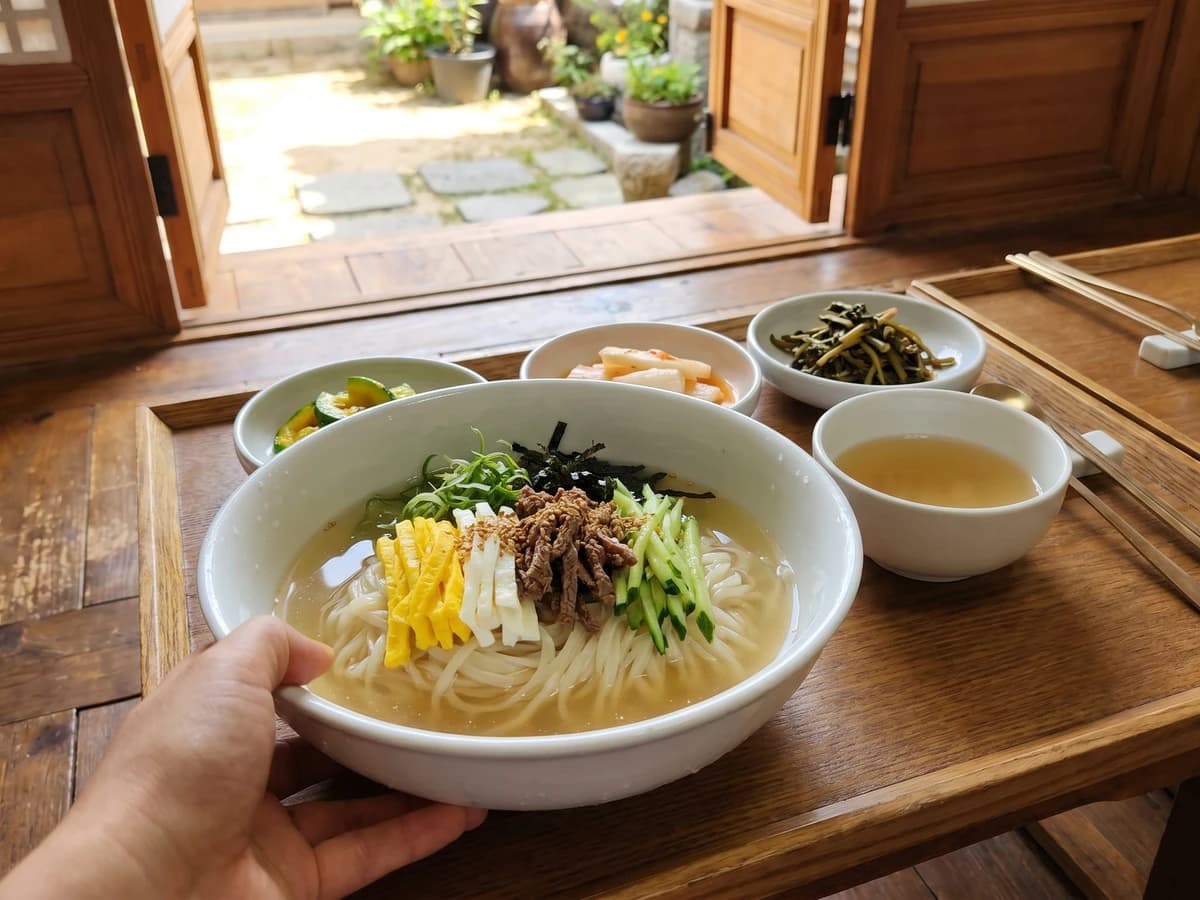
Andong's guest noodles, wheat and roasted soybean flour rolled thin, boiled and rinsed cold, then set in a clear chilled anchovy broth with careful strips of beef, egg, and cucumber.

Chef Jeong-sun
Andong's ritual-table rice served on an ordinary day: separate soy-sesame namul, warm rice, and clear radish soup, mixed without gochujang so every vegetable keeps its own voice.