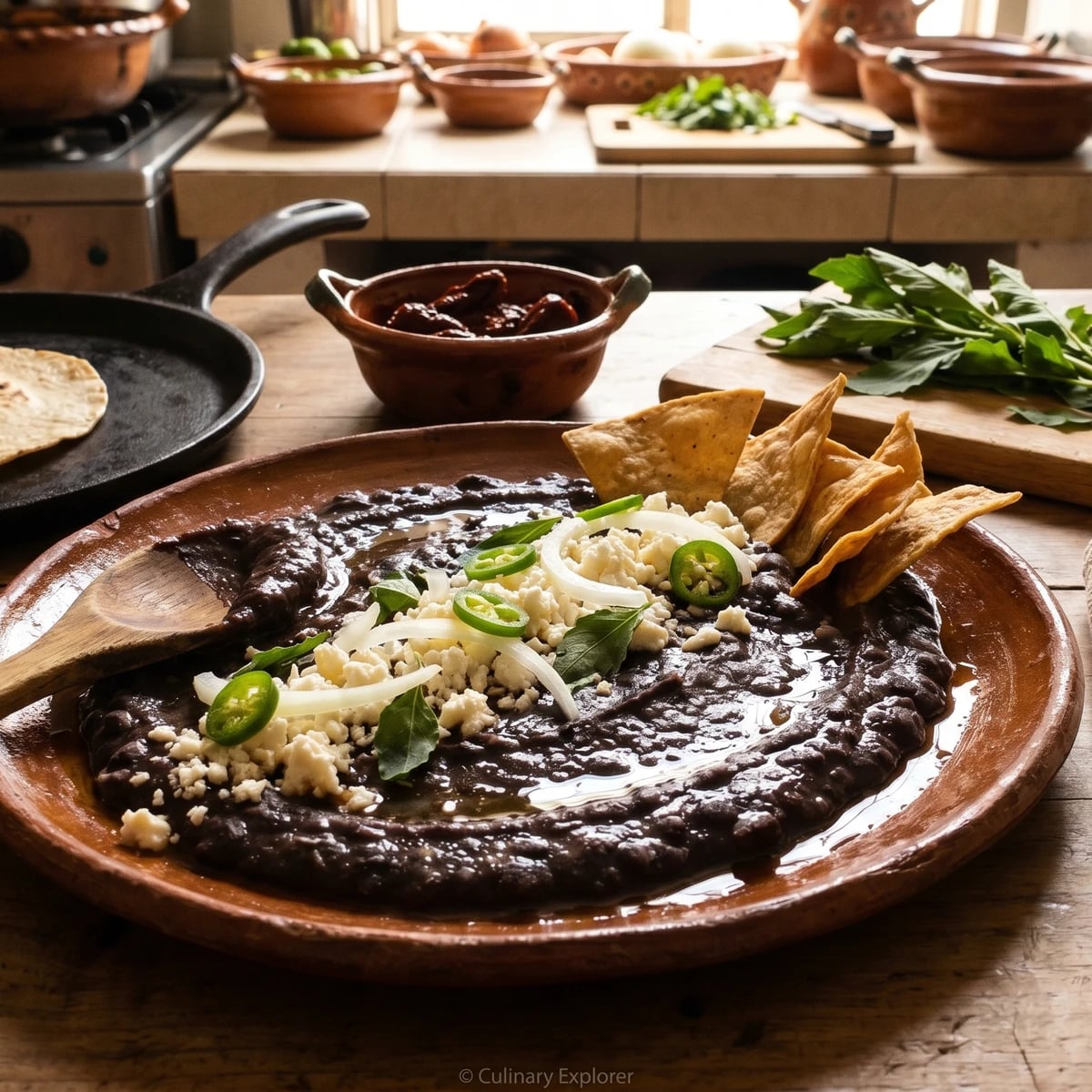
Mexico City's daily refried beans, slow-fried in lard with epazote, white onion, and chile serrano. The base that holds up molletes, tlacoyos, sopes, and half the breakfasts in the capital.
Appetizers & Snacks
Mexican
Weeknight
Comfort Food
Budget Friendly
15 min
Active Time
2 hr 30 min cook•2 hr 45 min total
Yield6 to 8 servings
These are capitalina beans. Ciudad de México beans. Not the lard-bomb pinto refritos of the north, not the soupy black beans of Veracruz, not the colado puree of Yucatán strained until silken. This is the everyday pot of Mexico City: black or pinto, depending on what your mother cooked, smashed by hand in the cazuela, fried slow in manteca, finished with epazote.
Epazote is the herb that tells you where you are. It grows wild in lots and sidewalk cracks across the Valle de México, and central Mexican cooks have used it on beans since before the Spaniards arrived. The smell is not subtle. Anise, gasoline, green pepper, something medicinal underneath. The first time you smell it on the comal you may not love it. Cook with it for a month and you will not understand how anyone makes beans without it. Pregúntale a las señoras del mercado at La Merced. They will tell you the same.
My mother kept a clay pot of beans on the stove from Monday to Thursday in our kitchen in Colonia Roma. Monday they were de la olla, just simmered. Tuesday she pulled half the pot into the cazuela, melted manteca, and turned them into refritos that fed us for two more days. Same beans, three dishes. That is household economy. That is how women have fed families in this city for generations. Saber cocinar es saber vivir.
The technique is patience. The fat is non-negotiable. La manteca es el sabor. Vegetable oil makes a sad imitation. Butter makes a French dish. Manteca de cerdo makes frijoles refritos. Así se hace y punto.
The phaseolus bean was domesticated in Mesoamerica more than seven thousand years ago, and the technique of cooking beans in clay pots with native herbs predates the conquest by millennia. Epazote (Dysphania ambrosioides), known to the Mexica as 'epazotl,' was used both for flavor and for its carminative properties, reducing the gas associated with bean digestion, a practical pairing that survived the colonial period intact. The act of refrying, frijoles refritos, is post-conquest, dependent on the introduction of pork lard by the Spanish, and the Mexico City style of mashing rather than pureeing reflects the pre-blender kitchen technology of the colonial and early republican periods. The word 'refritos' is itself a mistranslation in English; 'refrito' in Spanish does not mean fried twice but rather well-fried or thoroughly fried, an intensifier rather than a repetition.
The technique, the tradition, and the story behind every dish.
•Heavy clay olla or 4-quart Dutch oven for cooking the beans
•Wide cazuela or 12-inch heavy skillet for frying
•Wooden bean masher or sturdy wooden spoon
•Slotted spoon
Instructions
1
Cook the beans
Place the rinsed beans in a heavy pot, preferably a clay olla if you have one. Cover with cold water by three inches. Add the whole half of the onion, the smashed garlic, and one large sprig of epazote. Do not salt yet. Bring to a gentle simmer over medium heat and skim any foam that rises in the first ten minutes. Cover partially and cook for two hours, until the beans crush easily between two fingers but still hold their shape. Top up with hot water if the level drops below the beans. Cold water at this stage tightens the skins and you will fight them the rest of the cooking.
Do not soak the beans overnight. Mexican home cooks do not. The bean develops a creamier texture when it goes straight from dry to the pot. The only exception is if your beans are very old, then a four-hour soak helps them catch up.
2
Salt at the end
Once the beans are tender, add the salt and the second sprig of epazote. Simmer ten more minutes so the salt works its way into the bean. This is when you taste the broth. The caldo de frijol should taste like something you would drink from a clay jarro, savory and round. If it tastes flat, more salt. If it tastes thin, simmer it down. The caldo is half the flavor of the refritos.
3
Render the lard with onion and chile
In a wide cazuela or heavy skillet, melt the lard over medium heat. When it shimmers, add the diced onion and the chopped chile serrano. Cook for five to seven minutes, stirring, until the onion turns translucent at the edges and golden at the corners. La manteca es el sabor. This is not the place for olive oil. Olive oil tastes like the wrong country. Manteca tastes like a Mexico City kitchen at one in the afternoon.
4
Add the beans and their broth
Lift the beans into the cazuela with a slotted spoon, working in two batches. Pour in about a cup of the bean broth with each batch. Crush the beans with a bean masher or the back of a wooden spoon as they hit the fat. Some cooks puree everything in a blender. The capitalina way is to mash by hand and leave the texture uneven, some beans whole, most broken, the broth holding everything together.
5
Fry slow and patient
Lower the heat to medium-low. Now you fry. Stir often with a wooden spoon, scraping the bottom and folding the beans onto themselves. The mixture will sputter and thicken. Add more bean broth a half cup at a time as it tightens. You are doing this for twenty to thirty minutes. The beans will darken, the fat will pull to the edges of the pan, and the whole mass will start to pull away from the sides in one piece when you tilt the cazuela. That is the sign. That is when they are refritos and not just smashed beans.
If you rush this step on high heat, the beans scorch on the bottom and taste like punishment. No me vengas con atajos. The slow fry is the recipe.
6
Finish with fresh epazote
Tear the leaves from another sprig of fresh epazote and stir them in during the last two minutes of frying. The heat releases that anise-petrol smell that no other herb in the world has. Epazote is not a garnish in central Mexican cooking. It is the herb that tells the bean what it is. Without it, you have refried beans. With it, you have frijoles capitalinos.
7
Serve
Tip the beans onto a warm plate in a long oval, the way the fondas do it on Avenida Insurgentes. Crumble queso fresco down the center. Set totopos sticking out of one end like a fan. Pass the chipotles en adobo at the table. These beans are the platform for molletes, the spread for tlacoyos, the bed under huevos rancheros, the side that anchors a Sunday breakfast. Recetas probadas y garantizadas.
Chef Tips
•Black or pinto. Both are correct in the capital. Black beans are more common in the south of the city and among families with roots in Veracruz or Oaxaca. Pinto is more common in households with northern ties. Use what your family uses, or use what the mercado has good that week. Cada estado, su propia cocina, but in CDMX both are at home.
•Buy your lard from a carnicería, not the supermarket shelf-stable tub. Real manteca de cerdo from a butcher who renders it himself has a clean pork smell and a soft, spreadable texture at room temperature. Hydrogenated supermarket lard is a different ingredient and tastes like nothing.
•Dried epazote exists. It is a compromise, not an upgrade. The volatile oils that make epazote what it is do not survive drying well. If you cannot find fresh, use half as much dried and add it earlier in the cooking. But find a Latin grocer and look for the fresh sprigs. They are usually right next to the cilantro and they last a week in a glass of water in the refrigerator.
•Save the bean broth. After you have lifted the beans into the cazuela to fry, the leftover caldo de frijol is gold. Salt it, add a squeeze of lime, drop in some chopped onion and serrano, and you have a cup of broth that any Mexico City fonda would charge you for.
Advance Preparation
•The cooked beans (frijoles de la olla) can be made up to three days ahead and refrigerated in their broth. They will only taste better on day two.
•The refried beans hold for four days in the refrigerator and reheat well in a skillet with a splash of bean broth or water to loosen them.
•Frijoles refritos freeze well for up to two months. Thaw overnight in the refrigerator and reheat with a little extra manteca to revive the texture.
Frequently Asked Questions
Nutrition Information
1 serving (about 210g)
Calories
445 calories
Total Fat
21 g
Saturated Fat
7 g
Trans Fat
0 g
Unsaturated Fat
13 g
Cholesterol
20 mg
Sodium
680 mg
Total Carbohydrates
48 g
Dietary Fiber
11 g
Sugars
3 g
Protein
16 g
Where cooking meets culture.
Culinary guides, cultural storytelling, and the editorial depth that makes cooking meaningful.