
Chef Elsa
Bosna (Salzburg Spiced Sausage Roll)
Salzburg's legendary spiced sausage roll, two Bratwürstel tucked into a sliced white roll with fried onions, curry mustard, and a spice mix that every Würstelstand in town guards like a state secret.
A cooking platform built around craft, culture, and the stories behind what we eat.

Created by
The Viennese Würstelstand classic: a pair of snappy, gently heated Frankfurter served on a paper plate with a Semmel, sweet mustard, and Kren so fresh it makes your eyes water.
The first thing you need to know about the Frankfurter Würstel is the name. The rest of the world calls this sausage a Wiener. The Viennese call it a Frankfurter. The people of Frankfurt call it a Wiener. Nobody agrees and nobody is backing down. Gretel always said this was the most Viennese argument imaginable: two cities fighting over a sausage for two hundred years and both of them absolutely certain they're right.
I grew up eating these on every trip to Austria with Gretel and my grandmother Eva. We'd arrive in Vienna, drop the bags at the hotel, and walk straight to a Würstelstand. It was always the first meal. Two Frankfurter on a paper plate, a Semmel torn open, a smear of süßer Senf, and a small hill of freshly grated Kren that hit the back of your nose before you'd even tasted it. Gretel would stand at the counter with her coat still buttoned and eat with her fingers, and I thought that was the most glamorous thing in the world.
The technique here is almost nothing, and that's the point. You heat water to about 75 degrees Celsius, just hot enough that you wouldn't want to put your hand in it, and you hold the sausages there for ten to twelve minutes. You never let the water boil. Boiling splits the casing, forces the juices out, and turns a good sausage into a sad, waterlogged tube.The Viennese word for this gentle holding is "ziehen lassen," letting them draw. The sausage warms through slowly, the casing stays taut, and when you bite into it you get that clean snap followed by a rush of seasoned, smoky pork. That snap is everything. If there's no snap, something went wrong.
This is the simplest recipe I'll ever give you. It's also one of the most important. The Würstelstand is Vienna's great equalizer: opera singers, taxi drivers, politicians, and tourists all standing at the same counter eating the same sausage at two in the morning. Good Austrian home cooking doesn't always mean hours in the kitchen. Sometimes it means knowing how to heat a sausage properly and having the sense to serve it with the right things alongside.
Johann Georg Lahner, a butcher from Frankfurt who had trained in both cities, moved to Vienna in the 1820s and began producing a thin pork and beef sausage that combined Frankfurt's smoking tradition with Viennese spicing. The Viennese called it a Frankfurter after its maker's origins; everyone outside Vienna eventually called it a Wiener after the city where it became famous. The Würstelstand, Vienna's iconic street sausage stand, became a fixture of the city's nightlife and working-class culture by the late 19th century, and several historic stands, including Bitzinger near the Albertina, still operate today.
Quantity
4 (two per person)
Quantity
enough to cover sausages by 3cm
Quantity
2
Quantity
to taste
Quantity
1 small piece
freshly grated at the table
Quantity
4 small
Quantity
to taste
| Ingredient | Quantity |
|---|---|
| Frankfurter Würstel (pork sausages, natural casing) | 4 (two per person) |
| water | enough to cover sausages by 3cm |
| Semmeln (Austrian bread rolls) | 2 |
| süßer Senf (sweet mustard) | to taste |
| fresh horseradish root (Kren)freshly grated at the table | 1 small piece |
| Gurkerl (pickled gherkins) (optional) | 4 small |
| freshly ground black pepper (optional) | to taste |
Fill a pot tall enough to hold the sausages lying flat with enough water to cover them by at least three centimeters. Heat the water over medium heat until it reaches about 75 degrees Celsius. If you have a kitchen thermometer, use it. If you don't, watch for the first tiny bubbles forming on the bottom of the pot, well before any movement at the surface. The water should feel almost still. If you see a rolling simmer, you've gone too far. Pull the pot off the heat and let it calm down.
Lower the Frankfurter into the hot water gently. Don't drop them in. Reduce the heat to low, just enough to hold the temperature steady. You want the water to stay between 70 and 75 degrees. Let the sausages sit for ten to twelve minutes. They're already cooked and smoked. You're not cooking them. You're warming them through so the inside is as hot as the outside and the fat inside the casing has just barely begun to soften. This is what gives you the snap.
While the Würstel warm through, set out your Semmeln, the süßer Senf, and the Gurkerl. Peel your Kren and grate it fresh at the table on the fine side of a box grater or a dedicated Kren grater. Fresh Kren is not polite. It hits your sinuses with a clean, sharp heat that disappears as fast as it arrives. If you grate it too far ahead, it oxidizes and turns bitter. Keep it fresh. This is one of those details that separates good from great.
Lift the Frankfurter from the water with tongs. Let them drain for a moment. Place two sausages per person on a plate or a wooden board. Tear or slice each Semmel open and set it alongside, not around the sausage. Put a generous spoonful of süßer Senf on the plate, a small mound of freshly grated Kren, and a few Gurkerl if you're using them. No ketchup. No relish. No elaborate toppings. The Viennese have been eating this exactly this way for two centuries and they haven't needed to change a thing. Pick it up with your hands. Mahlzeit!
1 serving (about 270g)
Culinary guides, cultural storytelling, and the editorial depth that makes cooking meaningful.
Discover Culinary ExplorerChef Elsa
Salzburg's legendary spiced sausage roll, two Bratwürstel tucked into a sliced white roll with fried onions, curry mustard, and a spice mix that every Würstelstand in town guards like a state secret.
Chef Elsa
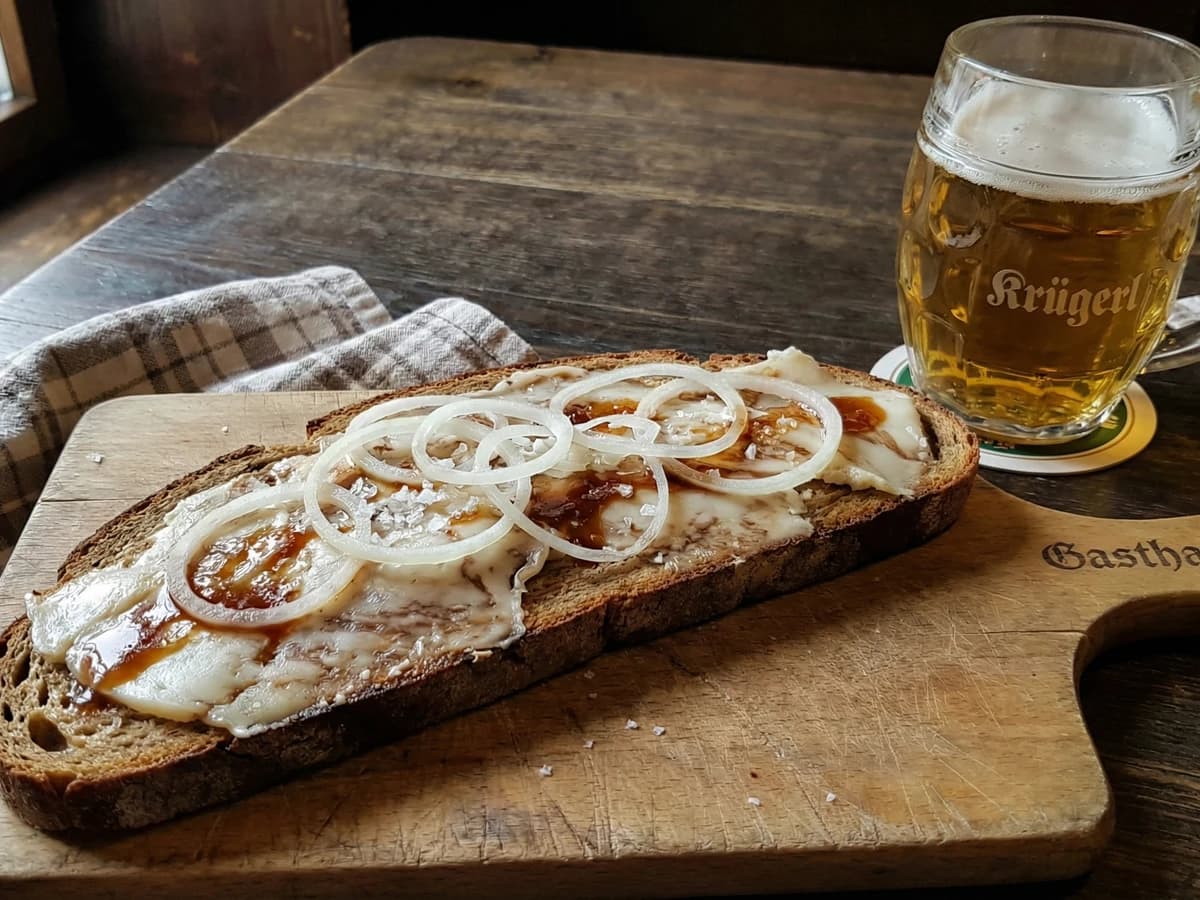
Cold roast pork drippings spread thick on dark farmhouse bread with raw onion rings and coarse salt. The best thing Austrians eat standing up, and they know it.
Chef Elsa
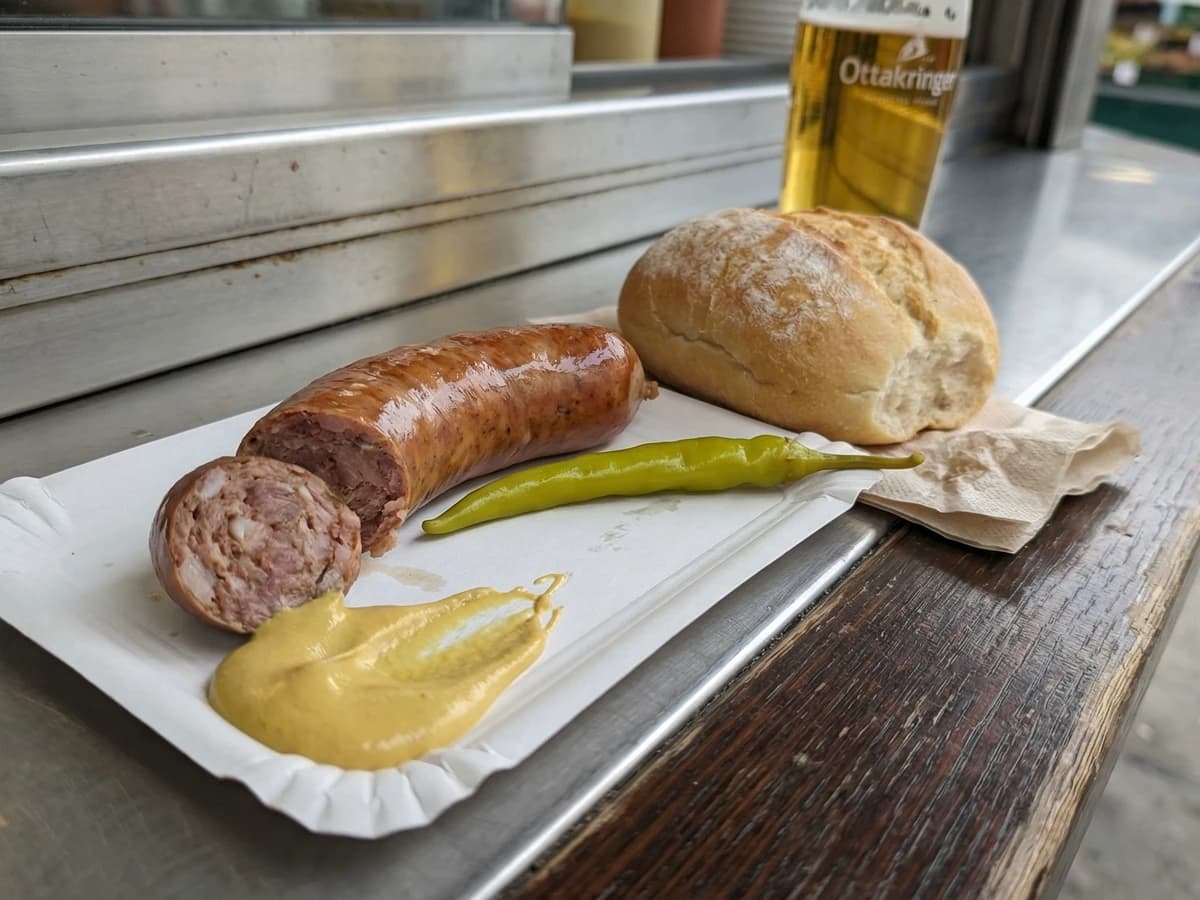
The Würstelstand's coarse, snappy pork sausage served the proper Viennese way: gently heated (never boiled), with sharp mustard, a fresh Semmel, and a Pfefferoni on the side.

Chef Elsa
The Würstelstand classic: bright red paprika sausage, scored and seared golden, served with sharp mustard, freshly grated Kren, and a warm Semmel the way Austrians have been eating it for generations.