Ensalada Victor (Tijuana Caesar of the Working Class)
Created by
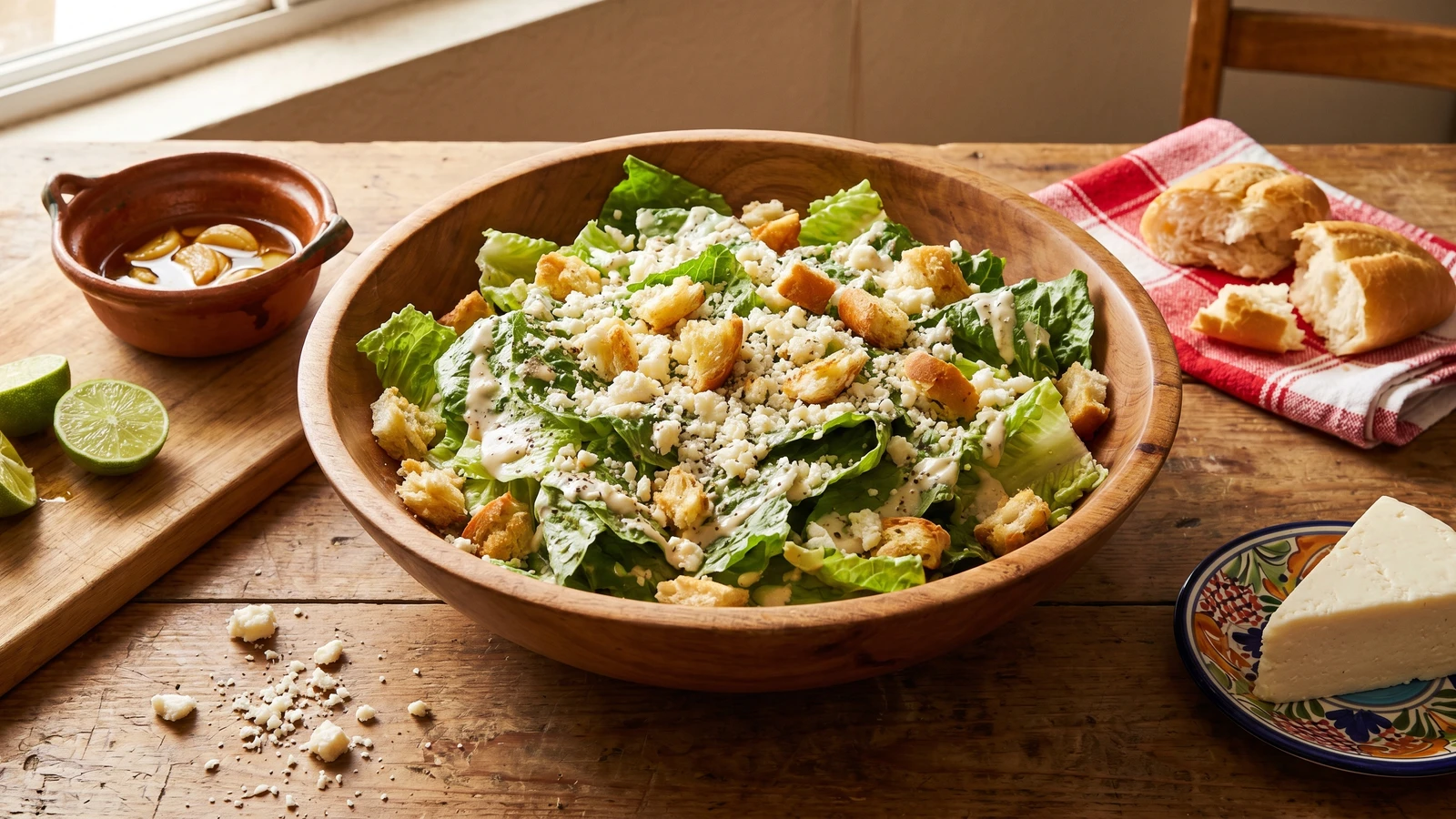
Tijuana's working-class Caesar, born in the peso crisis of the 1970s, with garlic-infused corn oil, crumbled queso cotija, and torn bolillo croutons. The same backbone as Caesar Cardini's, built for a baja Californian budget.
Salads
Mexican
Weeknight
Budget Friendly
Quick Meal
20 min
Active Time
10 min cook•30 min total
Yield4 servings
This is a Baja California dish. Tijuana, specifically. Not the Caesar of the tableside cart at Caesar's Restaurant on Avenida Revolucion, the one tourists photograph. This is the other Caesar, the one the cooks made for themselves and for the families who could not pay tourist prices.
The peso devaluation of the 1970s broke a lot of menus in Tijuana. Imported Parmigiano became a luxury. Olive oil disappeared from working-class kitchens. The cooks did what Mexican cooks have always done when the pantry shrinks: they substituted with what the mercado was selling. Cotija, the hard salty cheese from the highlands of Michoacan, took the place of Parmigiano. Corn oil, infused with garlic so it would carry the weight of olive oil, took its place too. The bolillo from the panaderia replaced the imported baguette croutons. The bones of the Caesar stayed: the egg yolk, the anchovy, the garlic, the lime, the romaine. Everything else became Mexican.
My mother kept a clipping in her notebook from a 1978 issue of a Tijuana paper, a recipe column written by a senora named Victoria who ran a comedor near the bullring. Her version called for corn oil and cotija and explained, plainly, that this was not a compromise. It was the Caesar that fed the people who actually lived in Tijuana. I cooked from that clipping for the first time when I was nineteen years old. It is bright, sharp, garlicky, and unmistakably Mexican. Cada estado, su propia cocina. Baja included.
The Caesar salad was invented in Tijuana in 1924 by Italian immigrant Caesar Cardini at his restaurant on Avenida Revolucion, originally as a tableside improvisation for American tourists during Prohibition. The Ensalada Victor, sometimes credited to Cardini's brother Alex (who called his version 'Aviator's Salad'), and later transformed by working-class Tijuana cooks during the peso crises of 1976 and 1982, swapped imported ingredients for Mexican equivalents: queso cotija for Parmigiano, corn oil for olive oil, bolillo for baguette. Baja California's culinary identity, often dismissed as merely an extension of California cuisine, has its own substitution traditions born of the peso-dollar border economy, where what crossed and what stayed defined what landed on the plate.
The technique, the tradition, and the story behind every dish.
garlic cloves (for the oil)peeled and lightly smashed
6
day-old bolillo or telera breadtorn into rough 1-inch pieces
2 cups
kosher salt
1 teaspoon, divided
egg yolksfrom very fresh eggs
2 large
oil-packed anchovy filletsdrained
4
garlic cloves (for the dressing)finely grated
2
fresh lime juice
2 tablespoons (from 1 to 2 Mexican limes)
Worcestershire sauce
1 teaspoon
Dijon-style mustard
1 teaspoon
freshly ground black pepper
1/4 teaspoon
corn oil from the garlic infusion
1/2 cup
queso cotijacrumbled
1/2 cup, plus more for finishing
lime wedges (optional)
for serving
Equipment Needed
•Wide wooden salad bowl
•Heavy skillet for the croutons
•Small saucepan for infusing the oil
•Microplane or fine grater for the garlic
•Whisk
Instructions
1
Infuse the corn oil with garlic
Place the corn oil and the six smashed garlic cloves in a small saucepan. Set it over the lowest heat your stove can hold. You want the garlic to barely whisper, never fry. Cook for 8 to 10 minutes, until the cloves turn pale gold and the kitchen smells like a Tijuana taqueria at lunch hour. Pull the pan off the heat and let it cool for 15 minutes. Strain. You now have garlic-infused corn oil for both the croutons and the dressing. This is the substitution that defines the dish. Olive oil was a luxury Tijuana cooks could not afford in 1976, and corn oil with garlic carried the same weight at a quarter of the price.
Save the soft, golden garlic cloves you strain out. Smash them onto a piece of bolillo with salt. That is the cook's snack while the salad gets dressed.
2
Toast the bolillo croutons
Heat a heavy skillet over medium. Add 3 tablespoons of the garlic oil and the torn bolillo. Sprinkle with half a teaspoon of salt. Toss the bread in the oil and toast for 6 to 8 minutes, turning often, until every piece is golden brown with a deep crust. The interior should still have a little chew. These are not the dry boxed croutons of an American restaurant. They are torn day-old Mexican bread, the same bolillo you would split for a torta, fried in garlic oil until the edges turn the color of caramelo. Set aside on a plate.
3
Build the dressing in the bowl
In a wide wooden salad bowl, mash the anchovies and the grated garlic with the back of a fork until they form a paste. Work them into the wood. The bowl should smell aggressive, almost too much. That is correct. Add the egg yolks, lime juice, Worcestershire, mustard, the remaining half teaspoon of salt, and the black pepper. Whisk until smooth and pale yellow.
4
Stream in the garlic oil
Whisking constantly, drizzle in the half cup of garlic-infused corn oil in a thin, slow stream. The dressing will thicken and turn the color of cream as the oil emulsifies into the yolks. If it looks broken, do not panic. Add a teaspoon of cold water and whisk hard. The dressing should coat the back of a spoon and slide off slowly. La manteca es el sabor in Michoacan; in Tijuana it is the corn oil and garlic. The principle is the same. Fat carries the flavor.
Raw egg yolks are non-negotiable in this dressing. If you are nervous, use pasteurized yolks. Do not use mayonnaise. Mayonnaise is what you get when you give up on making Caesar.
5
Tear the romaine and dress
Tear the romaine hearts into rough pieces, around three or four inches long. Do not chop them with a knife. The torn edge holds the dressing where a clean cut sheds it. Pile the leaves into the bowl on top of the dressing. Toss with two wooden spoons or with clean hands, lifting from the bottom, until every leaf is coated. The leaves should glisten, not drown.
6
Finish with cotija and serve
Add the croutons and half a cup of crumbled cotija. Toss once more, gently. Transfer to a serving platter or leave it in the bowl. Top with another generous handful of cotija and a few cracks of black pepper. Serve immediately with lime wedges on the side. Cotija is salty and dry, the way a hard cheese should be. It does not melt and it does not cling like Parmigiano. It crumbles. That is the texture of this version. Asi se hace y punto.
Chef Tips
•Use real queso cotija, the aged, dry, salty version from Michoacan. The fresh cotija sold in some U.S. supermarkets is closer to queso fresco and will not give you the right crumble or salinity. If your cheese vendor only has the soft kind, ricotta salata is a closer compromise than Parmigiano.
•Bolillo or telera bread, day-old, makes the croutons. Sourdough is a compromise. Boxed croutons are not the same dish. If your panaderia closed yesterday, dry the bread out in a low oven for 20 minutes before tearing.
•Mexican limes, the small green ones, make the dressing sharper and more fragrant than Persian limes. Use them if you can find them. The dressing is built around their acid.
•The dressing does not keep. Make it the moment before you serve. Caesar dressing held overnight tastes flat and the raw garlic turns harsh.
Advance Preparation
•The garlic-infused corn oil can be made up to three days ahead and held at room temperature in a sealed jar.
•The bolillo croutons can be toasted up to four hours ahead and held at room temperature, uncovered, on a plate. Past four hours they soften.
•The romaine can be washed, dried completely, and refrigerated wrapped in a clean kitchen towel up to one day ahead. Wet romaine ruins the dressing.
Frequently Asked Questions
Nutrition Information
1 serving (about 195g)
Calories
440 calories
Total Fat
35 g
Saturated Fat
8 g
Trans Fat
0 g
Unsaturated Fat
26 g
Cholesterol
130 mg
Sodium
905 mg
Total Carbohydrates
17 g
Dietary Fiber
1 g
Sugars
1 g
Protein
9 g
Where cooking meets culture.
Culinary guides, cultural storytelling, and the editorial depth that makes cooking meaningful.