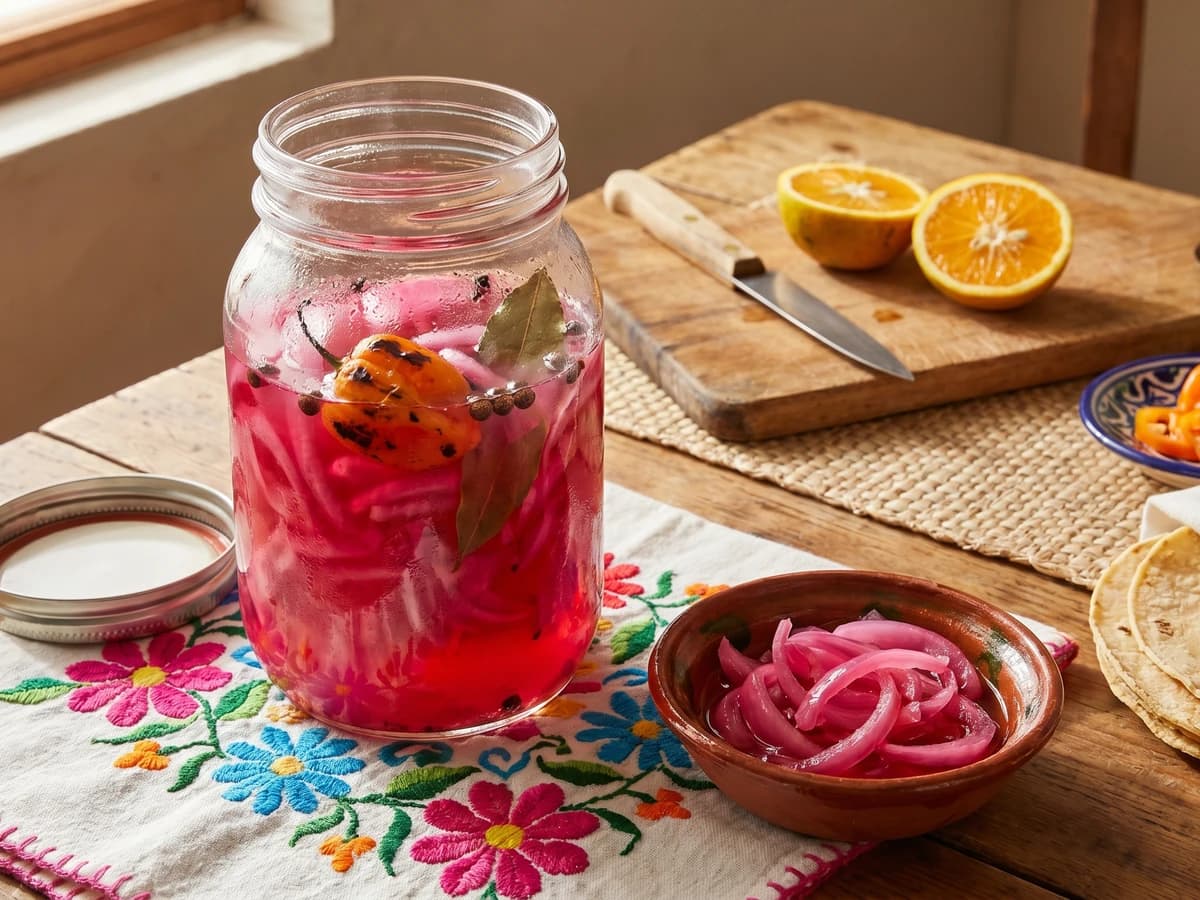
Mexicali's Chinese-Mexican slaw from a century of border kitchens. Crisp shredded cabbage and carrot in a sweet-sour rice vinegar and soy dressing, served cold with blistered chiles toreados.
Salads
Mexican
Weeknight
Quick Meal
Comfort Food
25 min
Active Time
5 min cook•30 min total
Yield6 servings
This is a Mexicali dish. From Baja California, from the border city that has the only Chinatown in Mexico that still functions as one. La Chinesca, they call it. The neighborhood where Cantonese laborers settled at the turn of the twentieth century, came to build the railroads and the cotton fields, and stayed to open restaurants that fed an entire region. Ensalada china is one of those restaurants on a plate.
The dressing is what makes this dish itself and not a generic coleslaw. Rice vinegar, soy sauce, toasted sesame oil, sugar, lime, garlic. The Cantonese half is the vinegar, the soy, and the sesame. The Mexican half is the lime, the cilantro, and the chiles toreados that come on the side. This is not fusion food invented for a cookbook. This is what a hundred years of two cultures sharing a kitchen in the desert produced. If you leave out the rice vinegar because it sounds wrong in a Mexican recipe, you do not understand Mexicali. Cada estado, su propia cocina, and Baja California's includes soy sauce.
Mexicali eats this cold, in a wide glass bowl, alongside chow mein and fried rice and arrachera. The cafes in La Chinesca have been serving it like this for generations. The chiles toreados, blistered serranos splashed with soy and lime, are the bridge that tells you which side of the border you are on. Saber cocinar es saber vivir, and in Mexicali it means knowing that two traditions can sit on the same table and neither one has to apologize.
Chinese migration to Mexicali began in the late 1880s and accelerated in the early 20th century, drawn by the Colorado River Land Company's cotton industry and barred from the United States by the Chinese Exclusion Act of 1882. By the 1920s, Mexicali's Chinese population briefly outnumbered its Mexican population, and the underground tunnel network of La Chinesca housed restaurants, gambling halls, and laundries that anchored the largest Chinese community in Mexican history. Ensalada china emerged from this milieu as a hybrid dish: Cantonese cooks adapting cabbage slaws to Mexican palates with lime and chile, Mexican cooks adopting rice vinegar and soy sauce as legitimate pantry items. The city of Mexicali today recognizes Chinese-Mexican cuisine as part of its official cultural patrimony, with over a hundred Chinese restaurants still operating within city limits.
The technique, the tradition, and the story behind every dish.
peeled and shredded on the large holes of a box grater
celery stalks
Quantity
4
sliced very thin on the bias
white onion
Quantity
1/2 small
sliced into thin half-moons
fresh cilantro
Quantity
1 bunch
leaves and tender stems, roughly chopped
rice vinegar
Quantity
1/3 cup
fresh lime juice
Quantity
2 tablespoons
soy sauce
Quantity
3 tablespoons
sugar
Quantity
2 tablespoons
toasted sesame oil
Quantity
1 tablespoon
neutral oil (vegetable or canola)
Quantity
3 tablespoons
garlic cloves
Quantity
2
finely grated
kosher salt
Quantity
1 teaspoon, plus more to taste
toasted sesame seeds
Quantity
1 tablespoon
fresh chile serrano or chile guero
Quantity
6
for the chiles toreados
vegetable oil for the chiles
Quantity
1 tablespoon
soy sauce and lime (optional)
Quantity
for finishing the chiles toreados
Ingredient
Quantity
small head green cabbagecored and shredded very thin
1 (about 2 pounds)
large carrotspeeled and shredded on the large holes of a box grater
2
celery stalkssliced very thin on the bias
4
white onionsliced into thin half-moons
1/2 small
fresh cilantroleaves and tender stems, roughly chopped
1 bunch
rice vinegar
1/3 cup
fresh lime juice
2 tablespoons
soy sauce
3 tablespoons
sugar
2 tablespoons
toasted sesame oil
1 tablespoon
neutral oil (vegetable or canola)
3 tablespoons
garlic clovesfinely grated
2
kosher salt
1 teaspoon, plus more to taste
toasted sesame seeds
1 tablespoon
fresh chile serrano or chile guerofor the chiles toreados
6
vegetable oil for the chiles
1 tablespoon
soy sauce and lime (optional)
for finishing the chiles toreados
Equipment Needed
•Sharp 8-inch chef's knife for shredding the cabbage
•Box grater for the carrots
•Wide glass or ceramic mixing bowl
•Small skillet for the chiles toreados
•Whisk or jar for the dressing
Instructions
1
Shred the vegetables thin
Cut the cabbage in quarters, core it, and shred it as thin as you can with a sharp knife. Not chopped. Shredded. The cabbage has to be thin enough that the dressing penetrates and the texture stays crisp without being chunky. Grate the carrots on the large holes of a box grater. Slice the celery thin on the bias and the onion into half-moons. Combine everything in a wide glass or ceramic bowl with the chopped cilantro.
Do not use a food processor for the cabbage. It bruises the leaves and you end up with watery slaw. A sharp knife and ten minutes of patience. La cocina no es decoracion, es trabajo.
2
Salt the cabbage briefly
Sprinkle the kosher salt over the shredded vegetables and toss with your hands. Let the bowl sit for ten minutes. The salt pulls a little water out of the cabbage and starts to soften it without turning it limp. This is the trick that keeps the slaw crisp once the dressing goes in. After ten minutes, tip the bowl over the sink and drain off any liquid that has collected.
3
Build the sweet-sour dressing
In a small bowl or jar, whisk the rice vinegar, lime juice, soy sauce, sugar, sesame oil, neutral oil, and grated garlic until the sugar dissolves completely. Taste it. It should be sharply sour, then sweet, then salty, in that order. If it tastes flat, add another teaspoon of vinegar. The rice vinegar is not optional and it is not a substitution. Mexicali's Chinese cooks brought it to the border a hundred years ago and it stayed. Esto no es comida de un solo Mexico.
4
Dress and rest
Pour the dressing over the salted vegetables. Toss thoroughly with your hands or two large spoons until every shred is glossy. Cover the bowl and refrigerate for at least 20 minutes before serving. This rest is the difference between a good ensalada china and a great one. The dressing seasons the cabbage from the inside out and the flavors marry. Do not skip it. No me vengas con atajos.
5
Make the chiles toreados
While the salad rests, heat one tablespoon of vegetable oil in a small skillet over medium-high heat until it shimmers. Add the whole serrano or guero chiles. Roll them in the hot oil for three to four minutes until the skins blister and turn dark in patches. They should look like they have been wrestled, which is exactly what toreado means. Transfer to a small dish and finish with a splash of soy sauce and a squeeze of lime.
6
Serve cold and generous
Toss the salad one more time and taste for salt and acid. Pile it into a wide glass or ceramic serving bowl. Scatter the toasted sesame seeds across the top. Set the chiles toreados alongside in their own dish so each person can take what they want. This is how it comes to the table at the cafes in La Chinesca: cold, glossy, sharp, and bracing. Asi se hace y punto.
Chef Tips
•The rice vinegar is the dish. Do not substitute white vinegar or apple cider vinegar. Both are too harsh and neither belongs here. Mexicali's pantries have rice vinegar because Mexicali's cooks have used it for a hundred years. Buy a bottle of unseasoned Japanese or Chinese rice vinegar and keep it for this and other Baja California dishes.
•Chile guero, the pale yellow chile, is the traditional toreado in the north. Serrano works and is easier to find. Jalapeno is too thick and the skin will not blister the same way. If you can only find jalapeno, slice it thin and use it raw on top of the salad instead.
•This is one of the few Mexican salads that improves with sitting. An hour in the refrigerator is better than twenty minutes. Overnight is fine. The cabbage softens just enough and the dressing fully marries with the vegetables. Make it in the morning for dinner.
•Serve it cold, served the way they do at the Chinese-Mexican cafes in La Chinesca: as a side to chow mein, fried rice, or grilled arrachera. It is also the right partner for carne asada tacos when you want something brighter than the usual cabbage and lime.
Advance Preparation
•The dressing can be whisked together up to three days ahead and refrigerated in a sealed jar. Shake before using.
•The whole salad can be made up to one day ahead. The cabbage holds its crunch in the refrigerator and the dressing only deepens. Past 24 hours the texture starts to soften too much.
•The chiles toreados are best fresh and blistered just before serving. They lose their character once they cool and sit.
Frequently Asked Questions
Nutrition Information
1 serving (about 295g)
Calories
210 calories
Total Fat
13 g
Saturated Fat
2 g
Trans Fat
0 g
Unsaturated Fat
10 g
Cholesterol
0 mg
Sodium
780 mg
Total Carbohydrates
19 g
Dietary Fiber
6 g
Sugars
8 g
Protein
3 g
Where cooking meets culture.
Culinary guides, cultural storytelling, and the editorial depth that makes cooking meaningful.