
Chef Lupita
Coditos con Camaron Sinaloenses
Sinaloa's pinata-and-wedding pasta salad. Elbow macaroni, small Pacific shrimp, mayo, crema, and the brine from a can of pickled jalapenos. Always cold. Always next to the frijoles puercos.
A cooking platform built around craft, culture, and the stories behind what we eat.
Created by
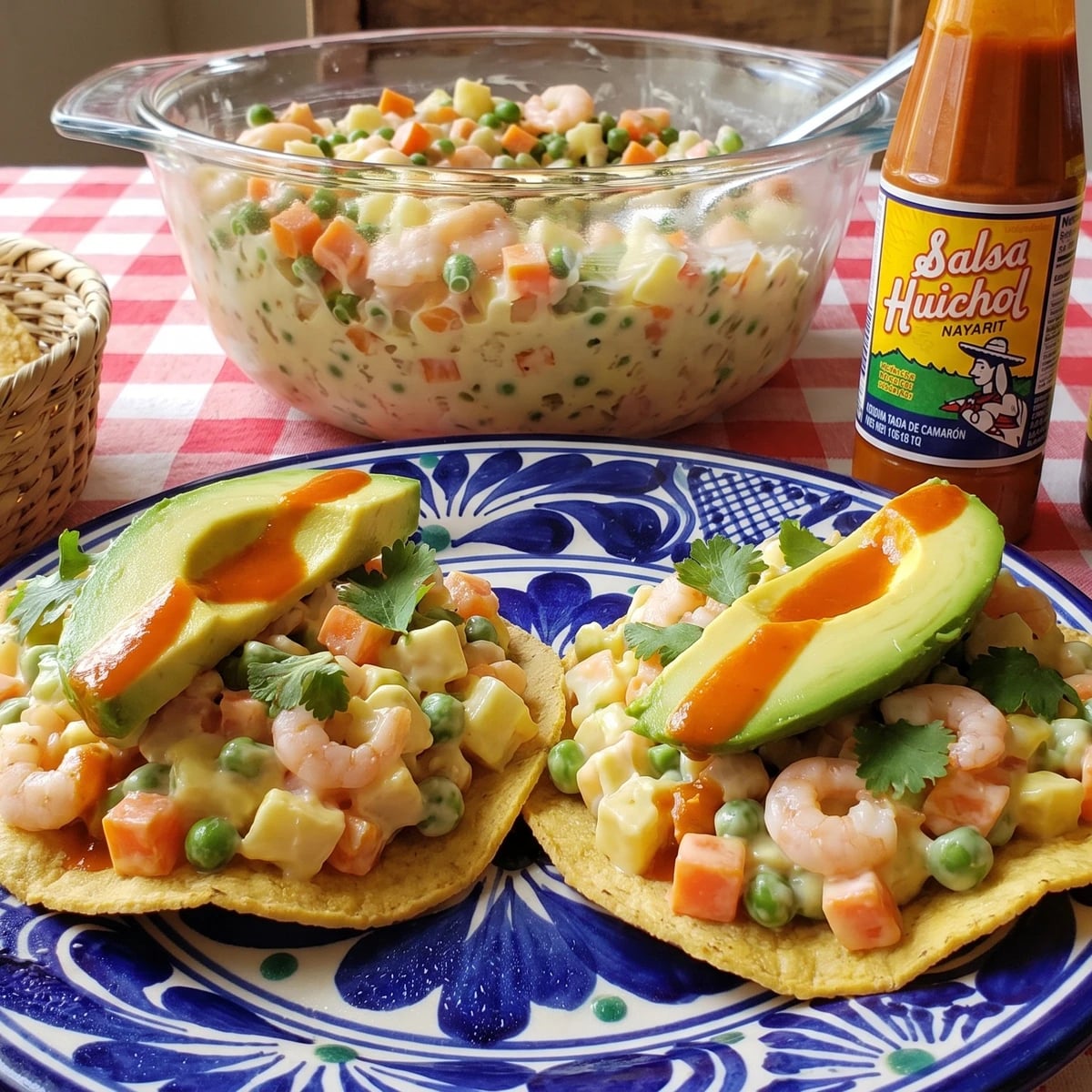
Sinaloa's coastal ensalada rusa: cold diced potato, carrot, and peas folded with tiny Pacific shrimp and lime mayonnaise, mounted on a crisp tostada with avocado and a stripe of Salsa Huichol.
This is from Sinaloa. Specifically from Mazatlán, where the marisquerias along the malecón serve it cold on a tostada with Salsa Huichol and a beer that is colder than the salad. Ensalada rusa exists in many Mexican states, but the Sinaloa version, with shrimp, on a tostada, with that particular orange-red Huichol stripe across the top, belongs to the coast.
The Russian salad arrived in Mexico through Spanish cookbooks in the 19th century, the way it arrived everywhere: potatoes, carrots, peas, mayonnaise. What Sinaloa did was add the shrimp that comes off their own boats and serve it on a tostada instead of with a fork. That single decision turned a European appetizer into a Pacific-coast botana that you eat standing at a marisco bar with a Pacífico in your hand.
The shrimp is the dish. Camarón pacotilla, the small bay shrimp, is what the cooks use because every spoonful needs to have shrimp in it, not just one or two big pieces hiding under the mayonnaise. The potato has to hold its cube. The peas have to stay whole. The mayonnaise has to be Mexican, made with lime, because the lime is part of the flavor signature. And the Salsa Huichol, that orange-red bottle on every Sinaloa table, is non-negotiable. Without it, this is just potato salad. With it, it is Mazatlán on a plate.
My mother did not make this. It was not in the Jalisco notebook. I learned it from a woman named Doña Estela who ran a marisco stand in the Mercado Pino Suárez in Mazatlán the first summer I went to Sinaloa to collect recipes. She told me three things and I have not forgotten them: the potato gets cooked in the shrimp water, the salad rests for two hours minimum, and the tostada gets eaten the moment it is loaded. Saber cocinar es saber vivir.
Russian salad, known in its country of origin as Olivier salad, was invented by the Belgian-born chef Lucien Olivier at the Hermitage restaurant in Moscow in the 1860s and traveled to Mexico through Spanish cookbooks during the late 19th-century Porfiriato, when European cuisine was a marker of bourgeois sophistication. The dish was naturalized along Mexico's coasts during the 20th century by adding local seafood: shrimp in Sinaloa and Nayarit, jaiba in Veracruz, sometimes octopus in Baja California. The tostada presentation is a Sinaloan innovation tied to the rise of marisquerias and tostaderías as casual coastal eating formats in Mazatlán and Culiacán in the mid-20th century, and the inclusion of Salsa Huichol, manufactured in Nayarit since 1959, made the dish a regional signature even though the salsa itself is not Sinaloan in origin.
Quantity
1 pound
peeled and deveined
Quantity
1 1/2 pounds
peeled and cut into 1/4-inch dice
Quantity
3 medium
peeled and cut into 1/4-inch dice
Quantity
1 cup
Quantity
1 medium
halved
Quantity
4
smashed
Quantity
2
Quantity
1 tablespoon, plus more to taste
Quantity
1/2 cup (about 6 small Mexican limes), divided
Quantity
1 cup
Quantity
2 tablespoons
Quantity
1/4 cup
Quantity
1/4 cup
Quantity
1
finely minced
Quantity
to taste
Quantity
16
Quantity
1
sliced
Quantity
for serving
Quantity
for serving
| Ingredient | Quantity |
|---|---|
| small Pacific shrimp (camarón pacotilla)peeled and deveined | 1 pound |
| Yukon gold potatoespeeled and cut into 1/4-inch dice | 1 1/2 pounds |
| carrotspeeled and cut into 1/4-inch dice | 3 medium |
| fresh shelled peas, or thawed frozen peas | 1 cup |
| white onionhalved | 1 medium |
| garlic clovessmashed | 4 |
| bay leaves | 2 |
| kosher salt | 1 tablespoon, plus more to taste |
| fresh lime juice | 1/2 cup (about 6 small Mexican limes), divided |
| Mexican mayonnaise (McCormick or Hellmann's con limón) | 1 cup |
| crema mexicana | 2 tablespoons |
| finely diced white onion | 1/4 cup |
| chopped fresh cilantro | 1/4 cup |
| fresh chile serrano (optional)finely minced | 1 |
| freshly ground black pepper | to taste |
| corn tostadas (tostadas horneadas if you can find them) | 16 |
| ripe avocado (optional)sliced | 1 |
| Salsa Huichol | for serving |
| lime wedges | for serving |
Bring 6 cups of water to a gentle simmer with the halved white onion, smashed garlic, bay leaves, and 1 tablespoon of salt. Drop in the shrimp. Small Pacific shrimp cook in 90 seconds, two minutes maximum. They are ready the moment they turn pink and curl into a loose C. An overcooked shrimp curls into a tight O and goes rubbery. There is no recovering from it. Lift them out with a slotted spoon and spread on a sheet pan to cool. Keep the poaching liquid on the heat.
Add the diced potatoes and carrots to the same poaching liquid. The shrimp seasoning belongs in the vegetables. Simmer for 8 to 10 minutes, until a paring knife slides into a potato cube with the lightest resistance. Test one. The potato should hold its cube shape, never collapse. Mush is the death of ensalada rusa. Drop the peas in for the final 60 seconds, just to set their color and warm them through.
Drain the vegetables in a colander and spread them in a single layer on a sheet pan. Do not rinse them. Rinsing washes away the seasoning. Let them cool to room temperature on the counter for 15 minutes, then refrigerate uncovered for at least 30 minutes more until completely cold. Warm vegetables break the mayonnaise and turn the salad into soup. No me vengas con atajos.
While the vegetables cool, toss the cooled shrimp with 2 tablespoons of the lime juice and a pinch of salt. Let them sit for 10 minutes. This is not aguachile. The lime here brightens the shrimp without curing it further. The shrimp are already cooked. The lime is for flavor.
In a wide glass bowl, whisk the mayonnaise with the crema, the remaining lime juice, several grinds of black pepper, and half a teaspoon of salt. The crema thins the mayo just enough so it coats every cube without weighing the salad down. Mexican mayonnaise made with lime is the right starting point. American mayonnaise will work but you will need to add more lime to wake it up.
Add the cold vegetables, the dressed shrimp, the diced raw white onion, the cilantro, and the serrano if using. Fold everything together with a rubber spatula. Fold, do not stir. You want the cubes intact, the peas whole, the shrimp visible. Taste for salt and lime. The salad should taste assertive. It will mellow as it sits.
Cover and refrigerate for at least one hour before serving, two is better. The flavors need time to talk to each other. The mayonnaise relaxes into the vegetables. The lime sharpens. This is the dish settling into itself. Serve it cold, never room temperature.
Set the bowl of salad in the middle of the table with the tostadas, sliced avocado, Salsa Huichol, and lime wedges. Each person spoons a generous mound onto a tostada, lays a slice of avocado on top, and finishes with a stripe of Salsa Huichol. Eat immediately. The tostada starts to soften under the salad within a few minutes, so you assemble and eat one at a time. Asi se hace y punto.
1 serving (about 270g)
Culinary guides, cultural storytelling, and the editorial depth that makes cooking meaningful.
Discover Culinary Explorer
Chef Lupita
Sinaloa's pinata-and-wedding pasta salad. Elbow macaroni, small Pacific shrimp, mayo, crema, and the brine from a can of pickled jalapenos. Always cold. Always next to the frijoles puercos.

Chef Lupita
Tijuana's 1924 original from Caesar Cardini, whole romaine hearts dressed tableside with coddled egg, Mexican lime, Worcestershire, garlic, and Parmigiano. No anchovies. Eaten with the hands, leaf by leaf.

Chef Lupita
Mexicali's Chinese-Mexican slaw from a century of border kitchens. Crisp shredded cabbage and carrot in a sweet-sour rice vinegar and soy dressing, served cold with blistered chiles toreados.

Chef Lupita
Sinaloa's pantry salad of canned tuna, peas, white onion, and tomato bound with mayonnaise and the brine from a jar of pickled jalapeños. Eaten on saltines or stuffed into a bolillo, the way the coast has done it for generations.