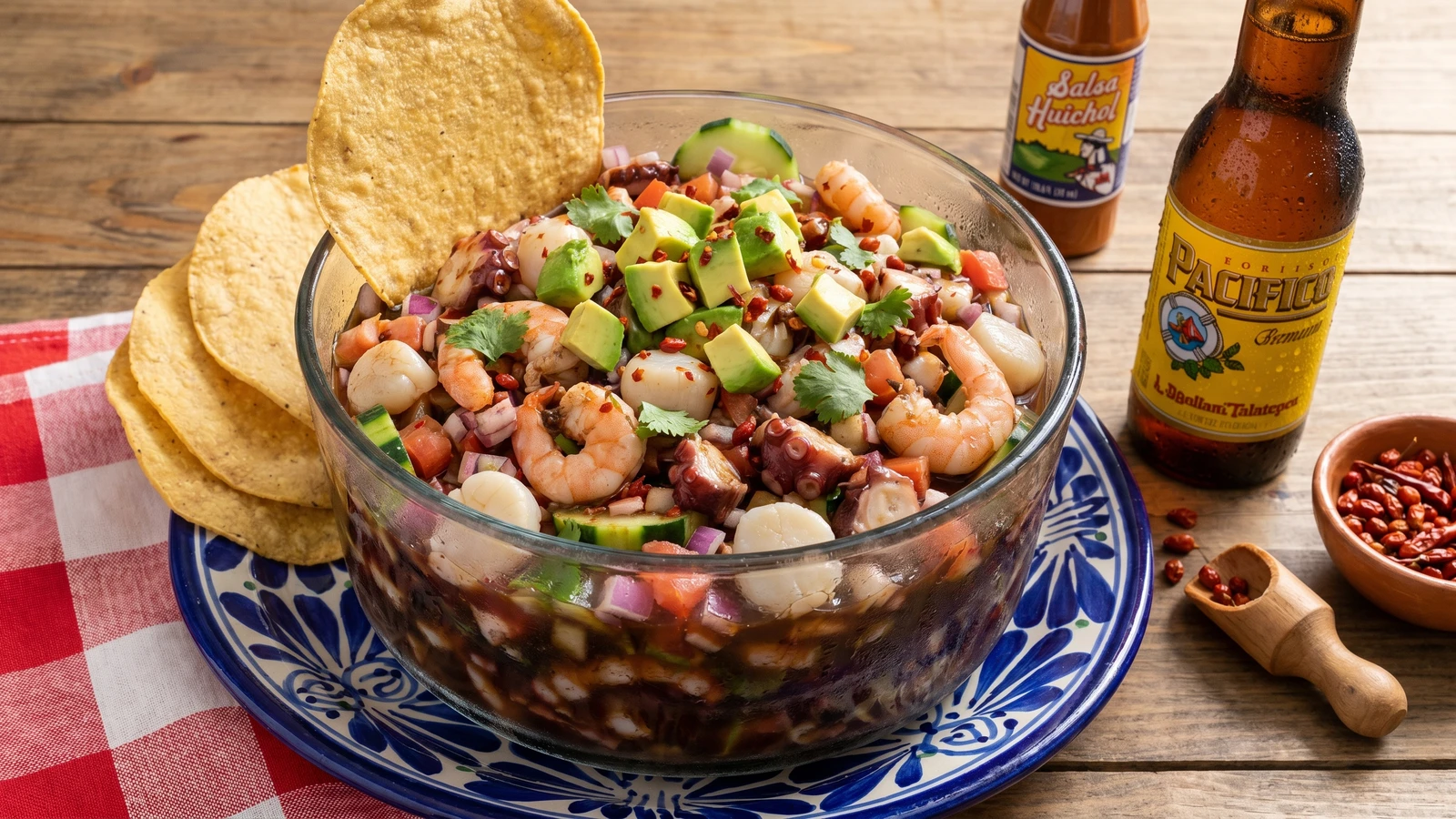
Sinaloa's marisqueria mixed seafood salad. Shrimp, octopus, and scallops cured in Mexican lime and dressed in Salsa Negra of soy, Worcestershire, and chiltepín. Served on tostadas with cold Pacifico.
Salads
Mexican
Dinner Party
Outdoor Dining
Special Occasion
45 min
Active Time
45 min cook•1 hr 30 min total
Yield6 to 8 servings
This is from Sinaloa. Specifically from the marisquerias along the coast between Mazatlan and Culiacan, the open-air seafood restaurants where the catch comes off the boats in the morning and is cured in lime by lunchtime. Sinaloa is the shrimp capital of Mexico. More than half of the country's shrimp comes out of those waters and those farms. The cooks who built this dish were not improvising. They were working with the best raw material in the country.
The Salsa Negra is what tells you the dish is Sinaloan and not from somewhere else. Soy sauce, Worcestershire, Maggi, lime, garlic, and crushed chiltepín. People who have not eaten this dish hear the soy and Worcestershire and think Asian fusion. They are wrong. Mazatlan has been a Pacific trade port for more than 150 years and these bottles have lived on every marisqueria counter for as long as anyone alive can remember. The salsa is Sinaloan. The chiltepín on top makes it Sinaloan twice over: that pinhead chile is wild-harvested across the Sierra Madre Occidental and Sonora declared it cultural heritage in 2009. No me vengas con cayenne. It is not the same chile.
The technique is not difficult, but it is exact. You poach the octopus with a wine cork in the water. You dip it three times before you commit it to the pot. You cure the shrimp and scallops in lime separately, drain them, then build the salad cold. You add the avocado last so it does not turn to paste. Each of these steps is a decision a Sinaloa cook makes without thinking about it. Now you make them deliberately. Saber cocinar es saber vivir.
The Salsa Negra that defines Sinaloan marisqueria cuisine is a direct legacy of Mazatlan's 19th-century role as Mexico's most active Pacific port, where soy sauce, Worcestershire (salsa inglesa), and Maggi seasoning arrived through commercial trade with Asia, Britain, and Europe and were absorbed into the local cooking idiom by the early 20th century. The chiltepín, the small wild chile that crowns the dish, is the only chile species native to what is now the United States and northern Mexico, and Sonora declared it patrimonio cultural in 2009 after generations of Sierra Madre families had harvested it by hand from the wild bushes that grow across the foothills. Sinaloa's status as Mexico's leading producer of shrimp, accounting for roughly half of national output between farmed and wild-caught, made the marisqueria, the casual seafood restaurant born in Mazatlan and Culiacan in the mid-20th century, the institution that codified dishes like aguachile, ceviche sinaloense, and ensalada de mariscos as regional signatures.
The technique, the tradition, and the story behind every dish.
white onionhalved (one half for poaching, one half reserved)
1 medium
head of garlichalved crosswise, plus 2 cloves reserved
1
bay leaves
2
wine corktossed in the pot with the octopus
1
large raw shrimppeeled and deveined
1 pound
bay scallops or sea scallopsif using sea scallops, cut into small pieces
1/2 pound
fresh lime juicedivided
1 cup (about 12 to 14 Mexican limes)
red onionfinely diced
1 medium
English cucumberpeeled in stripes and finely diced
1
Roma tomatoesseeded and finely diced
2
fresh cilantro leaves and tender stemschopped
1/2 cup
fresh chile serranofinely minced, seeds in for heat
2
soy sauce
1/3 cup
Worcestershire sauce (salsa inglesa)
1/4 cup
Maggi seasoning
2 tablespoons
dried chiltepíncrushed by hand or in a chiltepinero
1 tablespoon
fresh lime juice (for the Salsa Negra)
2 tablespoons
kosher salt
1 tablespoon, plus more to taste
ripe Hass avocadosdiced just before serving
2
tostadas (optional)
for serving
Mexican lime halves (optional)
for serving
Clamato or Salsa Huichol (optional)
for the table
cold Pacifico or Tecate (optional)
for serving
Equipment Needed
•Heavy 6-quart pot for poaching the octopus
•Wine cork (the marisqueria trick)
•Sharp citrus juicer or hand-press
•Wide glass or ceramic mixing bowl (no metal, the lime reacts)
•Chiltepinero or wooden mortar for crushing the chiltepín
Instructions
1
Poach the octopus
Bring a large pot of water to a boil with the half white onion, the halved head of garlic, the bay leaves, and the wine cork. Hold the cleaned octopus by the head and dip it into the boiling water three times, letting it touch the water for a few seconds each time before lifting. The tentacles will curl. This is the Sinaloa marisqueria trick that keeps the skin from tearing. On the fourth dip, lower the whole octopus in. Reduce to a bare simmer and cook for 35 to 45 minutes, until a paring knife slides easily into the thickest part of a tentacle.
The wine cork is not a superstition. The cooks at the Mazatlan marisquerias swear by it and they are not wrong. Whether it is the chemistry or the ritual, the octopus comes out tender.
2
Cool and chop the octopus
Lift the octopus out and let it cool on a cutting board for 10 minutes. Do not shock it in ice water. That tightens the meat. Once it is cool enough to handle, cut the tentacles into bite-sized pieces and chop the head into similar pieces. Refrigerate while you work the rest.
3
Cure the shrimp and scallops
Cut the raw shrimp into thirds. Place them in a glass or ceramic bowl with the bay scallops. Pour 3/4 cup of the lime juice over them and add a generous pinch of salt. Toss to coat. Cover and refrigerate for 20 minutes. The shrimp should turn opaque pink around the edges and stay translucent at the center. The scallops will firm and turn matte white. This is not aguachile. The seafood here cures more thoroughly because it sits with the dressing.
Use Mexican lime, the small green ones, if you can find them. They have a brighter, more aggressive acidity than Persian limes and that bracing edge is what makes Sinaloa ceviche taste like Sinaloa ceviche.
4
Build the Salsa Negra
In a small bowl, whisk together the soy sauce, Worcestershire, Maggi, the 2 tablespoons of lime juice, and the crushed chiltepín. Mince the 2 reserved garlic cloves to a paste with a pinch of salt and stir it in. This is the Salsa Negra that defines a Sinaloa marisqueria salad. It is not a Chinese sauce. It is a coastal Mexican sauce built on the soy and Worcestershire that the Pacific ports have stocked since the 19th-century trade routes ran through Mazatlan. Asi se hace y punto.
Chiltepín is the pinhead-sized wild chile from Sonora and Sinaloa, declared cultural heritage by Sonora in 2009. Crush it between your fingers or in a chiltepinero. Do not substitute cayenne. The flavor is wholly different: brief, bright heat that fades fast.
5
Combine the seafood
Drain the cured shrimp and scallops in a colander. Discard most of the lime, but save 2 tablespoons. In a large glass or ceramic mixing bowl, combine the drained shrimp, scallops, chopped octopus, the reserved diced white onion, the red onion, cucumber, tomato, cilantro, and minced chile serrano. Pour the Salsa Negra and the reserved 2 tablespoons of curing lime over the top. Toss gently with a wooden spoon until everything is coated.
6
Rest in the cold
Cover the bowl and refrigerate for 15 to 20 minutes. The flavors marry, the salt finds its level, the chiltepín releases into the lime. Do not skip this rest and do not push it past 30 minutes. Past that, the cucumber starts to weep and the seafood tightens.
7
Finish with avocado and serve
Pull the bowl from the refrigerator. Taste for salt and lime. Adjust. Now fold in the diced avocado, gently, so the cubes stay intact. Pile generous spoonfuls onto crisp tostadas at the table. Set Mexican lime halves, extra crushed chiltepín, and a bottle of Salsa Huichol within reach. Serve with very cold Pacifico. Recetas probadas y garantizadas.
Chef Tips
•The seafood has to be very fresh. If your shrimp smells like ammonia, throw it out. If your octopus is not springy and clean-smelling, find a different fishmonger. Lime cannot save bad seafood. Si no conoces el mercado, no conoces la cocina.
•Frozen octopus is actually preferable to fresh for tenderness. The freezing process breaks down the connective tissue. Buy a good frozen octopus from Spain or Mexico, thaw it slowly in the refrigerator for 24 hours, and you will have an easier time than fighting a fresh one.
•Maggi is not optional. Sinaloan cooks use Jugo Maggi the way Italian cooks use anchovy paste: it is the umami floor of the salsa. If you cannot find it, double the Worcestershire, but you will know it is missing.
•Chiltepín can be ordered dried from Sonoran specialty suppliers. Buy more than you think you need. Crush it fresh each time, into the salsa, into salads, onto fruit. Sonora puts it on watermelon. Try that and you will understand why.
Advance Preparation
•The octopus can be poached and chopped one day ahead. Refrigerate in a covered container with a splash of its poaching liquid to keep it from drying out.
•The Salsa Negra can be mixed up to three days ahead and refrigerated. The flavors actually integrate better with a day of rest.
•Do not cure the shrimp or assemble the salad more than 30 minutes before serving. This is a cold dish that lives in the moment of its dressing. Past an hour, the seafood tightens and the cucumber weeps.
Frequently Asked Questions
Nutrition Information
1 serving (about 360g)
Calories
275 calories
Total Fat
10 g
Saturated Fat
1 g
Trans Fat
0 g
Unsaturated Fat
8 g
Cholesterol
210 mg
Sodium
1800 mg
Total Carbohydrates
16 g
Dietary Fiber
5 g
Sugars
4 g
Protein
31 g
Where cooking meets culture.
Culinary guides, cultural storytelling, and the editorial depth that makes cooking meaningful.