
Chef Juliette
Smelt (Éperlans)
Tiny éperlans, lightly floured and fried until their tails stand crisp, arrive in a generous heap on a napkin with fried parsley and grooved lemon, a weeknight lesson in heat and restraint.
A cooking platform built around craft, culture, and the stories behind what we eat.
Created by
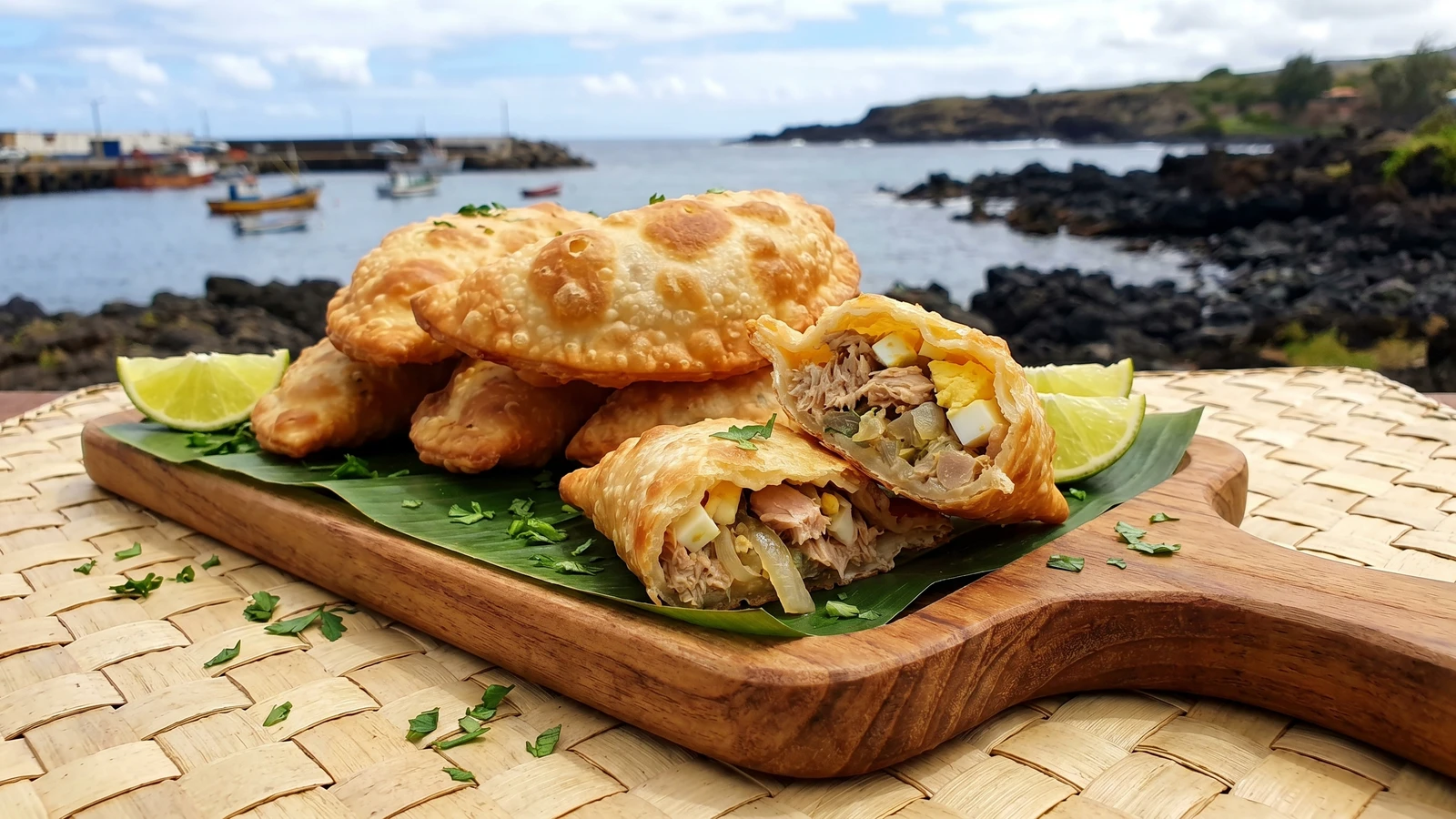
Fresh kahi from Rapa Nui folded with sweet onion and egg into Chilean-style dough, fried gold for the far corner's everyday hand pie: portable, salty, and meant for one more cousin.
At the far corner of the Triangle, the ocean has a long memory. Rapa Nui looks lonely on a map, but not to the canoe. It sits out there as Te Pito o te Henua, the navel of the world, with black volcanic stone underfoot and kahi, tuna, running in the deep blue water. This dish belongs to Rapa Nui: empanadas de atún, fresh fish and onion folded into a Chilean pastry and fried for the hand.
Back home in Hawaiʻi, we might cut ʻahi for poke with limu and ʻinamona. In Tahiti the cousins make ʻia ota, in Sāmoa oka iʻa, in Tonga ʻota ʻika, in the Cook Islands ika mata. Same fish, different bowl. Rapa Nui takes that same ocean law and folds it into a pocket of wheat dough, because history came in ships and stayed in the pantry, and the island made it useful.
The why is simple: don't beat good fish to death. Sweat the onion until it goes sweet, turn the kahi only until it just firms, cool the filling, then seal it inside dough so the fryer can make the outside blistered and gold while the inside stays moist. The filling should taste like harbor salt, onion sweetness, and clean fish. Not old oil. Not dry flakes.
This is not my home island's deep ceremony, and for the umu pae, the Rapa Nui stone earth oven, and the sacred parts of Rapa Nui feast ways, I send you to Rapa Nui elders. They should tell their own story. Here we're making everyday comfort food, picnic food, the kind you eat warm from a paper napkin with another one waiting. Eat what you have: fresh kahi if you can, good canned tuna if that's what the cupboard gives. Keeper, not gatekeeper.
Rapa Nui sits at the eastern point of the Polynesian Triangle, nearly 2,200 miles off Chile, with an older deep table of kumara, sweet potato, taro, banana, chicken, fish, and the umu pae, the Rapa Nui stone earth oven. After Chile annexed the island in 1888, wheat flour, frying oil, and the Spanish-Chilean empanada became part of everyday cooking, and island cooks filled that pastry with local kahi instead of beef. This is not pre-contact deep food; it is living Rapa Nui food, where Polynesian fishing knowledge and a Chilean pantry meet without either one disappearing.
Quantity
3 cups
plus more for rolling
Quantity
1 teaspoon
Quantity
1 teaspoon
Quantity
4 tablespoons
softened
Quantity
3/4 to 1 cup
Quantity
1 1/4 pounds
cut into 1/2-inch dice
Quantity
1 tablespoon, plus about 6 cups
for cooking the filling and frying
Quantity
1 large
finely diced
Quantity
2 cloves
minced
Quantity
1 teaspoon
Quantity
1/2 teaspoon
Quantity
1/2 teaspoon
Quantity
2
chopped
Quantity
1 tablespoon
Quantity
1/4 cup
chopped
Quantity
to taste
Quantity
for serving
| Ingredient | Quantity |
|---|---|
| all-purpose flourplus more for rolling | 3 cups |
| fine sea salt | 1 teaspoon |
| baking powder | 1 teaspoon |
| lard, unsalted butter, or neutral oilsoftened | 4 tablespoons |
| warm water | 3/4 to 1 cup |
| fresh tuna (kahi)cut into 1/2-inch dice | 1 1/4 pounds |
| neutral oilfor cooking the filling and frying | 1 tablespoon, plus about 6 cups |
| yellow onionfinely diced | 1 large |
| garlicminced | 2 cloves |
| ají de color or sweet paprika | 1 teaspoon |
| ground cumin | 1/2 teaspoon |
| dried oregano | 1/2 teaspoon |
| hard-boiled eggschopped | 2 |
| fresh lime or lemon juice | 1 tablespoon |
| flat-leaf parsley or cilantro (optional)chopped | 1/4 cup |
| sea salt and black pepper | to taste |
| lime wedges (optional) | for serving |
Whisk the flour, salt, and baking powder in a wide bowl. Rub in the lard, butter, or oil until the flour feels sandy between your fingers, then pour in 3/4 cup warm water and mix until a rough dough forms. Add the last 1/4 cup water only if the dough is dry and cracking. Knead 4 to 5 minutes, until smooth and soft, then cover and rest 30 minutes.
Heat 1 tablespoon oil in a skillet over medium heat. Add the onion with a pinch of salt and cook 8 to 10 minutes, stirring often, until it turns soft, sweet, and translucent without browning hard. Stir in the garlic, ají de color, cumin, oregano, and a few grinds of black pepper, and cook another minute until the pan smells warm and savory.
Pat the diced kahi dry so it sears instead of leaking water. Fold it into the onion and cook 1 to 2 minutes, just until the outside turns opaque and the pieces begin to firm. Pull the pan from the heat before the tuna goes dry. Fold in the chopped egg, lime or lemon juice, and parsley or cilantro if using, then taste for salt.
Spread the filling on a plate or shallow pan and let it cool until it is no longer warm to the touch. Hot filling makes the dough soft and weak, then the empanada opens in the oil and you lose the good part. No blame the dough. You hurried it.
Divide the rested dough into 10 to 12 balls. On a lightly floured surface, roll each one into a thin 6-inch round, about the thickness of a tortilla. Keep the rounds covered with a towel so they do not dry at the edges while you work.
Set 2 to 3 tablespoons cooled tuna filling just off center on each round. Wet the edge with a fingertip of water, fold the dough over into a half-moon, and press out any trapped air. Seal with a fork or fold the edge over itself in a simple rope. Don't overfill. A modest empanada that stays closed beats a proud one that bursts.
Heat 2 inches of oil in a heavy pot to 350F. Fry 2 or 3 empanadas at a time, turning once, until the pastry is blistered, crisp, and deep golden, about 2 to 3 minutes per side. Let the oil come back to temperature between batches. Drain on a rack, not on a pile of paper where the bottom goes soft.
Serve warm with lime wedges, the crust crisp under your teeth and the tuna inside still moist and savory. These are hand food, picnic food, harbor food. Put them out in a pile, because somebody will reach for the last one and then look around like they didn't do it.
1 serving (about 125g)
Culinary guides, cultural storytelling, and the editorial depth that makes cooking meaningful.
Discover Culinary ExplorerChef Juliette
Tiny éperlans, lightly floured and fried until their tails stand crisp, arrive in a generous heap on a napkin with fried parsley and grooved lemon, a weeknight lesson in heat and restraint.

Chef Juliette
Brandade de Morue turns salt cod, warm olive oil, and milk into a pale, silky emulsion: keep everything warm and add the oil slowly, then crown the generous dome with butter-fried bread.

Chef Juliette
Salt cod worked warm with cream, one patient spoonful at a time, until the rough flakes become a glossy Nîmes paste, domed generously and ringed with butter-fried croutons for the table.

Chef Juliette
Wine-poached char packed in its earthenware crock beneath butter gold: a make-ahead first course that turns careful cooling, thorough boning, and one unbroken seal into quiet abundance.