
Chef Lupita
Chiapas Crystallized Fruits (Frutas Cristalizadas)
Los Altos de Chiapas preserves fruit the patient way: cal-firmed papaya, calabaza, duraznos, and ciruelas cooked and rested in syrup until each piece shines like market candy.
A cooking platform built around craft, culture, and the stories behind what we eat.
Created by
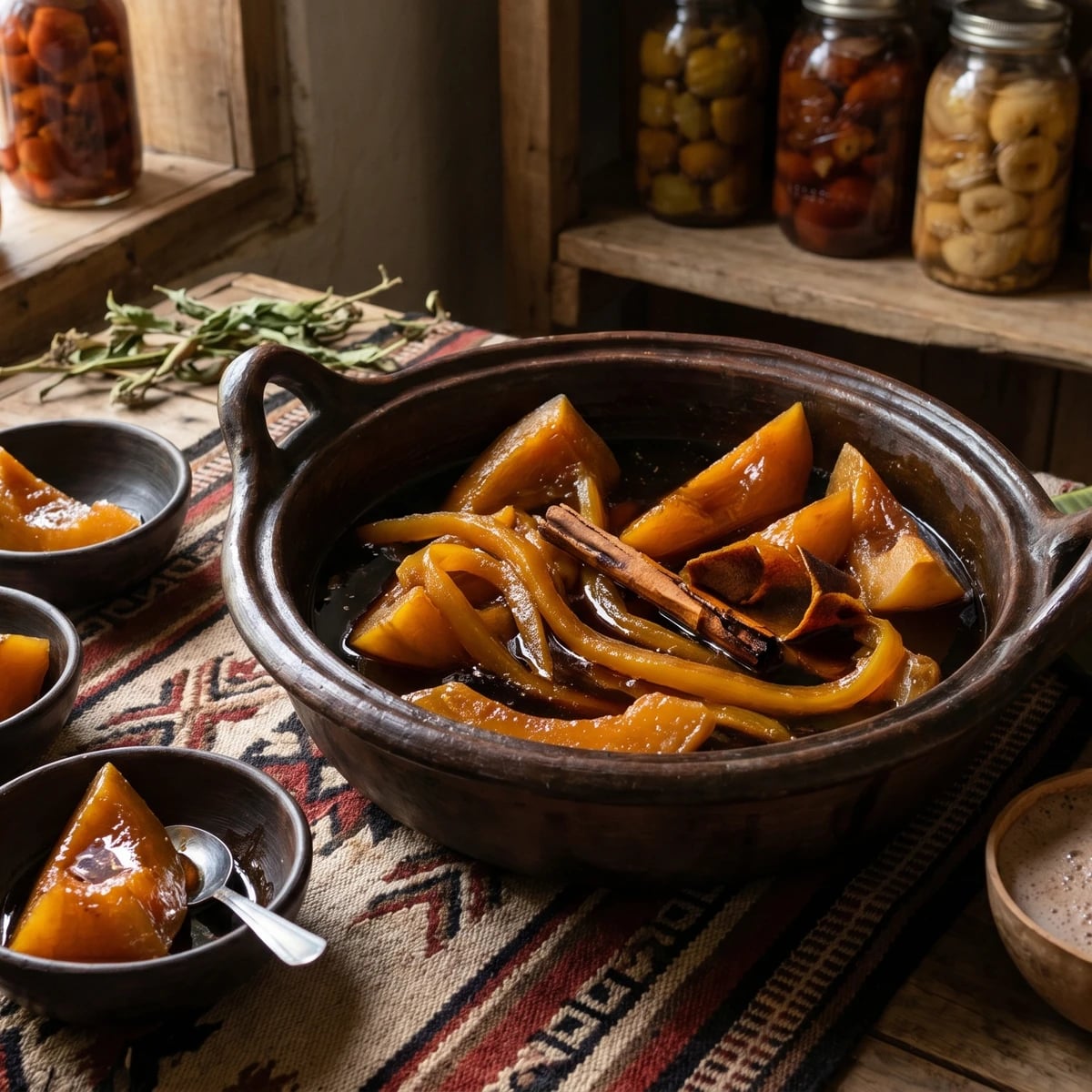
Chiapas's Lenten chilacayota, firmed with cal, then simmered slowly in piloncillo, canela, clavo, and orange peel until the pale squash turns amber and glassy.
Chiapas, especially Chiapa de Corzo and the Grijalva basin, knows this dulce by the look of the strands: pale chilacayota cooked until it turns translucent in dark piloncillo syrup. This is not a pastry-shop candy. This belongs in a clay cazuela, on a tile kitchen floor, beside jars of preserved fruit and a jicara of pozol.
The ingredient is chilacayota, Cucurbita ficifolia, a hard-skinned squash with white flesh that separates into threads when cooked. The technique belongs to the women who learned to make fruit last: soak in food-grade cal so the pieces hold their shape, rinse well, then cook patiently in piloncillo with canela de Ceylan, clavo de olor, and orange peel. No me vengas con atajos. If you skip the cal, the squash collapses into jam. Good jam, maybe. Not this dulce.
I first wrote down a Chiapas version from a señora near Chiapa de Corzo during Fiesta Grande, where the dulces sit in glass jars like little pieces of the market preserved in syrup. She used panela from the region, not white sugar, and she did not measure with spoons. She measured by color, by smell, by the way the syrup fell from the paddle. Recetas probadas y garantizadas, but your eyes still have to work.
This is a 32-state cuisine. Cada estado, su propia cocina. Chilacayota appears in other parts of Mexico, yes, but this version carries the southern sweetness of piloncillo, citrus peel, and the patient pantry work of Chiapas.
Chilacayote, Cucurbita ficifolia, is a Mesoamerican squash cultivated long before the Spanish conquest and valued because its hard shell allowed it to store well through dry months. The practice of candying squash in piloncillo syrup developed after sugarcane became established in colonial New Spain, joining an older Indigenous squash tradition with Spanish and Afro-Caribbean sugar techniques. In Chiapas, dulce de chilacayota is strongly tied to Cuaresma and Semana Santa tables, where preserved fruits, marquesote, turuletes, and pozol show the state's southern pantry.
Quantity
1 medium, about 4 pounds
washed
Quantity
2 tablespoons
for soaking
Quantity
3 quarts
for the cal soak
Quantity
2 pounds
chopped or broken into cones
Quantity
4 cups
for the syrup
Quantity
2
Quantity
4
Quantity
2 wide strips
white pith removed
Quantity
1/2 teaspoon
| Ingredient | Quantity |
|---|---|
| chilacayota squashwashed | 1 medium, about 4 pounds |
| food-grade cal (calcium hydroxide)for soaking | 2 tablespoons |
| waterfor the cal soak | 3 quarts |
| piloncillochopped or broken into cones | 2 pounds |
| waterfor the syrup | 4 cups |
| Mexican cinnamon sticks (canela de Ceylan) | 2 |
| whole cloves (clavo de olor) | 4 |
| orange peelwhite pith removed | 2 wide strips |
| kosher salt | 1/2 teaspoon |
Set the chilacayota on a steady board and cut it into large wedges with a heavy knife. The rind is hard. Work slowly and keep your fingers out of the path of the blade. Scrape out the seeds and loose fibers, then cut the flesh, rind still attached, into pieces about 2 inches wide. The rind helps the pieces keep their shape during the long cooking.
Dissolve the food-grade cal in 3 quarts of water in a large nonreactive bowl. Add the chilacayota pieces and weigh them down with a plate so they stay submerged. Let them soak 8 to 12 hours. The cal firms the surface so the syrup can enter slowly without turning the squash to mush. This is pantry knowledge, not decoration.
Drain the chilacayota and rinse each piece under running water, rubbing the surface with your hands. Change the water in the bowl two or three times until it runs clear. Taste matters here. If you leave cal on the squash, the syrup will taste chalky and harsh. There is no romance in bad rinsing.
In a wide clay cazuela or heavy pot, combine the piloncillo, 4 cups water, canela, clavo, orange peel, and salt. Bring to a simmer over medium heat, stirring until the piloncillo dissolves. The syrup should smell dark and mineral, with the orange just behind the cinnamon. White sugar cannot give you that flavor. Piloncillo is the point.
Add the rinsed chilacayota pieces to the syrup, rind side down when possible. Reduce the heat to low and simmer uncovered for 2 to 3 hours, turning the pieces gently every 30 minutes. Do not stir like you are making soup. Lift and turn. The flesh will go from white to pale gold, then amber and translucent at the edges.
When the squash is tender and glassy, remove the canela, clavo, and orange peel. Continue simmering until the syrup thickens enough to coat a spoon and falls in a slow thread. Watch the bottom of the pot now. Piloncillo can burn when it gets thick, and burned piloncillo tastes bitter. The finished dulce should be glossy, not scorched.
Turn off the heat and let the chilacayota rest in the syrup until cool. It tastes better after several hours, and better still the next day. Serve the pieces with a spoonful of syrup in small clay bowls, or pack them into clean glass jars and refrigerate. Saber cocinar es saber vivir.
1 serving (about 285g)
Culinary guides, cultural storytelling, and the editorial depth that makes cooking meaningful.
Discover Culinary Explorer
Chef Lupita
Los Altos de Chiapas preserves fruit the patient way: cal-firmed papaya, calabaza, duraznos, and ciruelas cooked and rested in syrup until each piece shines like market candy.

Chef Lupita
Chiapas's soaked marquesote cake from Chiapa de Corzo, firm egg sponge drenched in piloncillo syrup scented with Mexican cinnamon, clove, and star anise.

Chef Lupita
Tabasco's celebration pudding of day-old panetela, dark piloncillo syrup, canela, eggs, and salty queso de bola de Ocosingo, baked until the edges turn caramel-dark and the center stays tender.

Chef Lupita
Chiapas's coastal coconut candy, cooked slowly with milk, piloncillo, sugar, and canela until the fresh coconut turns chewy, glossy, and honey-brown.