
Chef Jeong-sun
Aehobak-guk (애호박국, Korean Zucchini Soup)
A clean summer soup of Korean zucchini and salted shrimp, built on quick anchovy-kelp broth and finished before the half-moons lose their shape on a weeknight table.
A cooking platform built around craft, culture, and the stories behind what we eat.

Created by
A winter table stew of frozen pollock, roe, radish, and tofu, cleaned by blanching first and simmered in a spicy broth that should taste clear and briny, never heavy.
Dongtae-jjigae lives or dies before the stew begins: clean the fish. Master Seong-nyeo would set the frozen pollock in front of me and say nothing until I found the dark blood near the spine and the black membrane inside the belly. Miss that, and the pot tells on you. The broth goes dull, the fish smells tired, and everyone blames the market.
This is a winter stew, the kind that comes home from the fish stall in a plastic bag with a few precious sacks of myeongnan (pollock roe) tucked beside the cut fish. It is not a rich stew. It is a clean, sharp one, built on radish, anchovy broth, and enough chili to warm the face without burying the pollock. The radish has the harder work than people think. Cut it thick enough to hold, simmer it first, and it sweetens the broth before the fish arrives.
I won't tell you this is difficult, but it asks for order: thaw cold, trim clean, blanch briefly, build the broth, then add the roe late. One tablespoon too much gochujang will make the pot heavy. One hard stir will break the fish into rags. 손맛 is real, the hand-taste your grandmother trusted, but I measure it anyway so the next cook can make the same good stew twice.
Pollock, myeongtae (Alaska pollock), is one of the most specifically named fish in Korean markets: saengtae when fresh, dongtae when frozen, bugeo when dried, hwangtae when repeatedly frozen and dried by winter wind, kodari when half-dried, and nogari when young. Dongtae-jjigae belongs to winter homes and ordinary restaurants that could stretch a frozen fish into a full table with radish, tofu, roe, and rice. Since Korean pollock catches fell sharply in the late twentieth century, much of the dongtae sold in Korea now comes frozen from Russia or Alaska, but the home method remains Korean: clean the fish, build a radish broth, and season with restraint.
Quantity
800g
thawed in the refrigerator, cut into 2-inch pieces, belly membrane and blood clots removed
Quantity
120g
rinsed gently
Quantity
80g
rinsed gently
Quantity
6 cups
Quantity
1 tablespoon
Quantity
2 tablespoons
Quantity
6 cups
Quantity
1 piece, about 4 inches square
Quantity
10 large
heads and guts removed
Quantity
350g
peeled and cut into 1/2-inch half-moons
Quantity
3 tablespoons
Quantity
1 tablespoon
Quantity
1 tablespoon
Quantity
1 tablespoon
Quantity
1 teaspoon
Quantity
4 cloves
minced
Quantity
1 teaspoon
grated
Quantity
1/4 teaspoon
freshly ground
Quantity
150g
rinsed
Quantity
1/2 medium
sliced 1/2 inch thick
Quantity
300g
cut into 1/2-inch slabs
Quantity
2
cut into 2-inch lengths
Quantity
1
sliced on the diagonal
Quantity
1
sliced on the diagonal
Quantity
40g
trimmed
Quantity
1/2 teaspoon
| Ingredient | Quantity |
|---|---|
| frozen pollock (dongtae)thawed in the refrigerator, cut into 2-inch pieces, belly membrane and blood clots removed | 800g |
| raw pollock roe sacks (myeongnan)rinsed gently | 120g |
| pollock milt (goni) (optional)rinsed gently | 80g |
| water for blanching | 6 cups |
| coarse sea salt for blanching | 1 tablespoon |
| soju or rice wine for blanching (optional) | 2 tablespoons |
| water for broth | 6 cups |
| dried kelp (dasima) | 1 piece, about 4 inches square |
| dried anchovies (myeolchi)heads and guts removed | 10 large |
| Korean radish (mu)peeled and cut into 1/2-inch half-moons | 350g |
| gochugaru (Korean chili flakes) | 3 tablespoons |
| gochujang (Korean chili paste) | 1 tablespoon |
| guk-ganjang (Korean soup soy sauce) | 1 tablespoon |
| anchovy fish sauce (myeolchi aekjeot) | 1 tablespoon |
| doenjang (fermented soybean paste) | 1 teaspoon |
| garlicminced | 4 cloves |
| fresh gingergrated | 1 teaspoon |
| black pepperfreshly ground | 1/4 teaspoon |
| soybean sprouts (kongnamul)rinsed | 150g |
| onionsliced 1/2 inch thick | 1/2 medium |
| firm tofucut into 1/2-inch slabs | 300g |
| scallionscut into 2-inch lengths | 2 |
| green chilisliced on the diagonal | 1 |
| red chilisliced on the diagonal | 1 |
| crown daisy (ssukgat) or water dropwort (minari) (optional)trimmed | 40g |
| fine sea salt (optional) | 1/2 teaspoon |
Thaw the frozen pollock overnight in the refrigerator, set on a tray to catch any liquid. Never thaw it on the counter. Rinse each piece quickly under cold running water, then look inside the belly. Pull away any loose black membrane and scrape out dark blood near the spine with a small spoon or the back of a knife. Keep the skin on; it gives the stew body. Keep the roe sacks whole if you can, but do not worry if one tears. Torn roe clouds the broth a little and still eats well.
Bring 6 cups water, 1 tablespoon coarse sea salt, and the soju or rice wine, if using, to a hard boil. Lower in the pollock pieces for 45 seconds, just until the outside tightens and gray foam rises. Lift them out with a spider or slotted spoon, rinse quickly under cool running water to remove clinging scum, and drain. Dip the roe and milt, if using, for 10 seconds only, then lift them out carefully. This is not cooking the fish through. It is washing it with boiling water so the stew tastes clean, like sea, not mud.
Put 6 cups fresh water, the kelp, anchovies, and radish in a wide heavy pot. Bring it slowly to a simmer over medium heat. Pull the kelp out as soon as the water begins to simmer, because kelp left too long turns the broth slick and bitter. Simmer the anchovies and radish for 10 minutes more, then remove the anchovies and leave the radish in the pot. The radish should look slightly translucent at the edges. It is doing real work here, sweetening the broth and giving the fish a clean place to land.
In a small bowl, stir together the gochugaru, gochujang, guk-ganjang, anchovy fish sauce, doenjang, garlic, ginger, black pepper, and 1/2 cup hot broth from the pot. Use the gochujang for body, not domination. One tablespoon is enough. The gochugaru should carry the color, and the fish should still taste like fish.
Stir the seasoning paste into the radish broth. Add the onion and soybean sprouts, then lay the blanched pollock pieces on top in one layer. Cover the pot halfway and simmer over medium heat for 8 minutes. Do not stir hard. Pollock flakes if you bully it. Nudge the pieces gently and spoon broth over the top so the seasoning reaches everything.
Slide in the tofu slabs, roe, and milt, if using. Simmer gently for 5 to 6 minutes, until the fish flakes at the thickest part and the roe is opaque and firm through the center. If you check with a thermometer, the fish should reach 145 F / 63 C. Skim any foam that gathers at the edge, but do not chase every speck. A home stew is not a clear consommé, and it should not pretend to be one.
Add the scallions, green chili, red chili, and crown daisy or water dropwort. Simmer 1 minute, just until the greens relax. Taste the broth now. If it is flat, add up to 1/2 teaspoon fine sea salt. If it is too salty, add a splash of hot water and let it settle for 1 minute. Carry the pot to the table with rice and a few banchan. Write it down. Memory is a borrowed bowl.
1 serving (about 750g)
Culinary guides, cultural storytelling, and the editorial depth that makes cooking meaningful.
Discover Culinary ExplorerChef Jeong-sun
A clean summer soup of Korean zucchini and salted shrimp, built on quick anchovy-kelp broth and finished before the half-moons lose their shape on a weeknight table.
Chef Jeong-sun
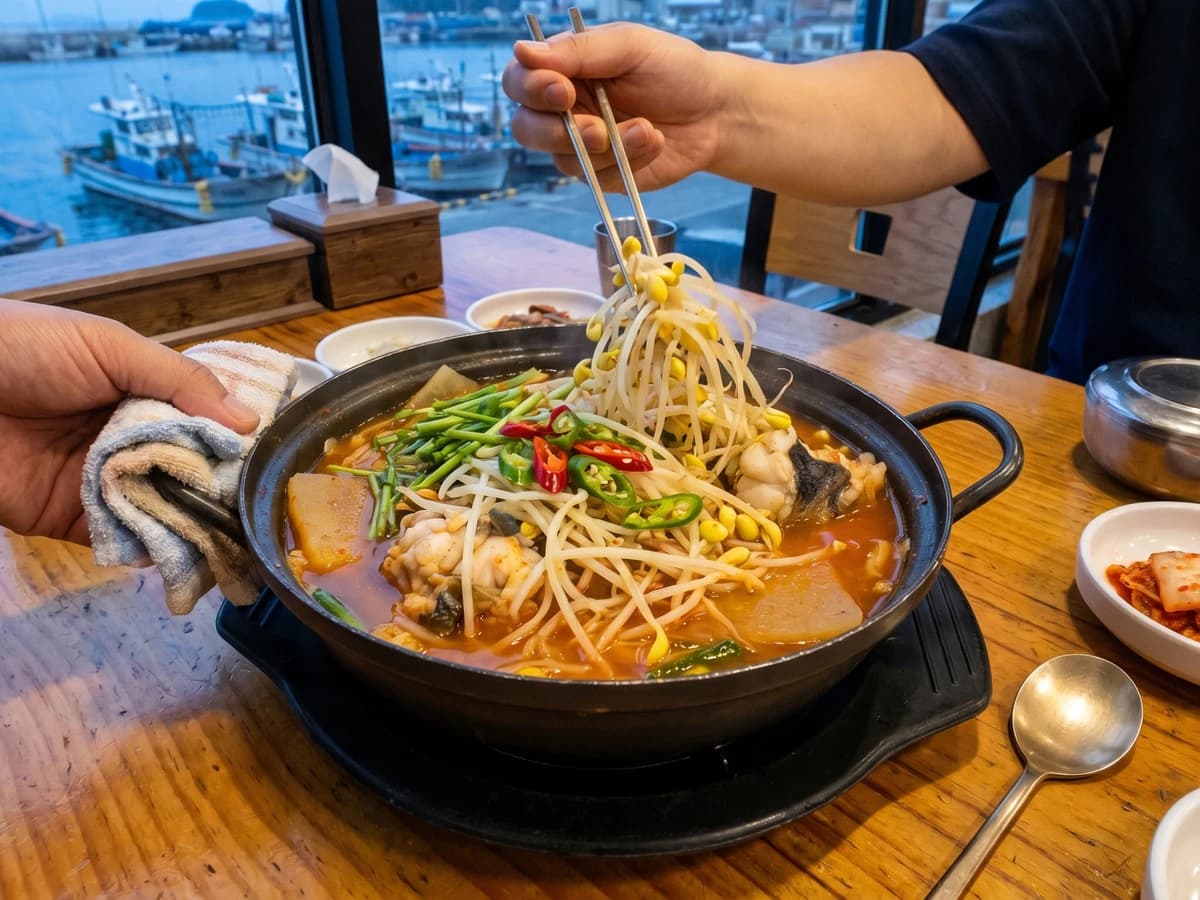
A Masan coast monkfish stew with firm white meat, gelatin at the bones, soybean sprouts for crunch, and a red broth seasoned to carry the fish, not bury it.

Chef Jeong-sun
A weeknight fish roe stew with radish and crown daisy in a clean spicy broth, where the whole success depends on adding the roe late enough that it sets tender, not chalky.

Chef Jeong-sun
Late-summer mallow leaves rubbed with salt until the bitter green water runs off, then simmered in a clean doenjang broth with dried shrimp, the quiet soup a Korean weeknight deserves.