Culinary Explorer

A cooking platform built around craft, culture, and the stories behind what we eat.
Discover Culinary Explorer
Crostini al Tartufo Nero di Norcia

Crostini al Tartufo Nero di Norcia

Created by

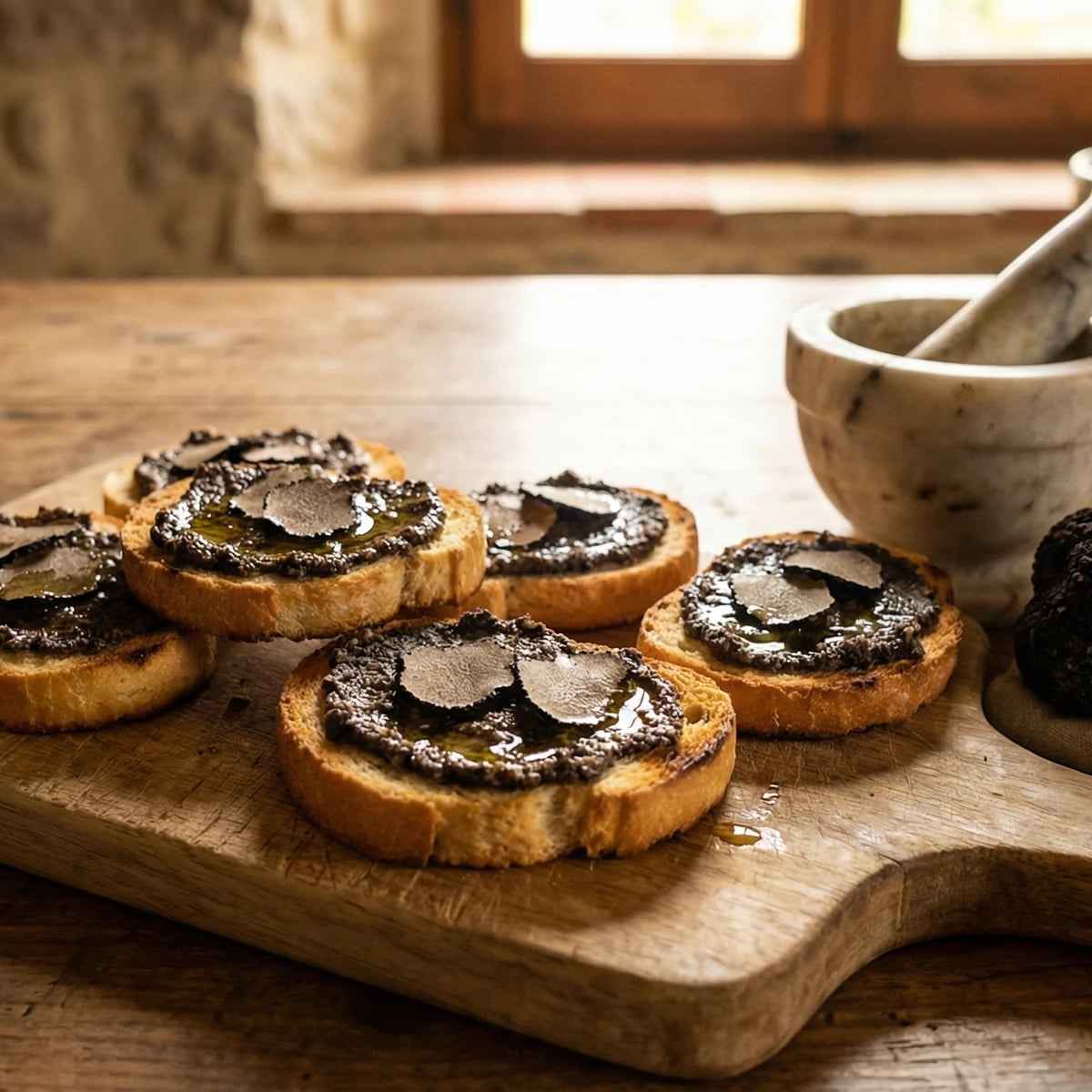
The black truffles of Norcia, pounded to a paste with nothing but olive oil and restraint, spread on warm bread. This is Umbrian luxury in its purest form.

Appetizers & Snacks
Italian
Special Occasion
Dinner Party
20 min
Active Time
10 min cook30 min total
Yield6 servings

Norcia sits in the mountains of Umbria, where the forests give up their treasures to those who know where to look. The black truffle of this region is less celebrated than its white cousin from Alba, which is a mistake. It has an earthiness, a depth, that speaks of the woods in autumn.

This is not a recipe that hides behind technique. There is no technique to speak of. You pound truffles with oil until they become paste. You toast bread. You spread one on the other. The only skill required is restraint: the courage to leave out everything that does not belong.

Americans want to add garlic. They want cream. They want to complicate what needs no complication. The truffle has traveled from the forest floor to your table. It does not need your help. It needs you to stay out of its way.

Norcia has been the center of Umbrian truffle hunting since at least the 14th century, when the town's hunters developed secret knowledge of the forests passed from father to son. The norcini, as the town's craftsmen are called, became so renowned for their skill with both truffles and pork that their name became synonymous with Italian charcuterie.

The technique, the tradition, and the story behind every dish.

Discover Culinary Explorer

Ingredients

fresh black truffles

Quantity

3 ounces

extra virgin olive oil

Quantity

1/3 cup

finest quality, preferably Umbrian

fine sea salt

Quantity

to taste

rustic Italian bread

Quantity

12 slices

cut 1/2 inch thick

anchovy fillet (optional)

Quantity

1 small

rinsed and minced

Equipment Needed

  • Mortar and pestle (marble preferred)
  • Soft brush for cleaning truffles
  • Sharp knife

Instructions

  1. 1

    Clean the truffles

    Brush the truffles gently with a soft brush to remove any soil. Do not wash them under water. Truffles absorb moisture like a sponge, and you will dilute the very flavor you paid dearly for. If there is stubborn dirt, scrape it away with a small knife. Pat dry with a clean cloth.

  2. 2

    Pound the truffle paste

    Chop the truffles roughly and place them in a mortar. Add a pinch of salt. If using the anchovy, add it now. Begin pounding with the pestle, working in a circular motion. Add the olive oil gradually, a tablespoon at a time, continuing to pound and work the mixture until you have a coarse paste. It should not be perfectly smooth. Some texture is correct.

    The anchovy dissolves entirely and adds a subtle depth that enhances the truffle without announcing itself. Old Umbrian cooks knew this. You will not taste fish. You will taste a rounder, more complete truffle flavor.
  3. 3

    Toast the bread

    Toast the bread slices under a broiler or on a grill until golden on both sides. Watch them carefully. They should be crisp at the edges but still have give at the center. The bread must be warm when you spread the paste. Cold bread is a waste of good truffle.

  4. 4

    Assemble and serve

    Spread the truffle paste generously on each warm crostino. Do not be stingy. You have already spent the money on the truffles. Arrange on a board or platter and serve immediately. These wait for no one. The warmth of the bread releases the truffle's perfume. Within minutes, that moment passes.

    If you wish, shave a few thin slices of fresh truffle over the finished crostini. This is gilding the lily, but with truffles, gilding the lily is sometimes appropriate.

Chef Tips

  • Seek out tartufo nero di Norcia specifically if you can find it. The black truffles of Umbria have a character distinct from those of Périgord or elsewhere. If unavailable, any fresh black truffle will serve, but know what you are missing.
  • The olive oil must be exceptional. Umbrian oil, pressed from the region's small olives, has a peppery finish that complements the truffle. Do not use supermarket oil and expect the same result.
  • A food processor will create truffle paste more quickly, but the mortar produces superior texture. The slow pounding releases aromatic compounds differently than the violent spinning of blades. You will taste the difference.
  • Store any leftover paste in a small jar, covered with a thin layer of olive oil, refrigerated. Use within three days. The flavor fades quickly. This is not something you make ahead for a party next week.

Advance Preparation

  • The truffle paste can be made up to four hours ahead. Cover directly with plastic wrap touching the surface to prevent oxidation. Bring to room temperature before using.
  • The bread must be toasted just before serving. There is no way around this. Cold, stale toast insults the truffle.

Frequently Asked Questions

Nutrition Information

1 serving (about 85g)

Calories
275 calories
Total Fat
13 g
Saturated Fat
2 g
Trans Fat
0 g
Unsaturated Fat
10 g
Cholesterol
2 mg
Sodium
420 mg
Total Carbohydrates
32 g
Dietary Fiber
2 g
Sugars
1 g
Protein
6 g

Note: Chef personas and recipes are created with AI assistance. Cook with care: follow safe food-handling practices, check doneness with a thermometer when needed, and adapt for allergies and your kitchen.

Where cooking meets culture.

Culinary guides, cultural storytelling, and the editorial depth that makes cooking meaningful.

Discover Culinary Explorer

More from Chef Graziella's Appetizers & Snacks

Browse the full collection