
Chef Lupita
Agua de Alfalfa
Ciudad de México's highland market agua fresca, fresh alfalfa blended with pineapple and lime until bright green, strained clean, and poured cold from the vitrolero.
A cooking platform built around craft, culture, and the stories behind what we eat.
Created by
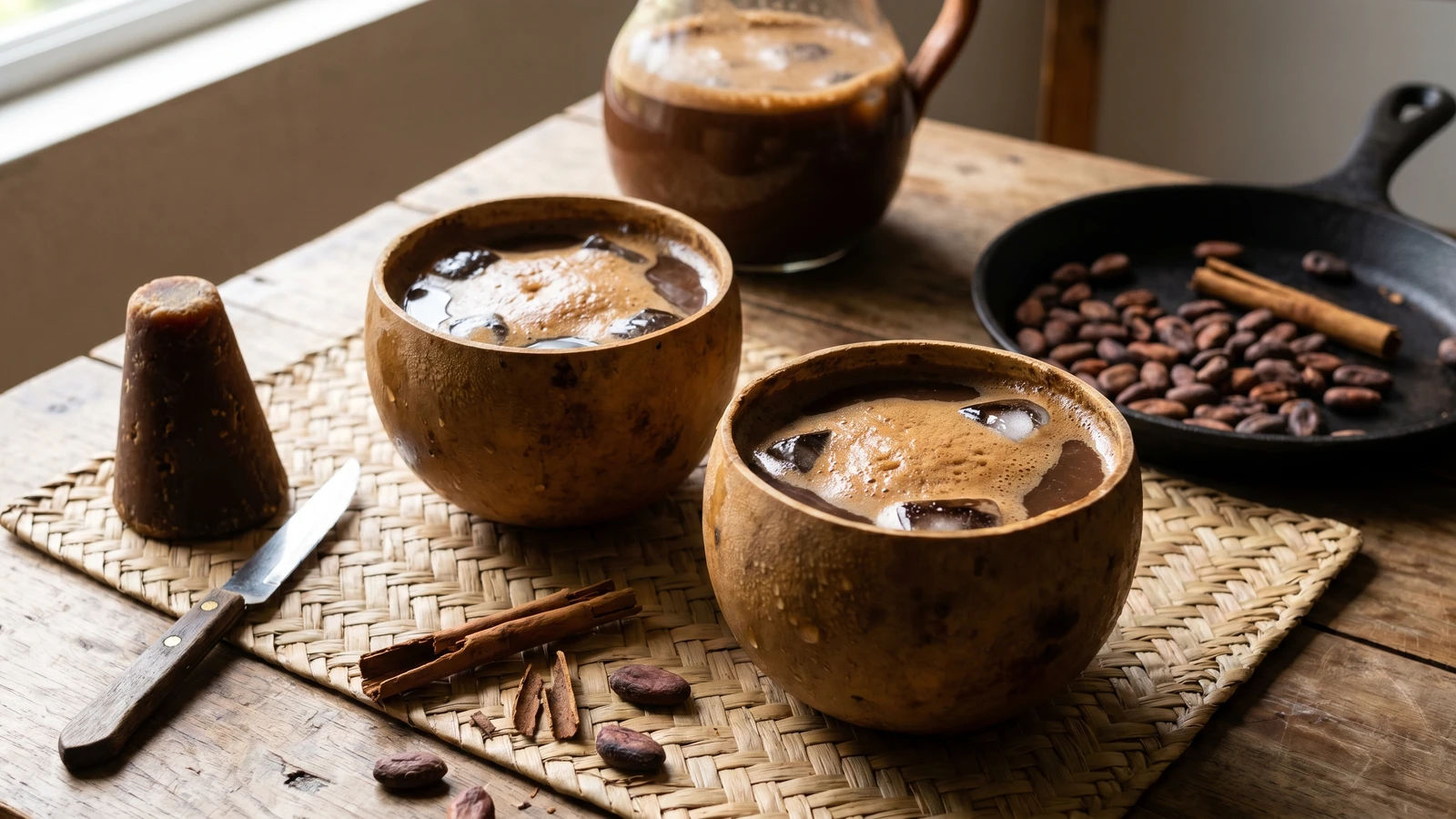
The Afro-Mexican drink of Oaxaca's Costa Chica, built on toasted cacao, rice, cinnamon, and piloncillo, then poured from a great height until it froths and served ice-cold in jicaras.
Chilate is from the Costa Chica. That strip of Pacific coast that runs from Oaxaca into Guerrero, where the Afro-Mexican communities of Pinotepa Nacional, Cuajinicuilapa, and Jamiltepec have lived and cooked for four centuries. This drink does not belong to the rest of Mexico. It belongs to them.
The word chilate comes from the Nahuatl chilatl, meaning chile water, but the version made on the Costa Chica is something else entirely: cold, dark, frothy, sweet with piloncillo, built on toasted cacao and rice and Mexican cinnamon. No chile. The name traveled and the recipe changed. What stayed is the technique of pouring the drink from a great height to froth it, and the jicara, the dried gourd cup that has held this drink at celebrations, funerals, and ordinary afternoons since long before there was a Mexico.
The cacao matters. You want whole beans, not powder, and you toast them yourself on a comal until the shells crackle off. The rice matters too. It has to be toasted, dry, until it smells nutty. Skip either of those steps and you have a sad brown drink that tastes of nothing in particular. Do them right and you have chilate, the cold cacao drink of the Afro-Mexican coast, the one that gets carried in tin buckets through the markets of Pinotepa Nacional on hot afternoons.
My mother never made this. She was from Jalisco and Jalisco does not know chilate. I learned it on the Costa Chica from a woman named dona Esperanza who runs a stall in the Pinotepa market and who frothed it from so high above her head that I thought she would spill it on the ground. She did not spill a drop. Saber cocinar es saber vivir, and dona Esperanza knows both.
Chilate de cacao is one of the signature drinks of Mexico's Afro-descendant communities, whose ancestors were brought to the Costa Chica of Oaxaca and Guerrero as enslaved laborers on Spanish colonial cattle ranches in the 16th and 17th centuries. The drink combines indigenous Mesoamerican cacao traditions with West African techniques of grain-based cold beverages and the elevated pour, a method used across the African diaspora to aerate drinks and create foam. The Mexican government did not officially recognize Afro-Mexicans as a distinct cultural group in the national census until 2015, and chilate remains one of the most visible culinary markers of an Afro-Mexican identity that the rest of the country has only recently begun to acknowledge.
Quantity
1 cup
Quantity
4 ounces
unroasted
Quantity
2 sticks, about 4 inches each
Quantity
8 ounces (about 1 cone)
chopped, plus more to taste
Quantity
8 cups
divided
Quantity
1 pinch
Quantity
for serving
Quantity
as needed for thinning
| Ingredient | Quantity |
|---|---|
| long-grain white rice | 1 cup |
| whole cacao beansunroasted | 4 ounces |
| Mexican cinnamon (canela de Ceylan) | 2 sticks, about 4 inches each |
| piloncillochopped, plus more to taste | 8 ounces (about 1 cone) |
| cold filtered waterdivided | 8 cups |
| fine sea salt | 1 pinch |
| ice cubes (optional) | for serving |
| additional cold water (optional) | as needed for thinning |
Heat a dry comal or heavy skillet over medium-low. Add the cacao beans in a single layer. Toast for 8 to 10 minutes, shaking the pan often, until the shells crackle and lift away from the bean and the kitchen smells like a chocolate mill in Pinotepa Nacional. Tip them onto a plate to cool. Once cool enough to handle, rub the beans between your palms or inside a clean kitchen towel. The papery shells slip off. Discard them. You want only the dark, fragrant nibs.
On the same comal, still over medium-low heat, toast the dry rice and the cinnamon sticks together for about 5 minutes. Stir constantly. The rice will turn from white to pale gold and smell nutty, like the bottom of a cazuela. The cinnamon will release its oils and perfume the kitchen. Pull it off the heat the moment the rice colors. Toasted rice is what gives chilate its body. Untoasted rice gives you horchata, and that is a different drink from a different state.
Combine the toasted cacao nibs, toasted rice, cinnamon sticks, and 4 cups of the cold water in a large bowl or jar. Cover and refrigerate for at least 8 hours, or overnight. The rice swells, the cinnamon bleeds into the water, and the cacao softens enough to give itself up to the blender. Do not skip this soak. The texture of chilate depends on it.
While the rice and cacao soak, make a simple syrup. Combine the chopped piloncillo with 1 cup of water in a small saucepan over medium heat. Stir until the piloncillo dissolves completely, about 5 minutes. It will smell like molasses and burnt sugar, because that is what piloncillo is. Remove from heat and let cool. Use real piloncillo, the dark cone of unrefined cane sugar from the mercado. Brown sugar is not piloncillo. The depth is not the same.
Pour the soaked rice and cacao mixture, including all the soaking liquid and the cinnamon sticks, into a high-powered blender. Add the cooled piloncillo syrup and the pinch of salt. Blend on the highest setting for 3 to 4 full minutes. Stop and scrape down the sides once or twice. The mixture should be deep brown, thick, and nearly smooth. The cacao will never go fully silky in a home blender, and that gritty edge is part of what tells you this is chilate and not chocolate milk.
Set a fine-mesh strainer over a large pitcher. Pour the blended mixture through it in batches, pressing down hard with the back of a wooden spoon to extract every drop. Discard the solids that stay in the strainer. You should have a thick, dark brown liquid. Stir in the remaining 3 cups of cold water. Taste it now. If it needs more sweetness, dissolve more piloncillo in a splash of hot water and stir it in. The chilate should taste of toasted cacao first, cinnamon second, sugar last.
Chill the pitcher for at least one hour. To serve, pour the chilate from one pitcher into another from a height of about two feet, then pour it back. Do this three or four times. The drink will foam up the way it does at the stalls in Pinotepa and Cuajinicuilapa, where the women lift the jicara high and let the chilate fall in a long brown ribbon. The froth on top is the signature. Serve immediately over ice in jicaras or clay cups.
1 serving (about 240g)
Culinary guides, cultural storytelling, and the editorial depth that makes cooking meaningful.
Discover Culinary ExplorerChef Lupita
Ciudad de México's highland market agua fresca, fresh alfalfa blended with pineapple and lime until bright green, strained clean, and poured cold from the vitrolero.

Chef Lupita
Aguascalientes' Lenten agua fresca, jewel-red from cooked beet and full of apple, banana, orange, lettuce, and ground peanuts, served cold when Holy Week meets the Feria de San Marcos.

Chef Lupita
Sonora and Sinaloa's creamy malted barley water, built on toasted cebada perla, Mexican canela, vanilla from Papantla, and evaporated milk. Pink-beige, rich, and served cold over heavy ice in a heavy glass tumbler. Liquid cookie comfort the northwest way.

Chef Lupita
Yucatán's everyday tonic of boiled chaya leaves blended with lima agria, sugar, and ice. The bright green jarra that sits on every Peninsula table from Mérida to Valladolid.