
Chef Lupita
Agua de Alfalfa
Ciudad de México's highland market agua fresca, fresh alfalfa blended with pineapple and lime until bright green, strained clean, and poured cold from the vitrolero.
A cooking platform built around craft, culture, and the stories behind what we eat.
Created by
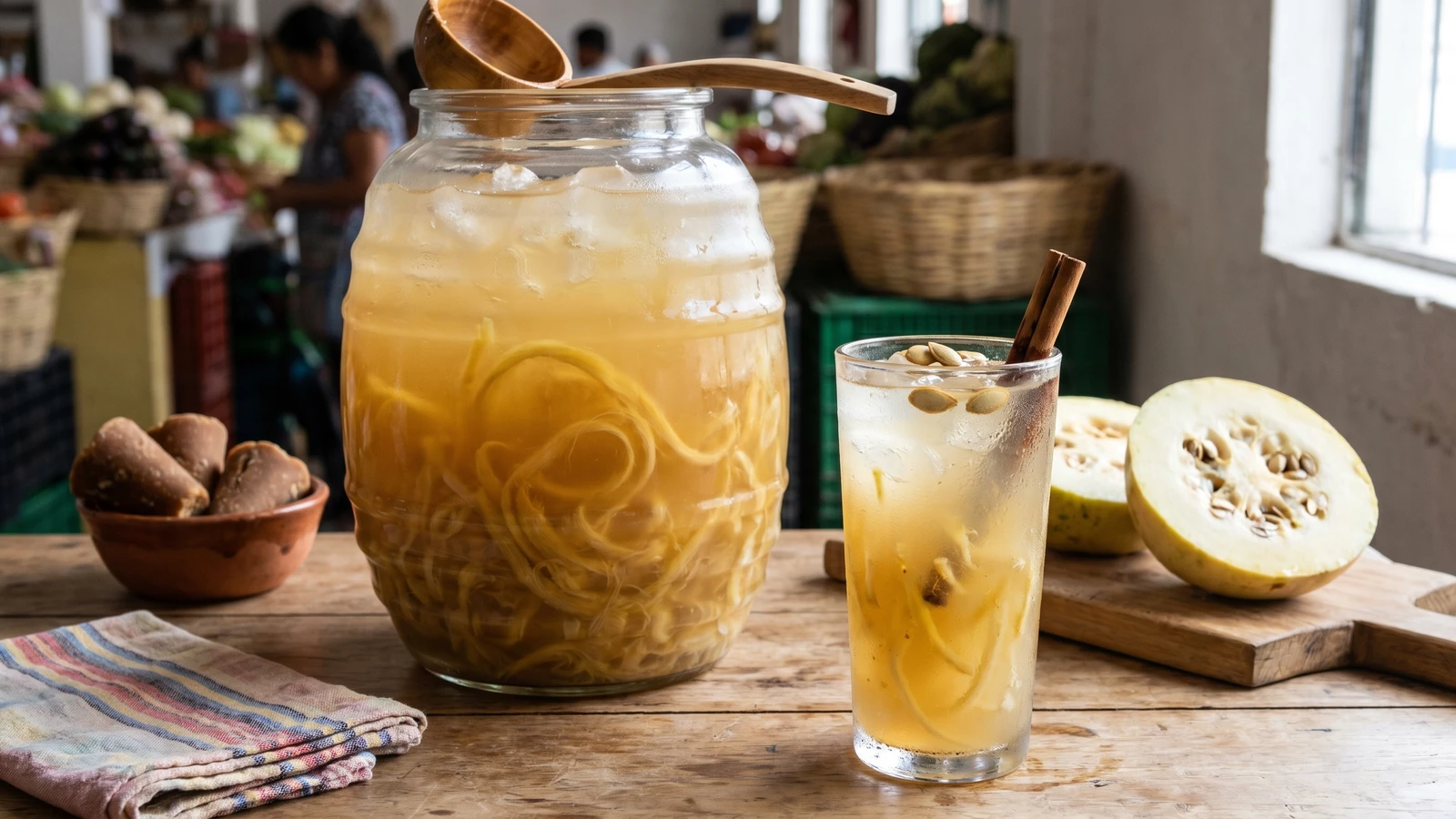
Oaxaca's market agua fresca built on chilacayota squash, piloncillo, and Mexican canela, served cold with the spaghetti-like strands of squash and toasted seeds floating in the glass.
This is from Oaxaca. Walk into the Mercado 20 de Noviembre on any morning and you will see them lined up: the great glass vitroleros holding aguas frescas of horchata, jamaica, chia, tamarindo, and the pale, golden one in the middle, full of long pale strands suspended in cinnamon-scented syrup. That is chilacayota. It is the agua that tells you which mercado you are standing in.
The chilacayota itself is a squash you will not find in most American supermarkets. Cucurbita ficifolia. The skin is hard, pale green, marbled with white. The flesh, when you cook it, breaks down into long fibrous strands that look like pale spaghetti. That is the entire point of the dish. You are not making a smooth blended drink. You are making an agua where you chew the squash as you drink it. If you strain those strands out, you have missed what chilacayota is.
The sweetener has to be piloncillo. Real piloncillo, the cones of unrefined cane sugar with the deep dark notes of molasses still in them. Not brown sugar. Not honey. Not maple. The canela has to be the soft, papery true cinnamon from Ceylon that any tienda mexicana sells as canela. The hard cassia at the supermarket is the wrong spice. Get the right ingredients or wait until you can. Cada estado, su propia cocina, and Oaxaca's aguas freshcas are not negotiable.
My mother did not make this. It is not a Jalisciense drink. I learned it in Oaxaca, watching a senora named Dona Mela ladle it from her vitrolero at a stall in the Central de Abastos. She told me her secret was the lime at the end, just enough to wake the canela up. I wrote it in the margin of my notebook. Saber cocinar es saber vivir.
Chilacayota, Cucurbita ficifolia, is one of the oldest domesticated squashes in the Americas, with archaeological evidence of cultivation in highland Mesoamerica dating back at least 7,000 years. Its name derives from the Nahuatl 'tzilacayotli,' and unlike most cucurbits the species thrives in cool highland climates above 4,000 feet, which is why it became a staple in Oaxaca, Puebla, and the Mexican altiplano rather than in the tropical lowlands. The agua fresca version emerged from the colonial-era marriage of indigenous chilacayota with Spanish-introduced sugar cane, which Mexican cooks transformed into piloncillo by boiling and pouring the unrefined cane juice into clay molds, a technique still practiced in small Oaxacan trapiches today.
Quantity
1 medium (4 to 5 pounds)
halved and seeded, seeds reserved
Quantity
12 cups, divided
Quantity
2 cones (about 8 ounces total)
broken into chunks
Quantity
2 sticks, about 4 inches each
Quantity
from 2 to 3 limes, to taste
Quantity
1 cup
finely diced
Quantity
for serving
Quantity
for garnish
toasted on a comal
| Ingredient | Quantity |
|---|---|
| chilacayota squashhalved and seeded, seeds reserved | 1 medium (4 to 5 pounds) |
| water | 12 cups, divided |
| piloncillobroken into chunks | 2 cones (about 8 ounces total) |
| true Mexican canela (Ceylon cinnamon) | 2 sticks, about 4 inches each |
| fresh lime juice | from 2 to 3 limes, to taste |
| ripe pineapple (optional)finely diced | 1 cup |
| ice (optional) | for serving |
| reserved chilacayota seeds (optional)toasted on a comal | for garnish |
Place the chilacayota on a sturdy cutting board. The skin is hard and pale green with white speckles, almost like a small watermelon. Use your heaviest knife and split it lengthwise. Scoop out the seeds and the stringy core into a bowl. Reserve the seeds. Cut the flesh, skin still on, into large chunks that will fit your stockpot.
Place the chilacayota chunks in a large stockpot, skin side down. Pour in 8 cups of water. Bring to a steady simmer over medium heat. Cover partially and cook for one hour to one hour and fifteen minutes, until the flesh pulls away from the skin in long, pale strands when you scrape it with a fork. The strands are the dish. That is what makes chilacayota chilacayota and not any other squash.
Lift the chunks out of the pot with tongs and let them cool until you can handle them. Reserve the cooking liquid in the pot. Working over a bowl, scrape the flesh off the skin with a fork. It will come away in those characteristic spaghetti-like strands. Discard the skins. You should have several cups of pale, fibrous strands and a bowl of pale yellow cooking liquid.
Return the cooking liquid to the pot and add the remaining 4 cups of water along with the broken piloncillo and the canela sticks. Use real Mexican canela, the soft, papery sticks that crumble between your fingers. The hard cassia sold as cinnamon at most American supermarkets is not the same spice and the agua will taste medicinal if you use it. Bring to a simmer over medium heat, stirring until the piloncillo dissolves completely, about 10 minutes.
Add the chilacayota strands back into the syrup. Stir gently, you want the strands to stay long, not break apart. Lower the heat and let the whole pot steep at the barest simmer for 15 minutes. The strands will absorb the syrup and the canela will perfume the liquid. Pull the pot off the heat and let it cool to room temperature with the canela sticks still in. The longer it sits, the more the cinnamon speaks.
While the agua cools, rinse the reserved seeds and pat them dry. Heat a comal or dry skillet over medium. Toast the seeds, shaking the pan often, until they puff slightly and turn golden, about five minutes. They should pop here and there. Set aside. These are the same seeds Oaxacan cooks save for pipianes and salsas. Nothing in this squash gets thrown away.
Fish out the canela sticks. Stir in the lime juice, starting with the juice of two limes and tasting before adding more. The lime is what wakes the agua up, it cuts the piloncillo and brightens the canela. If you want pineapple, fold it in now. Chill the agua thoroughly. Serve in tall glasses over ice, ladling generous amounts of the chilacayota strands into each glass. A pinch of toasted seeds on top. This is how they pour it from the vitroleros at the Mercado 20 de Noviembre. Asi se hace y punto.
1 serving (about 255g)
Culinary guides, cultural storytelling, and the editorial depth that makes cooking meaningful.
Discover Culinary ExplorerChef Lupita
Ciudad de México's highland market agua fresca, fresh alfalfa blended with pineapple and lime until bright green, strained clean, and poured cold from the vitrolero.

Chef Lupita
Aguascalientes' Lenten agua fresca, jewel-red from cooked beet and full of apple, banana, orange, lettuce, and ground peanuts, served cold when Holy Week meets the Feria de San Marcos.

Chef Lupita
Sonora and Sinaloa's creamy malted barley water, built on toasted cebada perla, Mexican canela, vanilla from Papantla, and evaporated milk. Pink-beige, rich, and served cold over heavy ice in a heavy glass tumbler. Liquid cookie comfort the northwest way.

Chef Lupita
Yucatán's everyday tonic of boiled chaya leaves blended with lima agria, sugar, and ice. The bright green jarra that sits on every Peninsula table from Mérida to Valladolid.