
Chef Lupita
Agua de Alfalfa
Ciudad de México's highland market agua fresca, fresh alfalfa blended with pineapple and lime until bright green, strained clean, and poured cold from the vitrolero.
A cooking platform built around craft, culture, and the stories behind what we eat.
Created by
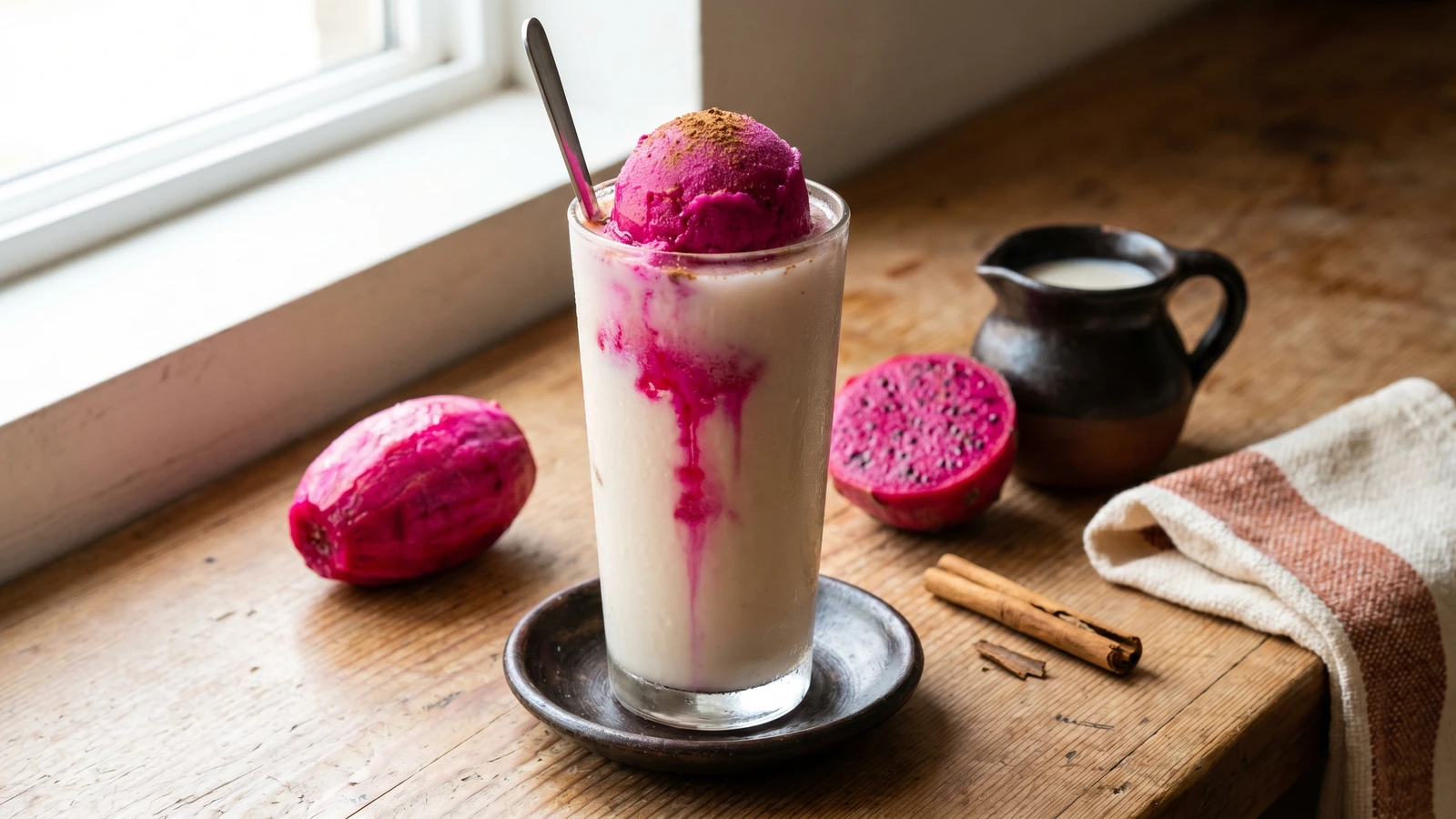
Oaxaca's mercado float, a tall glass of cold rice horchata crowned with a scoop of magenta prickly pear nieve, eaten with a long spoon while the colors bleed into each other.
This belongs to Oaxaca. Specifically to the neverias under the laurel trees of the zocalo and to the marble counters of the Mercado 20 de Noviembre, where the women have been scraping nieves out of wooden tubs since before refrigeration was a given in that city.
An agua nieve is not an agua fresca and it is not a dessert. It is the conversation between the two. A tall glass of cold horchata, the rice and canela kind, gets a generous scoop of nieve dropped on top. You eat it with a long iced-tea spoon. The first bites are pure nieve. The middle is the bleed, where the magenta of the tuna streaks down through the white of the horchata. The bottom is sweetened, fruited horchata. Three drinks in one glass. That is the genius of it.
The tuna here is the prickly pear, the fruit of the nopal cactus, not the fish. Tuna roja is what you want, the deep magenta one that stains your hands and your cutting board and your shirt if you are not careful. It tastes like watermelon and dragonfruit and something older than both. Oaxaca uses it for nieves the way Michoacan uses guanabana and the way Puebla uses tuna verde. Cada estado, su propia cocina.
My mother did not make agua nieve. This drink belongs to the Oaxacans and they will tell you so. I learned it from Senora Chave, who ran a nieve cart on Calle Garcia Vigil for forty-one years and who let me sit behind her counter for three afternoons in 2009 with my notebook open. She shrugged when I asked her for the recipe. "Es horchata, es nieve, ya esta." That was the lesson. The dish is the assembly. Saber cocinar es saber vivir.
The nieves of Oaxaca trace back to the colonial era, when ice was carried down from the mountain peaks of the Sierra Norte by mule and packed in straw to reach the Valles Centrales markets, a labor-intensive trade that made flavored ices a luxury until industrial refrigeration arrived in the early 20th century. The pairing of nieve with horchata, sometimes called nieve de leche or simply agua-nieve in Oaxacan usage, formalized in the mid-1900s as the neverias around the zocalo competed with each other in flavor variety, and the city now claims more than thirty traditional sabores including leche quemada, beso oaxaqueno, tuna, and rose petal. The tuna itself, fruit of the Opuntia cactus, has been cultivated and eaten in Mesoamerica for at least nine thousand years, predating the domestication of corn, and Oaxaca's high-desert microclimates produce some of the deepest-pigmented tunas rojas in the country.
Quantity
1 cup
Quantity
1 stick, about 4 inches long
Quantity
4 cups
for soaking
Quantity
1 cup
Quantity
1 can (12 ounces)
Quantity
1/2 cup, plus more to taste
Quantity
1 teaspoon
Quantity
1 pinch
Quantity
8, about 2 pounds
Quantity
3/4 cup
Quantity
1/2 cup (about 4 to 5 limes)
Quantity
1/2 cup
Quantity
for dusting
Quantity
for serving
| Ingredient | Quantity |
|---|---|
| long-grain white rice | 1 cup |
| Mexican canela (true cinnamon) | 1 stick, about 4 inches long |
| warm waterfor soaking | 4 cups |
| whole milk | 1 cup |
| evaporated milk | 1 can (12 ounces) |
| granulated sugar (for horchata) | 1/2 cup, plus more to taste |
| Mexican vanilla extract | 1 teaspoon |
| fine sea salt | 1 pinch |
| ripe tunas rojas (red prickly pears) | 8, about 2 pounds |
| granulated sugar (for nieve) | 3/4 cup |
| fresh lime juice | 1/2 cup (about 4 to 5 limes) |
| cold water | 1/2 cup |
| ground Mexican canela (optional) | for dusting |
| long iced-tea spoons (optional) | for serving |
Rinse the rice once under cold water to wash off the loose starch. Place it in a bowl with the cinnamon stick and pour in the four cups of warm water. Cover and leave it on the counter overnight, at least eight hours. Do not skip the soak. The grains have to soften all the way through or your horchata will taste like raw rice water. The canela perfumes the soaking water and that perfume is the backbone of the drink.
Tip the soaked rice, the cinnamon stick, and all of the soaking water into a high-powered blender. Add the whole milk and the evaporated milk. Blend on the highest setting for a full two minutes. The blender will sound rough at first and smooth out as the rice breaks down. You want a chalky, sandy liquid, not a smoothie. The grit is the point. It strains out next.
Set a fine-mesh sieve over a large pitcher. Line it with a piece of clean cheesecloth or a thin cotton kitchen towel. Pour the blended mixture through, gathering the cloth and squeezing out every drop. Discard the rice pulp. Now strain a second time through the fine mesh alone. Two passes is what separates a horchata you sip from a horchata you chew. Stir in the half cup of sugar, the vanilla, and the pinch of salt. Taste. The horchata should be sweet but not cloying, milky, and clearly cinnamon. Refrigerate at least two hours until very cold.
Tunas have spines, even the ones at the supermarket that look bare. Hold each fruit with a kitchen towel or tongs. Slice off both ends, score the skin lengthwise from one cut end to the other, and peel back the thick magenta skin in a single piece. The flesh underneath is brilliant, almost fluorescent fuchsia. Put on gloves if your hands are sensitive. The pigment stains and the invisible glochids itch for hours.
Roughly chop the peeled tunas and drop them into the blender with the three-quarter cup of sugar, the lime juice, and the half cup of cold water. Blend until smooth, about one minute. The tuna has hard black seeds the size of peppercorns. Strain the puree through a fine-mesh sieve, pressing with the back of a ladle. Discard the seeds. You should have a vibrant magenta liquid that smells faintly of melon and watermelon at once. That is the tuna. La cocina no es decoracion, es trabajo, and peeling these is the trabajo.
If you have an ice cream maker, churn the tuna puree according to the manufacturer's instructions until it reaches a soft-scoop texture, about 25 minutes. Transfer to a chilled container and freeze for at least two hours to firm up. Without a machine, pour the puree into a wide shallow metal pan and freeze. Every 30 minutes, drag a fork through the surface to break up the crystals. After three or four passes you have a nieve raspada, closer to granita than ice cream. Both are correct. The neverias of Oaxaca's zocalo make a denser version, but the home version is rougher and just as honest.
Stir the cold horchata, it separates as it sits, and pour it into tall glasses, leaving two inches at the top. Use a flat-bottomed scoop to drop a generous round of tuna nieve onto the surface. The nieve will sit on top for a moment, then start to bleed magenta streaks down through the white. That bleeding is what makes this beautiful. Dust the top with a pinch of ground canela and slide a long spoon into the glass. Serve immediately. This drink does not wait. The nieve melts faster than you think and the magic is in those first few minutes when the two layers are still distinct.
1 serving (about 330g)
Culinary guides, cultural storytelling, and the editorial depth that makes cooking meaningful.
Discover Culinary ExplorerChef Lupita
Ciudad de México's highland market agua fresca, fresh alfalfa blended with pineapple and lime until bright green, strained clean, and poured cold from the vitrolero.

Chef Lupita
Aguascalientes' Lenten agua fresca, jewel-red from cooked beet and full of apple, banana, orange, lettuce, and ground peanuts, served cold when Holy Week meets the Feria de San Marcos.

Chef Lupita
Sonora and Sinaloa's creamy malted barley water, built on toasted cebada perla, Mexican canela, vanilla from Papantla, and evaporated milk. Pink-beige, rich, and served cold over heavy ice in a heavy glass tumbler. Liquid cookie comfort the northwest way.

Chef Lupita
Yucatán's everyday tonic of boiled chaya leaves blended with lima agria, sugar, and ice. The bright green jarra that sits on every Peninsula table from Mérida to Valladolid.