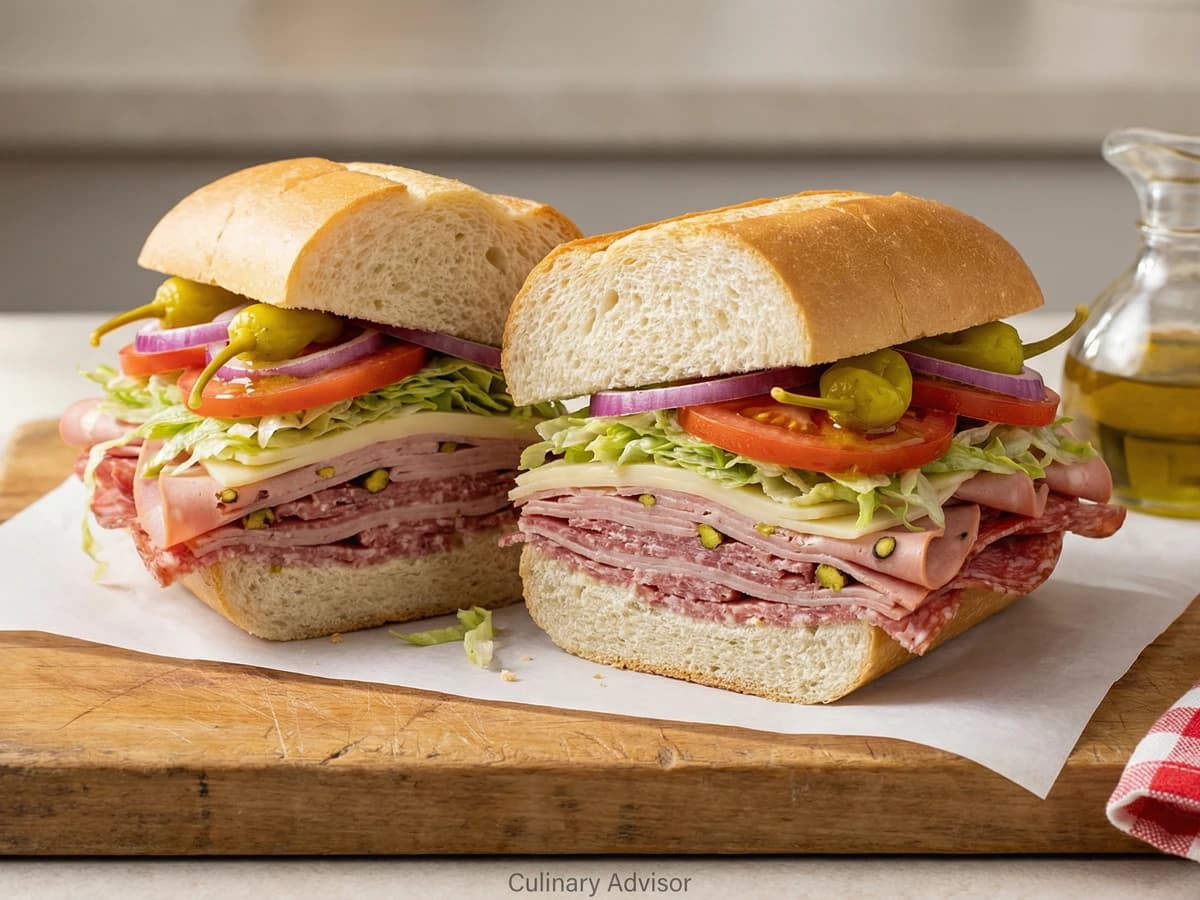
Paper-thin slices of herb-roasted beef swimming in aromatic jus, stuffed into a crusty Italian roll until the bread threatens to surrender, crowned with fiery giardiniera and silky sweet peppers. This is Chicago's gift to American sandwiches.
Sandwiches & Wraps
Italian
Weeknight
Game Day
Comfort Food
45 min
Active Time
4 hr cook•4 hr 45 min total
Yield8-10 sandwiches
Chicago gave America the skyscraper, the blues, and the Italian beef sandwich. Of these contributions, only one can be eaten standing over a trash can at two in the morning, jus dripping down your forearms while you contemplate ordering another.
The origins trace to Italian immigrants on the West Side during the Depression, stretching precious beef by slicing it impossibly thin and simmering it in seasoned broth. What began as economy became art. The sandwich spread from Taylor Street to every corner of the city, each neighborhood claiming its version as definitive.
The architecture is precise: a crusty Italian roll with a soft interior that absorbs jus without disintegrating, roast beef sliced so thin you can nearly read through it, and a broth redolent of oregano, garlic, and bay. The giardiniera provides heat and crunch. The sweet peppers offer relief. Together they create something greater than any component.
You can order it dry, wet, or dipped. Dry means the meat alone gets a bath in the jus. Wet means the assembled sandwich gets a ladle of broth poured over. Dipped means the whole thing goes swimming. There is no wrong answer, only degrees of commitment.
The technique, the tradition, and the story behind every dish.
crusty Italian rollspreferably Turano or Gonnella style
8-10 (6-inch)
hot giardinieradrained
1 jar (16 ounces)
sweet Italian peppersdrained and sliced
1 jar (12 ounces)
Equipment Needed
•Roasting pan with rack
•Instant-read meat thermometer
•Large Dutch oven or deep skillet
•Sharp carving knife (or meat slicer)
•Fine-mesh strainer
•Tongs for serving
Instructions
1
Season the roast
Combine the salt, black pepper, oregano, basil, thyme, granulated garlic, and red pepper flakes in a small bowl. Pat the beef completely dry with paper towels. Rub the seasoning mixture over every surface of the roast, pressing it into the meat. Set the roast on a wire rack over a rimmed baking sheet and refrigerate uncovered for at least 4 hours, or up to 24 hours. This dry-brine firms the exterior and concentrates flavor.
The overnight rest is worth the wait. The salt penetrates deeply and the surface dries, producing a better crust when roasted.
2
Roast the beef
Remove the roast from the refrigerator one hour before cooking. Preheat your oven to 325°F. Place the roast on a rack in a roasting pan and cook until an instant-read thermometer inserted in the thickest part reads 130°F for medium-rare, about 1 hour and 45 minutes to 2 hours depending on the roast's shape. The exterior should be deeply browned, almost leathery. Transfer to a cutting board and tent loosely with foil.
3
Build the jus
While the beef roasts, combine the beef broth, water, halved garlic head, bay leaves, peppercorns, quartered onion, and Italian seasoning in a large saucepan. Bring to a simmer over medium heat, then reduce to low and let it bubble gently for 45 minutes. The kitchen will smell like every great Italian beef stand you've ever visited. Strain the jus through a fine-mesh strainer, discarding the solids. Taste and adjust salt. Keep warm.
4
Slice impossibly thin
Once the beef has rested for 20 minutes, slice it against the grain as thin as you possibly can. The ideal is translucent, nearly shaved. A sharp carving knife and patience are your allies here. If you have a meat slicer, now is its moment of glory. Pile the slices loosely rather than stacking them tight.
For easier slicing, chill the rested roast in the refrigerator for 30 minutes to firm it up, then slice. The texture is easier to control when cold.
5
Simmer the beef in jus
Transfer the sliced beef to a large, deep skillet or Dutch oven. Pour the warm jus over the meat. Bring to a bare simmer over medium-low heat, then reduce the heat to the lowest setting. The beef should steep in the jus, not boil. Let it warm through for 10 to 15 minutes. The meat will turn from rosy to gray but will absorb the seasoned broth, becoming impossibly tender.
Never let the jus boil once the beef is added. High heat toughens the thin slices. A lazy bubble every few seconds is all you want.
6
Prepare the rolls
Split the Italian rolls lengthwise, leaving one edge attached as a hinge if possible. The bread should be crusty enough to crackle when you squeeze it, but the interior should be soft and slightly chewy. If your rolls are soft, toast them cut-side down in a dry skillet for 30 seconds to give them backbone.
7
Assemble dry, wet, or dipped
For a dry sandwich: Use tongs to lift a generous portion of beef from the jus, letting excess drip off. Pile into the roll. Top with giardiniera, sweet peppers, or both. For wet: Assemble the same way, then ladle a few tablespoons of jus over the open sandwich before closing. For dipped (the committed choice): Assemble the sandwich, close it, and dunk the entire thing briefly in the jus. Eat immediately, over the sink or a plate, with napkins at the ready.
8
Serve with authority
Present sandwiches with a small bowl of extra jus on the side for dipping as you eat. The giardiniera and sweet peppers should be within reach for those who want more. This is not delicate food. Sleeves should be rolled. Conversations should pause. Give the sandwich the respect it demands.
Chef Tips
•The bread makes or breaks this sandwich. Seek out Turano, Gonnella, or a proper Italian bakery roll with a shattering crust and absorbent crumb. Soft hoagie rolls will turn to paste. French bread is too crusty and won't absorb properly.
•Chicago-style giardiniera is oil-packed, not the vinegar-brined variety you find in most supermarkets. Look for brands like Marconi, Vienna, or JP Graziano, or find it at an Italian deli. The heat level matters less than the texture.
•For transporting to a tailgate or game day gathering, keep the beef and jus in a slow cooker on warm. Pack the rolls separately in paper bags to preserve their crust. Assemble on site. Never pre-assemble more than 10 minutes before eating.
•Leftover beef and jus improve overnight. Refrigerate together in an airtight container. Reheat gently in a covered pan, adding a splash of beef broth if the jus has reduced too much.
•If you want authentic Chicago flavor on a weeknight, use good quality deli roast beef sliced thin, then simmer it in the homemade jus. Not the same, but respectable.
Advance Preparation
•The seasoned roast can be refrigerated up to 24 hours before cooking, which improves both flavor and texture.
•The jus can be made 3 days ahead and refrigerated. Reheat before adding sliced beef.
•The complete roast can be cooked, sliced, and stored in jus up to 2 days ahead. Reheat gently in a covered pot.
•For a party, hold the beef in jus in a slow cooker on the warm setting for up to 3 hours. Stir occasionally and add broth if it reduces too much.
Frequently Asked Questions
Nutrition Information
1 serving (about 340g)
Calories
525 calories
Total Fat
19 g
Saturated Fat
7 g
Trans Fat
0 g
Unsaturated Fat
10 g
Cholesterol
95 mg
Sodium
480 mg
Total Carbohydrates
34 g
Dietary Fiber
2 g
Sugars
2 g
Protein
46 g
Where cooking meets culture.
Culinary guides, cultural storytelling, and the editorial depth that makes cooking meaningful.