
Chef Graziella
Anguilla Arrosto alla Comacchiese
The legendary roasted eel of Comacchio, where the brackish lagoons of the Po Delta have produced Italy's finest anguilla for two thousand years. Bay leaves, salt, fire. Nothing more.
A cooking platform built around craft, culture, and the stories behind what we eat.

Created by
The cheese-filled pasta of Romagna, folded into little hats and floated in golden capon broth. This is Christmas dinner along the Adriatic, where the distinction between tortellini and cappelletti is a matter of regional pride.
The first useful thing to know about Italian cooking is that, as such, it actually doesn't exist. What exists are the regional cuisines, and they guard their distinctions fiercely. In Bologna, they make tortellini filled with pork, prosciutto, and mortadella. Cross the border into Romagna, and you find cappelletti filled with cheese. To confuse the two is to misunderstand everything.
I grew up on the Adriatic coast, in Cesenatico, where cappelletti appeared on every Christmas table. My grandmother's filling was simple: fresh soft cheese, Parmigiano-Reggiano, egg, and a whisper of nutmeg. Nothing more. The filling should taste of cheese, not of meat. This is the fundamental difference that Americans never learn.
The broth matters as much as the pasta. Capon broth, golden and clear, made from an old rooster that has given its flavor to the pot. The cappelletti swim in this broth, absorbing it, releasing their cheese into the liquid. You eat them with a spoon, fishing for each little hat, drinking the broth between bites. This is how Christmas begins in Romagna.
Cappelletti appear in household records from Romagna dating to the 15th century, though the cheese filling that distinguishes them from Bologna's meat-filled tortellini likely predates written documentation. The word means 'little hats,' describing their peaked shape. Every town along the Adriatic coast claims the authentic version, and every grandmother insists hers is correct.
Quantity
400g
Quantity
4
Quantity
250g
drained overnight
Quantity
150g
finely grated
Quantity
1
Quantity
1/8 teaspoon
freshly grated
Quantity
to taste
Quantity
about 6 pounds
Quantity
2 pounds
Quantity
1 medium
halved
Quantity
2
cut into large pieces
Quantity
2
Quantity
1 small bunch
Quantity
10
Quantity
to taste
Quantity
for the table
freshly grated
| Ingredient | Quantity |
|---|---|
| tipo 00 flour | 400g |
| large eggs | 4 |
| fresh ricottadrained overnight | 250g |
| Parmigiano-Reggianofinely grated | 150g |
| large egg (for filling) | 1 |
| nutmegfreshly grated | 1/8 teaspoon |
| fine sea salt | to taste |
| capon or stewing hen | about 6 pounds |
| chicken backs (optional) | 2 pounds |
| yellow onionhalved | 1 medium |
| carrotscut into large pieces | 2 |
| celery stalks with leaves | 2 |
| flat-leaf parsley stems | 1 small bunch |
| black peppercorns | 10 |
| kosher salt | to taste |
| Parmigiano-Reggiano for servingfreshly grated | for the table |
Place the capon in a pot large enough to hold it comfortably with water to cover by two inches. Add the onion, carrots, celery, parsley stems, and peppercorns. Do not add salt yet. Bring to a gentle simmer over medium heat. The moment it begins to bubble, reduce the heat to the lowest setting. The broth should barely move, with only an occasional bubble breaking the surface. Skim any foam that rises. Let it simmer for at least 3 hours.
Mound the flour on a wooden board and create a well in the center. Crack the eggs into the well. Using a fork, beat the eggs gently, then begin incorporating flour from the inner walls of the well. When the mixture becomes too thick for the fork, use your hands. Knead the dough firmly, pushing with the heel of your palm, folding it over, turning it, pushing again. Continue for 10 minutes. The dough should become smooth, elastic, and slightly tacky but not sticky. If it sticks to your hands, add flour sparingly. Wrap in plastic and rest for 30 minutes at room temperature.
In a bowl, combine the drained ricotta, grated Parmigiano, egg, and nutmeg. Mix thoroughly until smooth and uniform. Season with a pinch of fine salt. The filling should taste of cheese, bright with Parmigiano, mellowed by ricotta. Taste it. Adjust if necessary. Refrigerate until ready to use.
Divide the rested dough into four pieces. Keep the pieces you are not working with covered. Using a rolling pin or pasta machine, roll each piece into a thin sheet. If using a machine, pass it through progressively thinner settings until you reach the second-thinnest. The pasta should be thin enough to see the shadow of your hand through it, but sturdy enough to hold the filling. Work quickly. Fresh pasta dries.
Using a knife or fluted pastry wheel, cut the pasta sheet into squares approximately 5 centimeters (2 inches) on each side. Cover cut squares with a barely damp towel as you work. You need them pliable, not dried and cracking.
Place a scant teaspoon of filling in the center of each square. Do not overfill. The pasta must close completely without splitting. Fold the square in half diagonally to form a triangle, pressing the edges firmly to seal, pushing out any air pockets. Then bring the two bottom corners of the triangle together, overlapping them slightly, and press to seal. The peak of the triangle should stand up like a little hat. This is the cappelletto shape. Work steadily. It becomes faster with practice.
After 3 hours, the broth should be golden and deeply flavored. Remove the capon and vegetables. Strain the broth through a fine-mesh strainer lined with cheesecloth. Season with salt. The broth should taste full but not aggressive. You want it to complement the cheese filling, not overpower it. Return to a clean pot and keep at a gentle simmer.
Drop the cappelletti into the simmering broth in batches, no more than 20 at a time. Do not crowd them or they will stick together. Cook until they float and the pasta is tender but with pleasant resistance, 3 to 4 minutes. Using a slotted spoon, transfer to warm shallow bowls. Ladle the hot broth over them. Pass grated Parmigiano-Reggiano at the table. Once the pasta is sauced, serve it promptly, inviting your guests and family to put off talking and start eating.
1 serving (about 400g)
Culinary guides, cultural storytelling, and the editorial depth that makes cooking meaningful.
Discover Culinary ExplorerChef Graziella
The legendary roasted eel of Comacchio, where the brackish lagoons of the Po Delta have produced Italy's finest anguilla for two thousand years. Bay leaves, salt, fire. Nothing more.

Chef Graziella
The mixed seafood fry of the Adriatic, where shrimp, squid, and small fish wear only a whisper of flour before meeting hot oil. Served immediately with lemon wedges. Nothing more.
Chef Graziella
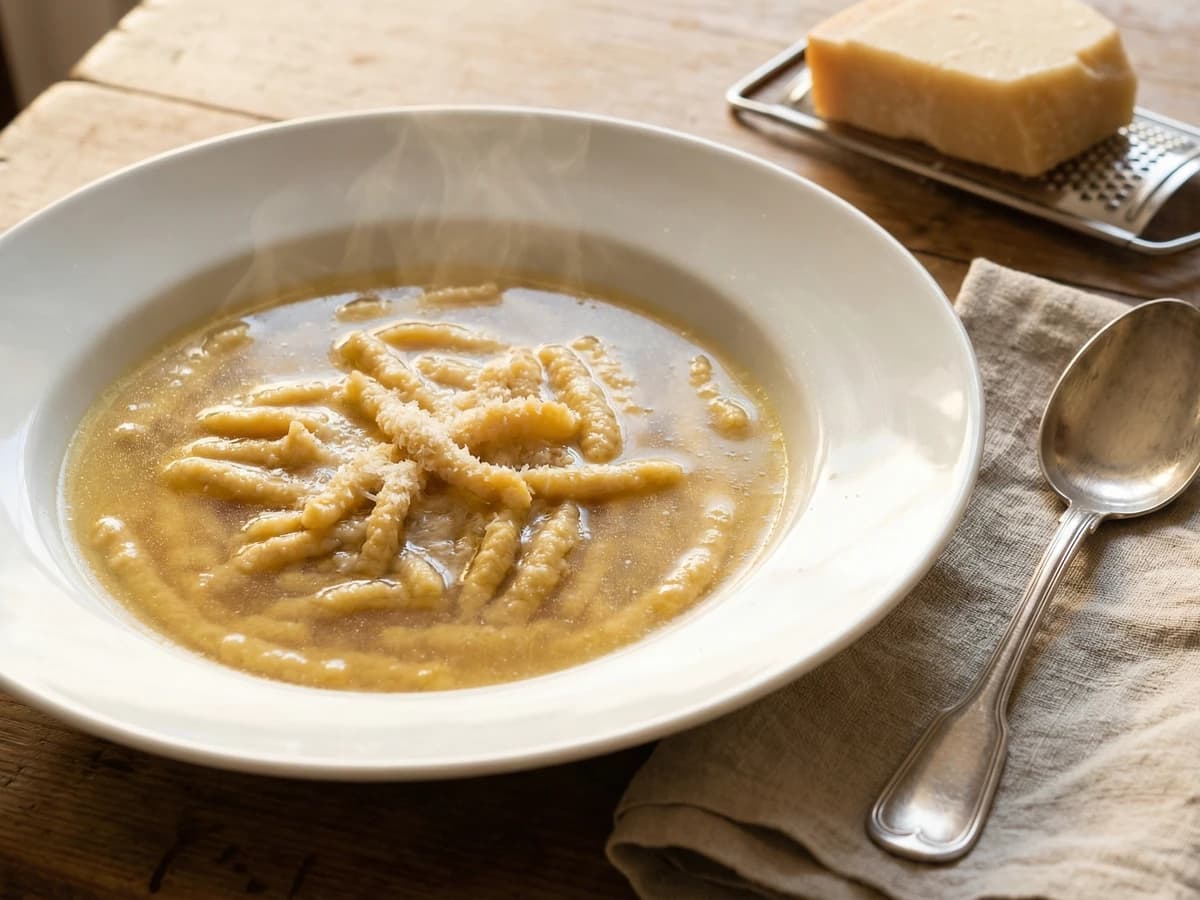
Breadcrumbs, aged Parmigiano, and eggs pressed directly into simmering broth. The first food of my childhood in Romagna, and the last food I would give up.

Chef Graziella
The pride of Romagna: a simple dough of breadcrumbs, aged cheese, and eggs pressed into simmering broth, creating something that defies category. Three ingredients transformed by technique into comfort itself.