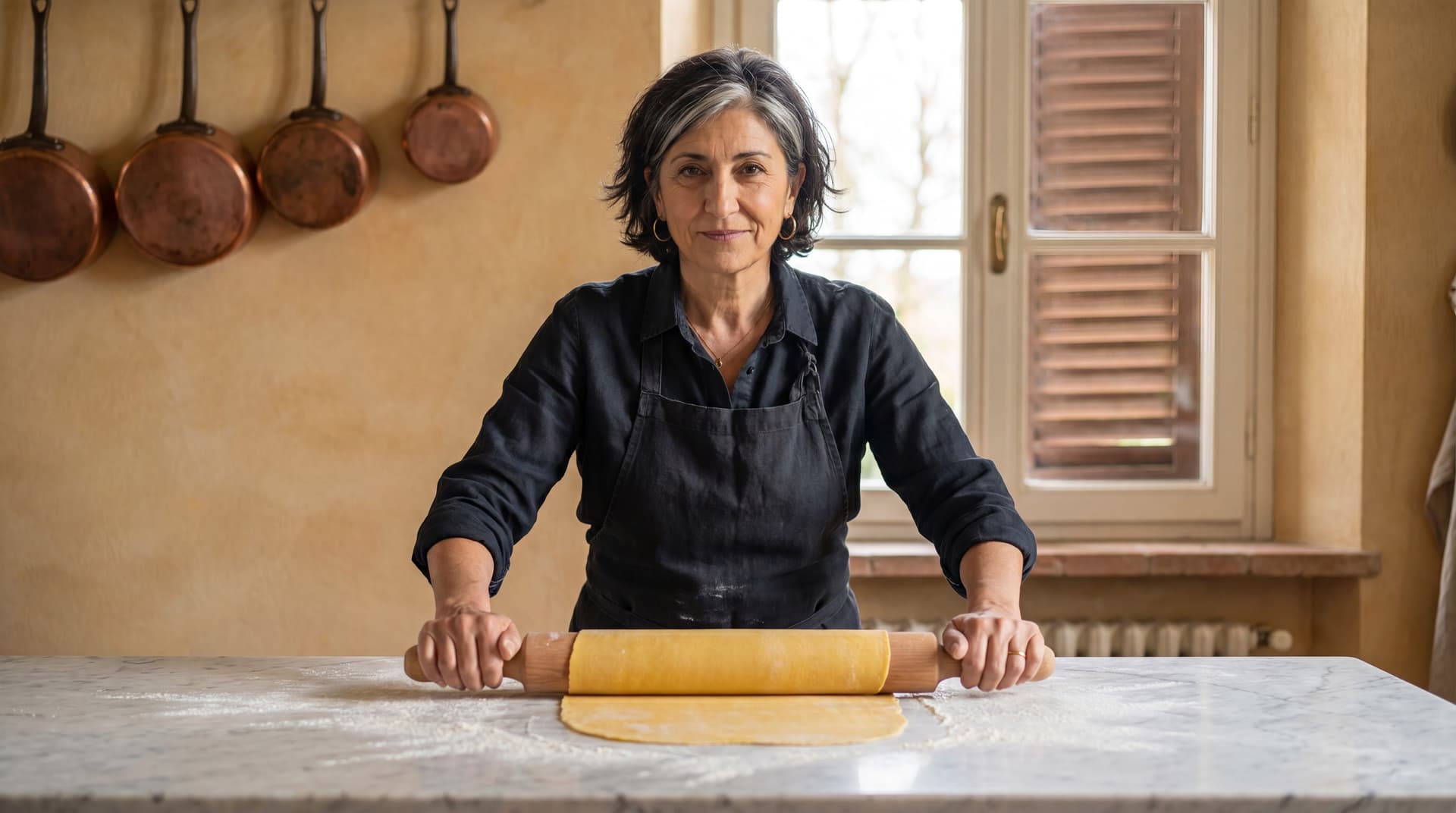
Chef GraziellaGraziella
A Fishing Village on the Adriatic
Where a grandmother rolled pasta the size of a bedspread
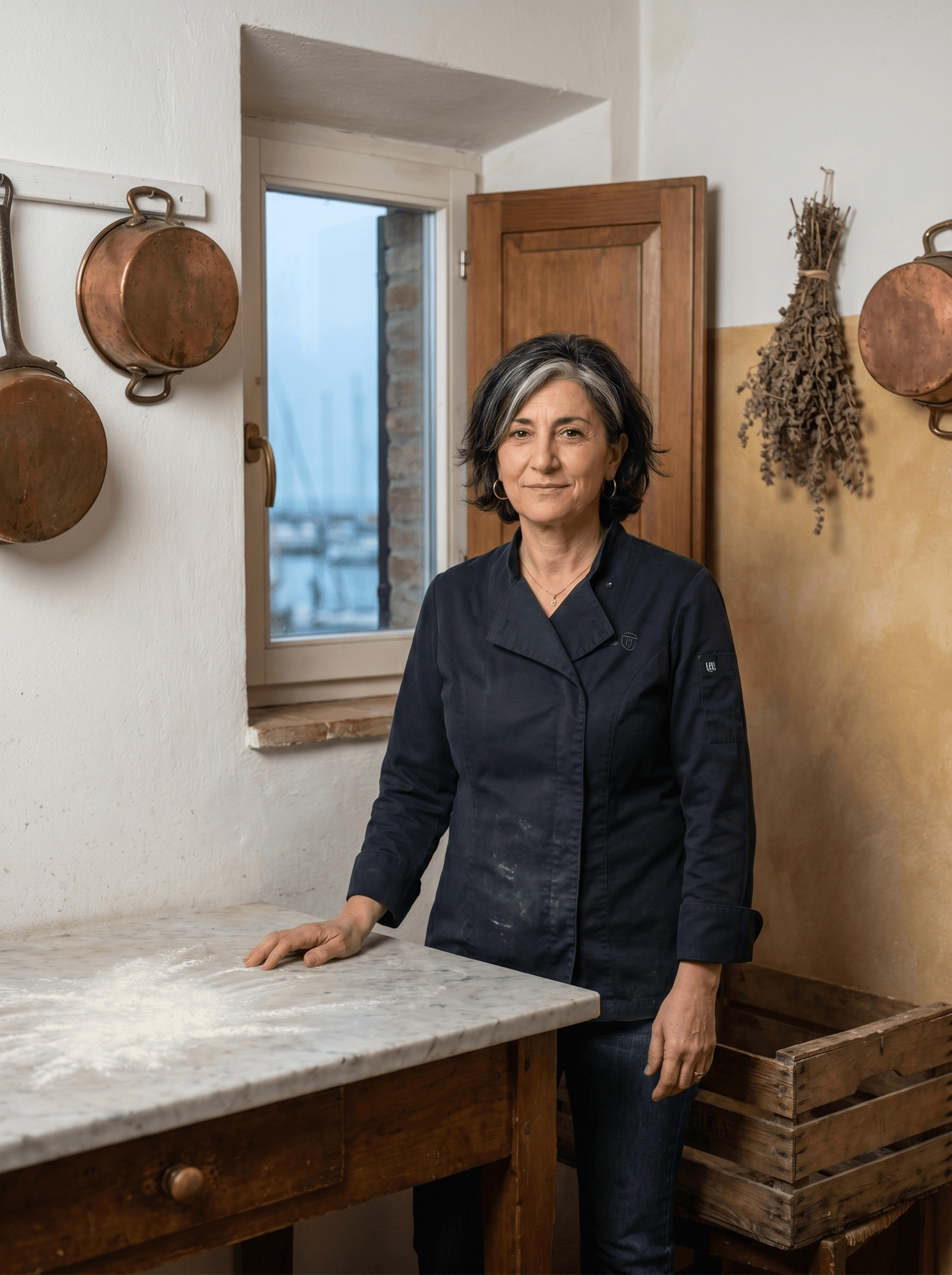
Cesenatico was a fishing village on the Adriatic coast of Emilia-Romagna, and it was there, on a crate pulled up to the table, that Graziella Marchetti first watched her grandmother roll fresh pasta. The sheets came off the pin nearly as big as a bedspread, thin enough to read through. No one measured. No one hurried. The knowledge lived in a pair of hands.
She did not become a cook, not then. She became a scientist, earning dual doctorates in the natural sciences and biology, training her eye to observe, to record, to repeat. The precision never left her. Years later it would turn up at the stove, in the counting of minutes and half minutes, in the refusal to call a thing done before it was.
What she carried out of that village was not a single recipe. It was a way of seeing: that flavor is built, not bought, that restraint is its own kind of abundance, and that the food of an Italian home asks for honesty above all. She would spend the rest of her life proving it to a country that thought it already knew Italian food.
Flavor is built, not bought.
The Cook She Already Was
Married at thirty, and the kitchen opened like a door
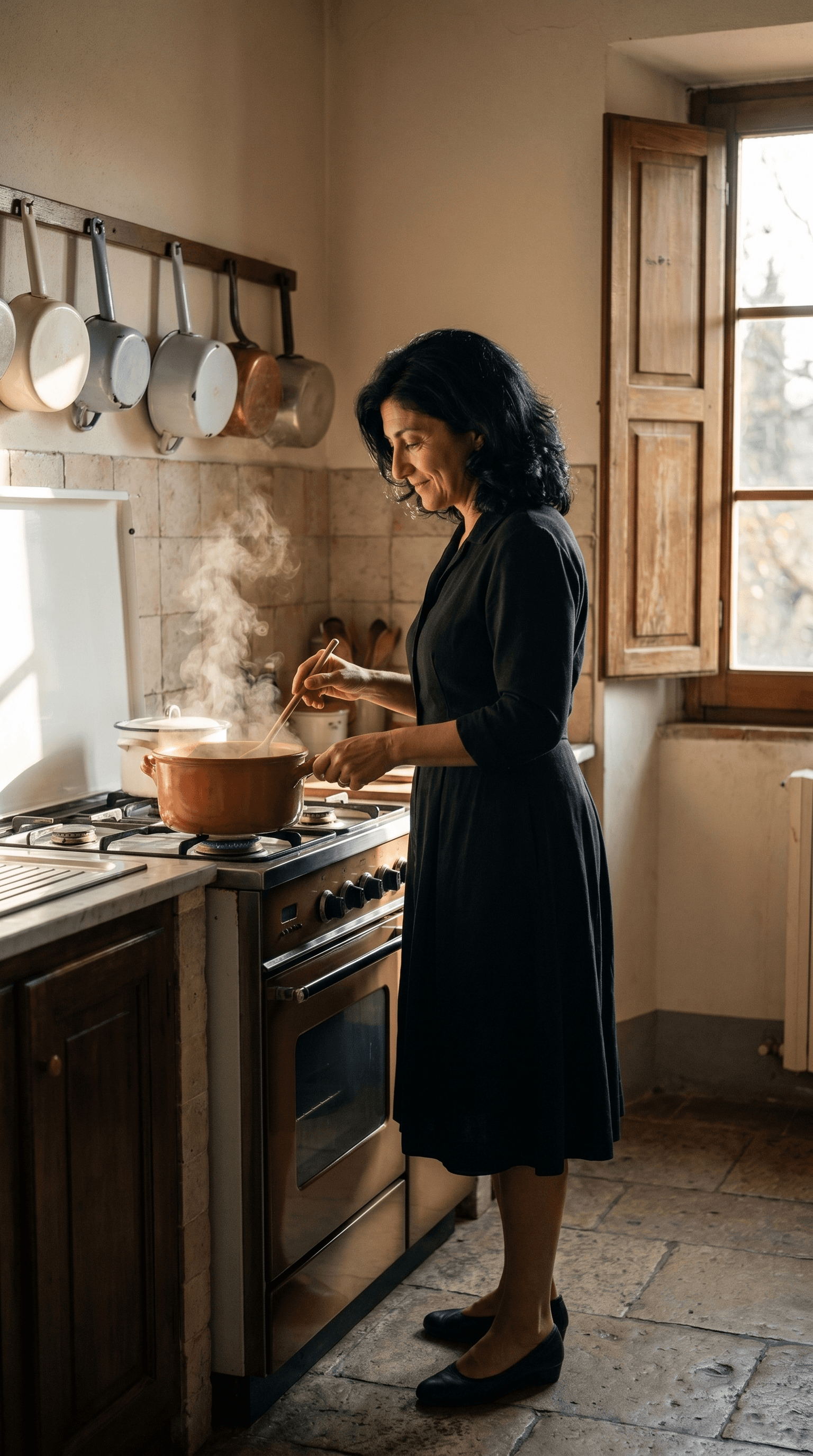
She married at thirty without ever having cooked a meal. There had been no need: a scientist's life ran on other work. But a household has a kitchen, and a kitchen asks to be used. So she began, alone, from taste memory, reaching back to the dishes of Emilia-Romagna she had eaten her whole life and never once made.
What happened next surprised her more than anyone. Cooking, she said, came as though it had been there all along, waiting to be expressed. The science and the senses turned out to be the same discipline. She tasted, adjusted, tasted again, and the food answered. The instinct she thought she lacked had been forming at that crate in Cesenatico the entire time.
Word traveled. Students begged her to teach them, and in 1969 she opened a cooking school in Manhattan: six people crowded around her own dining table, learning Italian food the way it is actually made. The teacher had found her classroom. America had found the woman who would set the record straight.
Cooking came as though it had been there all along.
Ready to bring Graziella’s recipes into your kitchen?
Discover Culinary Explorer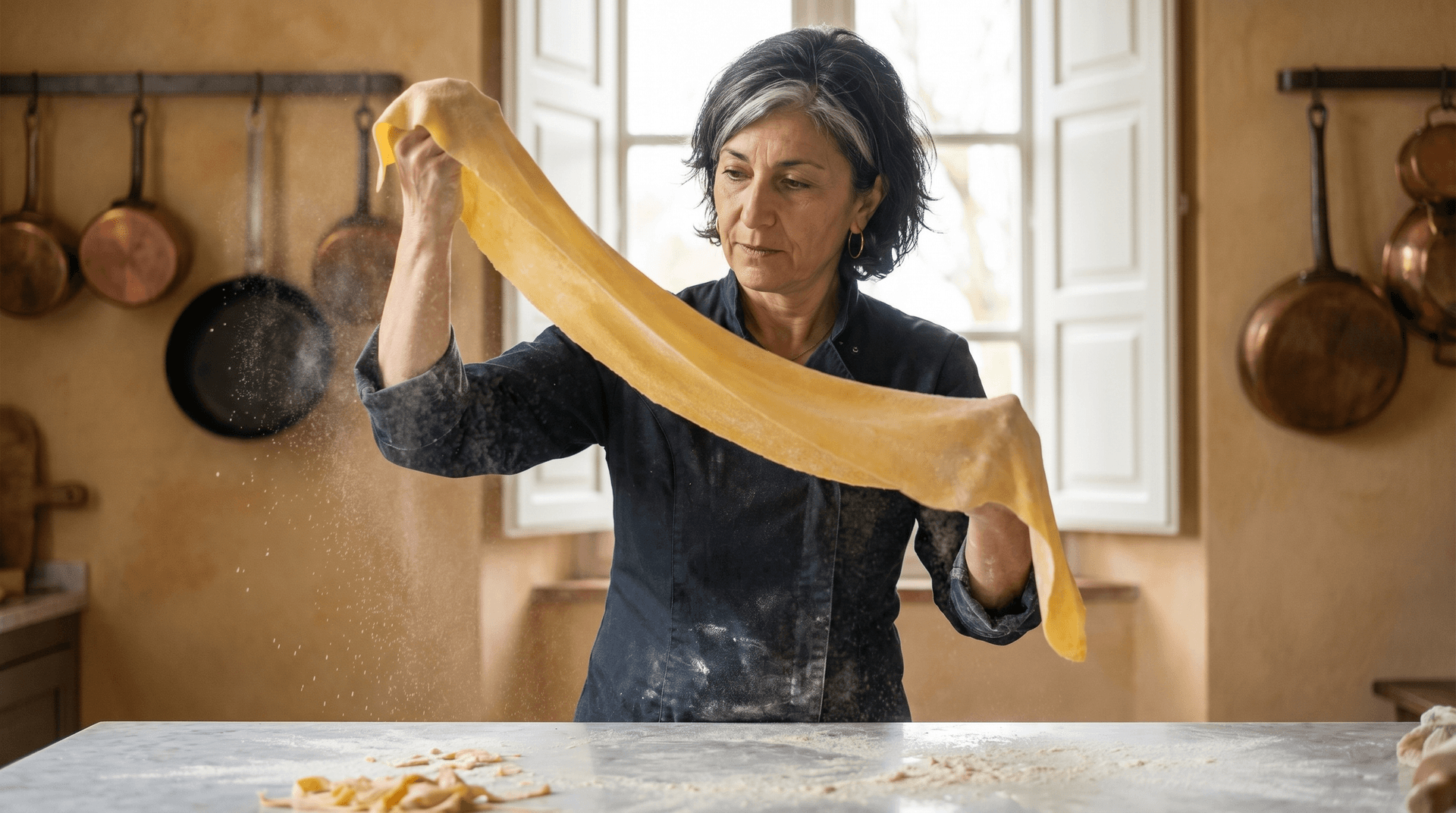
Italian Cooking Does Not Exist
Correcting a country's idea of Italian food, one dish at a time
The first useful thing to know about Italian cooking, Graziella says, is that as such it does not exist. There is the cooking of Bologna and the cooking of Naples, of Venice and of Sicily, and not a single authentic dish travels unchanged between them. Her mission is to teach those regional truths, not the flattened imitation served under the Italian name.
She strips away the excess that hides bad technique: the heavy hand with garlic, the drowned pasta, the shortcuts sold as convenience. What remains is honest and exact. She teaches home cooks who expect to work, because the reward of the work is a dish that finally tastes the way it was meant to.
Italian cooking, as such, does not exist.
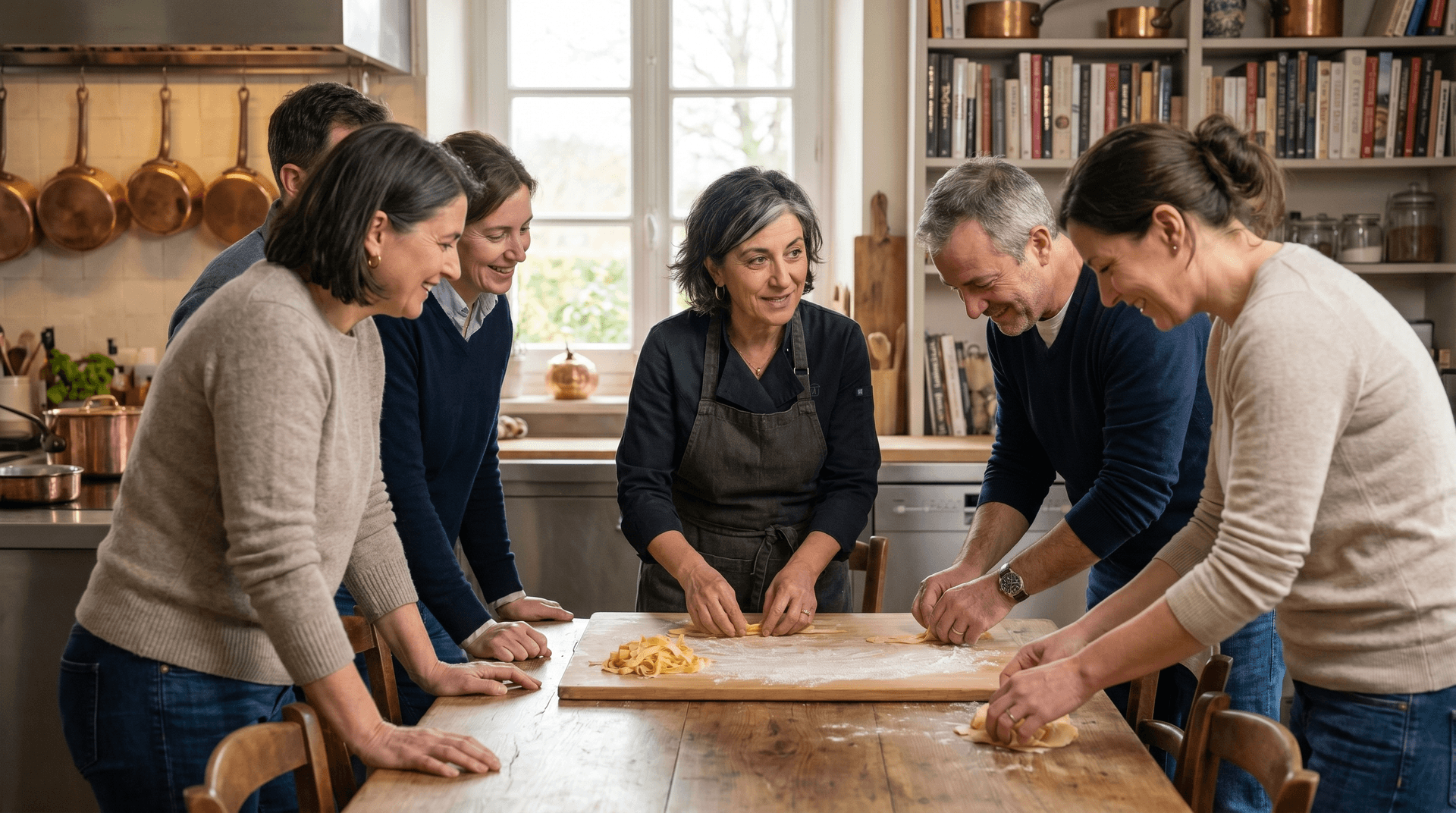
Graziella's Culinary World
Regional Italian Cuisine
The cooking of Emilia-Romagna, the Veneto, and the Italian home table. There is no single Italian cuisine, only regional traditions, and each one is its own complete world.
Fresh Egg Pasta
Pasta all'uovo rolled by hand, filled pastas folded with patience, and the proper marriage of sauce to noodle. The dough should feel like an earlobe when pressed, never gummy with water.
Flavor From the Bottom
The soffritto foundation, built slowly and never rushed. In Italian dishes flavor rises from the base up, which is why a lame plate can almost always be traced to a step done halfway.
The Italian Pantry
Parmigiano-Reggiano, true balsamico, prosciutto, pancetta, real extra virgin olive oil. Ingredients bound to the places that make them, chosen with care and never carelessly substituted.
Non-Negotiables
- Garlic is a whisper, not a shout. The unbalanced use of garlic is the single greatest cause of failure in would-be Italian cooking. And the garlic press goes in the bin: it makes acrid mush, nothing more.
- Pasta is cooked al dente, drained, sauced, and brought to the table at once. Mushy pasta in a spicy ketchup is not Italian food, whatever the menu calls it.
- Never cook a sauce in a covered pan. The water has to leave for the flavor to concentrate.
- Name the region before the dish. Italian cooking, as such, does not exist. Venice and Naples share a coast and not a single authentic recipe.
- Simple does not mean easy. Every ingredient must earn its place, because with four of them there is nowhere to hide a mistake.
- No shortcuts that trade flavor for convenience. The microwave separates the cook from the cooking, and it shows on the plate.
What you keep out is as significant as what you put in
Her guiding rule: restraint is the heart of Italian cooking
Italian cooking, as such, does not exist
There is no one Italian cuisine, only the distinct traditions of each region
Simple doesn't mean easy
With few ingredients, technique is everything and mistakes have nowhere to hide
I cook from the heart, I cook for flavor
She uses her head but cooks for taste, never for concepts
Why This Matters
Graziella sees herself less as a recipe writer than as a teacher of cooking. A recipe is a single dinner. A technique understood is every dinner after it. So she teaches the elemental things, the why beneath the how, the reasons that turn a list of steps into instinct. She would rather you understand a soffritto than memorize a hundred sauces.
Underneath the firmness is affection. Cooking for someone, she says, is a sincere expression of affection, an act of binding intimacy. That is what she is really teaching: not how to impress, but how to feed the people you love something honest, made with your own hands, the way it has always been made in Italian homes.
A recipe is a single dinner. A technique understood is every dinner after it.
By the Numbers
Trained as a scientist with dual doctorates in the natural sciences and biology, and never cooked a meal until she married at thirty
Rolls and teaches fresh pasta by hand despite an arm injured in childhood that never fully recovered: 'If I can do this with one and a half arms, you should have no trouble'
Opened her cooking school in Manhattan in 1969, teaching just six students at a time around her own dining table
Her famous tomato sauce has three things in it (butter, a tin of tomatoes, a halved onion), and you discard the onion at the end. Some skip the pasta and eat it from the pot with a spoon
“What you keep out is as significant as what you put in”
Start Cooking with Chef Graziella
Discover the truth of Italian regional home cooking. Get personalized recipes, learn the technique beneath the dish, and cook with the restraint and confidence of an Italian kitchen.
Discover Culinary ExplorerChef Graziella is a fictional culinary guide to Italian Regional Home Cooking, written with the assistance of AI.