Culinary Explorer

A cooking platform built around craft, culture, and the stories behind what we eat.
Discover Culinary Explorer
Cappelletti in Brodo

Cappelletti in Brodo

Created by

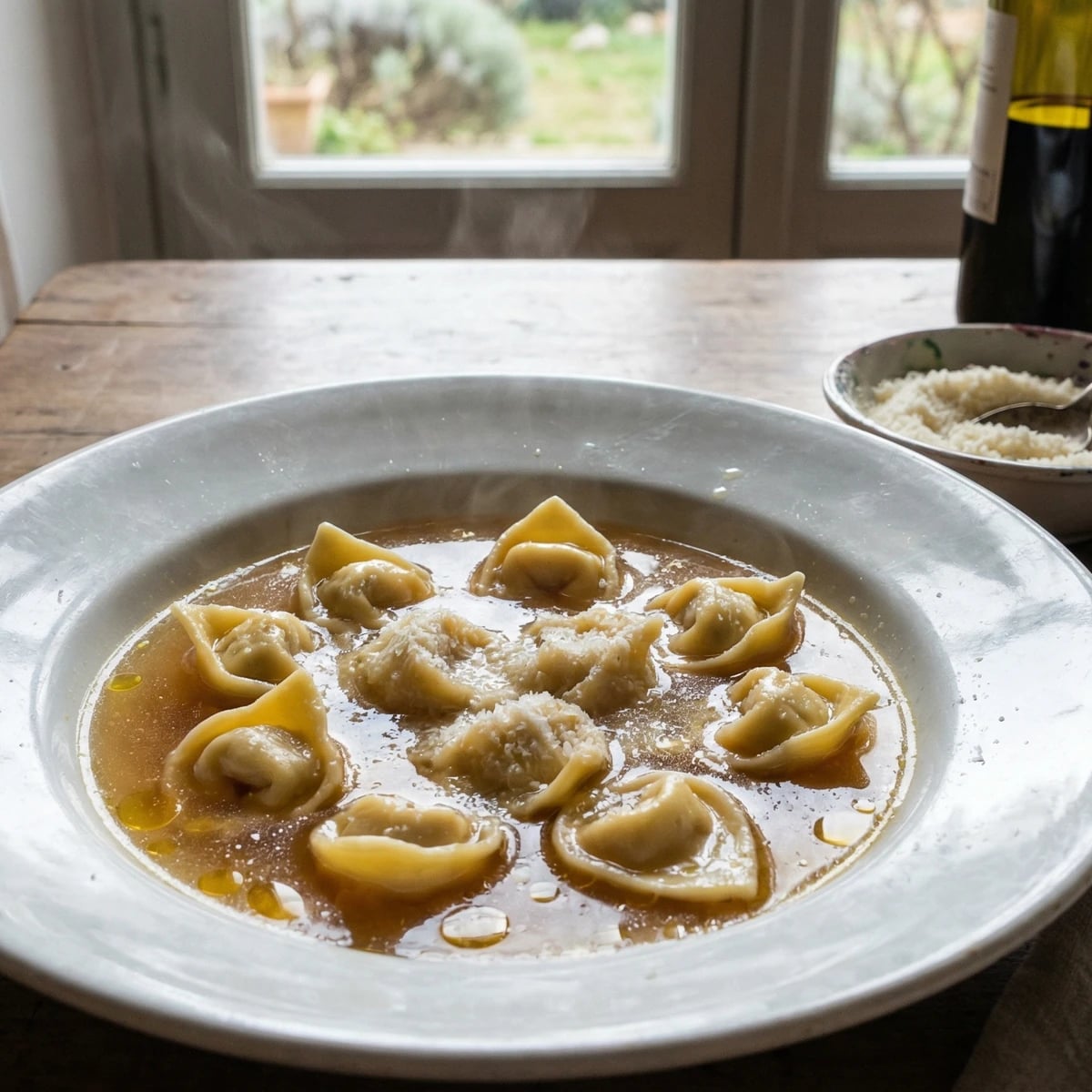
The Christmas soup of Romagna, where delicate cheese-filled pasta floats in amber capon broth. Smaller than their Bolognese cousins, these little hats require patience and reward it generously.

Soups & Stews
Italian, Romagnol
Christmas
Holiday
Comfort Food
2 hr
Active Time
4 hr cook6 hr total
Yield8 servings

The first useful thing to know about Italian cooking is that, as such, it actually doesn't exist. There is Bolognese cooking and Romagnol cooking, and they are not the same. Bologna has tortellini; Romagna has cappelletti. Both are small filled pastas served in broth. Both appear on Christmas tables. But the resemblance ends there.

Cappelletti are smaller, their shape subtly different, their filling lighter. In Romagna, the traditional filling combines soft fresh cheeses, ricotta and the nearly impossible-to-find raviggiolo, bound with egg and Parmigiano. No meat. The result is delicate, almost ethereal when floating in proper broth. Bologna stuffs its tortellini with mortadella and prosciutto. The Romagnoli look at this and shake their heads.

The broth matters as much as the pasta. This is not the place for chicken stock from a carton. You need capon, a castrated rooster whose flesh is more flavorful and whose fat produces a richer, more golden broth. Beef shank adds body. The two simmer together for hours, filling the house with the smell of Christmas, of anticipation, of something worth waiting for.

Cappelletti appear in written records from Romagna as early as the 14th century, though the recipes remained uncodified, passed from mother to daughter across generations. The cheese-based filling distinguishes them from Bologna's meat-filled tortellini and reflects Romagna's pastoral traditions, where soft fresh cheeses were abundant. On Christmas Eve and Christmas Day, families gather to fold cappelletti together, often making hundreds in a single afternoon.

The technique, the tradition, and the story behind every dish.

Discover Culinary Explorer

Ingredients

capon

Quantity

1 (about 6 pounds)

cleaned

beef shank with bone

Quantity

1 pound

yellow onion

Quantity

1 large

halved

carrots

Quantity

2

peeled, cut into large pieces

celery stalks with leaves

Quantity

2

cut into large pieces

flat-leaf parsley stems

Quantity

1 small bunch

whole black peppercorns

Quantity

1 teaspoon

kosher salt

Quantity

to taste

fresh ricotta

Quantity

1 cup

drained overnight

raviggiolo or fresh ricotta salata

Quantity

4 ounces

crumbled

Parmigiano-Reggiano

Quantity

1 cup, plus more for serving

freshly grated

egg yolk

Quantity

1 large

nutmeg

Quantity

1/8 teaspoon

freshly grated

fine sea salt

Quantity

pinch

tipo 00 flour

Quantity

300 grams

large eggs

Quantity

3

fine sea salt

Quantity

pinch

Equipment Needed

  • Large stockpot (at least 10 quarts)
  • Fine-mesh sieve
  • Cheesecloth
  • Pasta machine or long rolling pin
  • 2-inch round cutter or drinking glass
  • Flour-dusted sheet pans for holding cappelletti

Instructions

  1. 1

    Start the broth

    Place the capon and beef shank in a large stockpot. Cover with cold water by three inches. Set over high heat and bring slowly to a simmer. This takes 30 to 40 minutes. Do not rush it. As the water heats, gray foam will rise to the surface. Skim it away with a slotted spoon. Continue skimming until no more foam appears. This is tedious but essential for a clear broth.

    Starting in cold water and heating slowly extracts flavor gently and produces less scum. Dropping meat into boiling water seals the surface and clouds the broth.
  2. 2

    Add aromatics

    When the foam stops rising, add the onion halves, carrots, celery, parsley stems, and peppercorns. Reduce heat to the gentlest possible simmer. The surface should barely tremble, with only an occasional lazy bubble. Simmer uncovered for at least 3 hours, preferably 4. Never let it boil. A rolling boil makes cloudy, greasy broth.

  3. 3

    Strain and season

    Remove the capon and beef (the meat can be served separately with salsa verde, or saved for another use). Strain the broth through a fine-mesh sieve lined with cheesecloth into a clean pot. Taste and add salt carefully. The broth should be rich, golden, and deeply savory. Let it cool, then refrigerate. The fat will solidify on top. Remove most of it before reheating, but leave a thin layer for richness.

  4. 4

    Make the pasta dough

    Mound the flour on a wooden board or clean work surface. Make a well in the center. Crack the eggs into the well and add the salt. Beat the eggs gently with a fork, gradually incorporating flour from the inner walls of the well. When the mixture becomes too stiff to work with a fork, use your hands. Knead the dough firmly, pushing with the heel of your palm, folding, and turning. Continue for 10 minutes until the dough is smooth, elastic, and springs back when pressed. Wrap in plastic and rest for 30 minutes.

  5. 5

    Make the filling

    In a bowl, combine the drained ricotta, crumbled raviggiolo (or ricotta salata), Parmigiano-Reggiano, egg yolk, nutmeg, and salt. Mix thoroughly with a fork until smooth and uniform. The filling should be creamy but hold its shape on a spoon. If too wet, your cappelletti will burst when cooked. Taste and adjust salt. Cover and refrigerate until ready to use.

    If you cannot find raviggiolo, use additional fresh ricotta mixed with a bit more Parmigiano. The soft, milky flavor is what matters. Do not substitute aged cheeses.
  6. 6

    Roll the pasta

    Divide the rested dough into four pieces. Work with one piece at a time, keeping the rest covered. Roll the dough through a pasta machine, starting at the widest setting and progressing to the second-thinnest setting. The sheet should be thin enough to see your hand through it, but not so thin it tears. Lay the sheet on a lightly floured surface.

  7. 7

    Cut and fill

    Using a round cutter or glass about 2 inches in diameter, cut circles from the pasta sheet. Place a scant teaspoon of filling in the center of each circle. Do not overfill. Work quickly so the pasta does not dry out. Fold each circle in half to form a half-moon, pressing the edges firmly to seal and pushing out any air. Then bring the two points of the half-moon together around your finger and press to join, forming a little hat. The fold should create a small cuff on one side.

  8. 8

    Arrange the cappelletti

    As you form each cappelletto, place it on a flour-dusted tray, not touching its neighbors. A batch this size yields about 80 cappelletti. They can rest at room temperature for up to 2 hours, or refrigerated uncovered for up to 6 hours. If holding longer, freeze in a single layer on the tray, then transfer to bags.

  9. 9

    Cook and serve

    Bring the strained broth to a gentle boil in a wide pot. Add the cappelletti in batches so as not to crowd them. Fresh cappelletti cook in 3 to 4 minutes; frozen take 5 to 6. They are done when they float and the pasta at the sealed edge is tender. Ladle immediately into warm shallow bowls, ensuring each portion has plenty of broth and 8 to 10 cappelletti. Pass freshly grated Parmigiano-Reggiano at the table. That is all they need.

    Once the pasta is sauced, serve it promptly, inviting your guests and family to put off talking and start eating. Cappelletti wait for no one.

Chef Tips

  • Drain the ricotta overnight in a fine-mesh sieve set over a bowl. Wet ricotta produces soggy filling that bursts during cooking. You should lose at least two tablespoons of liquid.
  • The shape takes practice. Your first dozen will look clumsy. By the fiftieth, your hands will remember. This is how it was learned in Romagna, by doing.
  • Raviggiolo is a soft, fresh sheep's milk cheese from the Apennine foothills. Outside Italy, it is nearly impossible to find. Fresh ricotta salata or a very soft, mild fresh cheese can substitute, though purists will know the difference.
  • Make the broth the day before. Refrigerating it allows the fat to solidify completely, making it easier to remove. The broth also develops flavor overnight.
  • Leftover cappelletti can be frozen unblanched for up to two months. Cook directly from frozen, adding a minute to the cooking time.

Advance Preparation

  • The broth should be made at least one day ahead, preferably two. It improves with time and chilling allows complete fat removal.
  • Cappelletti can be formed up to 6 hours ahead and refrigerated uncovered on floured trays.
  • For longer storage, freeze cappelletti in a single layer until solid, then transfer to freezer bags. They keep for two months and cook directly from frozen.

Frequently Asked Questions

Nutrition Information

1 serving (about 350g)

Calories
330 calories
Total Fat
15 g
Saturated Fat
8 g
Trans Fat
0 g
Unsaturated Fat
6 g
Cholesterol
95 mg
Sodium
950 mg
Total Carbohydrates
30 g
Dietary Fiber
1 g
Sugars
2 g
Protein
15 g

Note: Chef personas and recipes are created with AI assistance. Cook with care: follow safe food-handling practices, check doneness with a thermometer when needed, and adapt for allergies and your kitchen.

Where cooking meets culture.

Culinary guides, cultural storytelling, and the editorial depth that makes cooking meaningful.

Discover Culinary Explorer

More from Chef Graziella's Soups and Stews

Browse the full collection