Culinary Explorer

A cooking platform built around craft, culture, and the stories behind what we eat.
Discover Culinary Explorer
Caponata Siciliana

Caponata Siciliana

Created by

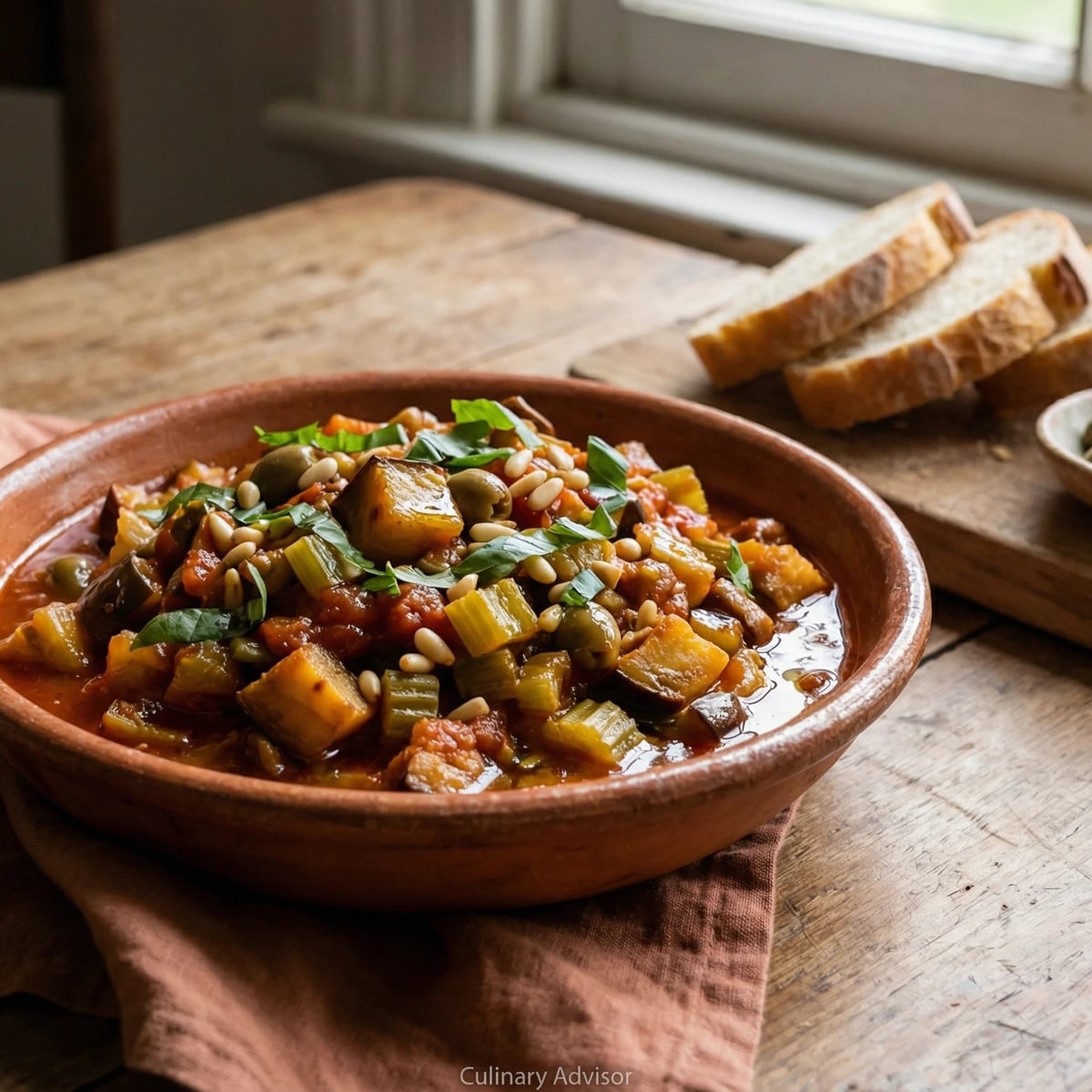
Sicily's celebrated sweet-sour eggplant, where Arab traders left their mark in the capers, vinegar, and sugar that transform humble vegetables into something unforgettable. Better tomorrow than today.

Appetizers & Snacks
Italian, Sicilian
Potluck
Make Ahead
45 min
Active Time
45 min cook1 hr 30 min total
Yield8 servings

Caponata tells you everything about Sicily in a single bite. You taste the eggplant the Arabs brought. You taste the sweet-sour agrodolce they carried from Persia. You taste the capers that grow wild on every crumbling wall, the olives from groves planted by Greeks, the tomatoes that arrived from the New World and never left. This is not a dish that was invented. It accumulated over centuries.

Every Sicilian family makes caponata differently. In Palermo, they add pine nuts and sometimes cocoa. In Catania, they use peppers. In Agrigento, they insist on almonds. These variations cause arguments at family tables that have lasted generations. What unites them all is the agrodolce, that perfect tension between sweet and sour that makes the tongue want more.

Caponata improves with time. Serve it the day you make it and you will wonder what the fuss is about. Let it rest overnight and the flavors marry into something greater than its parts. Two days is better still. This is a dish that rewards patience, and patience is something Sicilians understand.

Caponata descends from the Arab occupation of Sicily between the 9th and 11th centuries, when traders introduced eggplant, sugar, and the sweet-sour flavor profile to the island. The name likely derives from 'capone,' a type of dolphinfish that wealthy Sicilians once served with the same agrodolce sauce. When fish became scarce, the humble eggplant took its place.

The technique, the tradition, and the story behind every dish.

Discover Culinary Explorer

Ingredients

eggplant

Quantity

2 pounds (about 2 medium)

cut into 1-inch cubes

kosher salt

Quantity

for salting eggplant

extra virgin olive oil

Quantity

1 cup, divided

celery stalks with leaves

Quantity

4

stalks sliced 1/2 inch thick, leaves reserved

yellow onion

Quantity

1 large

diced

whole peeled tomatoes

Quantity

1 can (14 ounces)

crushed by hand

capers

Quantity

3 tablespoons

rinsed if salt-packed, drained if brined

green Sicilian olives

Quantity

1/2 cup

pitted and halved

red wine vinegar

Quantity

1/4 cup

sugar

Quantity

2 tablespoons

pine nuts

Quantity

3 tablespoons

lightly toasted

fresh basil leaves

Quantity

for serving

torn

black pepper

Quantity

to taste

freshly ground

Equipment Needed

  • Large heavy skillet (12-inch)
  • Colander for salting eggplant
  • Paper towels for draining

Instructions

  1. 1

    Salt the eggplant

    Place the eggplant cubes in a colander set over a bowl. Sprinkle generously with kosher salt, toss to distribute, and let stand for 30 minutes. The salt draws out moisture and the bitter compounds that make inferior eggplant unpleasant. After 30 minutes, rinse briefly under cold water and pat very dry with clean towels. This step is not optional. Wet eggplant will steam rather than fry.

    The eggplant must be truly dry before frying. Any surface moisture creates steam, prevents browning, and produces sad, greasy cubes instead of golden ones.
  2. 2

    Fry the eggplant

    In a large heavy skillet, heat half the olive oil over medium-high heat until it shimmers. Working in batches to avoid crowding, fry the eggplant cubes until golden brown on all sides, turning occasionally, about 8 minutes per batch. The eggplant should be deeply colored and soft within. Transfer to a paper towel-lined plate. Add more oil between batches as needed.

  3. 3

    Cook the celery

    In the same skillet, add two tablespoons of fresh oil if the pan is dry. Add the sliced celery and cook over medium heat until it softens slightly but retains some crunch, about 5 minutes. The celery should have bright color and pleasant texture. Transfer to a bowl and set aside.

  4. 4

    Soften the onion

    Add the remaining oil to the skillet. Add the diced onion and cook over medium-low heat, stirring occasionally, until completely soft and golden at the edges, about 12 minutes. Do not rush this. The onion provides the sweet foundation that balances the vinegar to come.

  5. 5

    Add tomatoes and aromatics

    Add the crushed tomatoes to the softened onion. Stir in the capers and olives. Let the mixture simmer gently until the tomatoes have thickened and lost their raw taste, about 10 minutes. The sauce should cling to a spoon.

  6. 6

    Create the agrodolce

    In a small bowl, stir the vinegar and sugar together until the sugar dissolves. Pour this mixture into the skillet and stir well. Let it simmer for 2 minutes. The kitchen will smell sharply of vinegar. This is correct. The sharpness will mellow as the caponata rests.

    The balance of sweet and sour defines caponata. Taste after adding the agrodolce. Some prefer more sugar, others more vinegar. Adjust to your palate, but both elements must be present.
  7. 7

    Combine and rest

    Gently fold the fried eggplant and cooked celery into the tomato mixture. Stir in the toasted pine nuts. Season with black pepper. Taste for salt; between the capers, olives, and salted eggplant, you may need none. Transfer to a serving bowl and let the caponata come to room temperature. Cover and refrigerate for at least 4 hours, preferably overnight.

  8. 8

    Serve properly

    Remove the caponata from the refrigerator at least one hour before serving. It must be at room temperature. Cold caponata tastes dull. Scatter torn basil leaves over the top just before bringing to the table. Serve with good crusty bread for scooping.

Chef Tips

  • Salt-packed capers from Pantelleria, a Sicilian island, have superior flavor to brined capers. Rinse them well and soak for 10 minutes to remove excess salt.
  • Sicilian green olives are meaty and mild. If unavailable, use Castelvetrano olives. Do not substitute kalamata or other strong varieties that will overpower the dish.
  • Toast pine nuts in a dry skillet over low heat, shaking constantly. They burn in seconds. The moment they turn golden and smell fragrant, remove them from the heat.
  • Make caponata in high summer when eggplants are heavy in the hand and glossy-skinned. Winter eggplants are often bitter and seedy.

Advance Preparation

  • Caponata must rest at least 4 hours before serving, but reaches its peak after 24 to 48 hours in the refrigerator.
  • The dish keeps refrigerated for one week. The flavors continue to develop for the first three days, then hold steady.
  • Bring to room temperature before serving. One hour out of the refrigerator is minimum. Cold dulls every flavor.

Frequently Asked Questions

Nutrition Information

1 serving (about 170g)

Calories
305 calories
Total Fat
26 g
Saturated Fat
4 g
Trans Fat
0 g
Unsaturated Fat
22 g
Cholesterol
0 mg
Sodium
335 mg
Total Carbohydrates
17 g
Dietary Fiber
5 g
Sugars
5 g
Protein
3 g

Note: Chef personas and recipes are created with AI assistance. Cook with care: follow safe food-handling practices, check doneness with a thermometer when needed, and adapt for allergies and your kitchen.

Where cooking meets culture.

Culinary guides, cultural storytelling, and the editorial depth that makes cooking meaningful.

Discover Culinary Explorer

More from Chef Graziella's Appetizers & Snacks

Browse the full collection