
Chef Graziella
Brodetto all'Anconetana
The storied fish stew of Ancona, where up to thirteen varieties of Adriatic fish simmer gently in a broth sharpened with vinegar and gilded with saffron. Every port town claims theirs is authentic.
A cooking platform built around craft, culture, and the stories behind what we eat.

Created by
Bread dumplings from the Italian Alps, where Austrian tradition meets Italian restraint. Stale bread, smoked speck, and mountain herbs, poached in clear beef broth.
The first useful thing to know about Italian cooking is that, as such, it actually doesn't exist. Italy is a collection of regions, and each cooks according to its own traditions. Nowhere is this more evident than in Trentino-Alto Adige, where the mountains separate Italy from Austria and the cooking belongs to both.
Canederli are bread dumplings. The word comes from the German Knödel, and the dish crossed the Alps centuries ago with the Tyrolean people who have always lived in these valleys. They speak German there still, alongside Italian. The cooking reflects this duality: Italian ingredients, Austrian technique.
The bread must be stale. I say this in every recipe that calls for stale bread, and still people try to substitute fresh. Fresh bread turns to wallpaper paste. Stale bread has structure. It absorbs the milk and eggs without dissolving. If your bread is not stale, leave it on the counter overnight. This is not difficult.
Speck is the smoked ham of the region, cured with juniper and mountain herbs, then cold-smoked. It is not prosciutto. It is not pancetta. If you cannot find speck, use a good smoked ham, but know that you are compromising. The smoke is essential to the character of this dish.
Canederli descend from the Knödel of Austria and Bavaria, carried into the Italian Alps by Tyrolean settlers who have inhabited the Dolomite valleys since the medieval period. The region became Italian only in 1919, after the First World War. The dumplings remain unchanged: proof that borders move but cooking traditions persist.
Quantity
10 ounces
crusts removed, cut into 1/2-inch cubes
Quantity
1 cup
warmed
Quantity
3 tablespoons
Quantity
1 small
minced fine
Quantity
4 ounces
cut into small dice
Quantity
3
beaten
Quantity
3 tablespoons
Quantity
2 tablespoons
chopped fine
Quantity
2 tablespoons
sliced thin
Quantity
1/2 teaspoon
Quantity
1/4 teaspoon
freshly ground
Quantity
1/8 teaspoon
freshly grated
Quantity
8 cups
Quantity
for garnish
| Ingredient | Quantity |
|---|---|
| stale white breadcrusts removed, cut into 1/2-inch cubes | 10 ounces |
| whole milkwarmed | 1 cup |
| unsalted butter | 3 tablespoons |
| yellow onionminced fine | 1 small |
| speckcut into small dice | 4 ounces |
| large eggsbeaten | 3 |
| all-purpose flour | 3 tablespoons |
| fresh flat-leaf parsleychopped fine | 2 tablespoons |
| fresh chivessliced thin | 2 tablespoons |
| fine sea salt | 1/2 teaspoon |
| black pepperfreshly ground | 1/4 teaspoon |
| nutmegfreshly grated | 1/8 teaspoon |
| homemade beef broth | 8 cups |
| chives | for garnish |
Place the bread cubes in a large bowl. Pour the warm milk over them and toss gently to coat. The bread should absorb the milk but not become sodden. Let it sit for 15 minutes, tossing once or twice. If after 15 minutes there is milk pooling at the bottom, your bread was too fresh. Squeeze out the excess gently.
Melt the butter in a small skillet over medium-low heat. Add the minced onion and cook slowly until soft and translucent, about 8 minutes. The onion must not brown. Add the diced speck and cook for 3 minutes more, until the fat renders slightly and the edges begin to crisp. Remove from heat and let cool for 5 minutes.
Add the cooled onion and speck mixture to the soaked bread. Add the beaten eggs, flour, parsley, chives, salt, pepper, and nutmeg. Mix with your hands, squeezing the mixture through your fingers until everything is evenly combined. The mixture should hold together when pressed. If it seems too wet, add flour one tablespoon at a time. If too dry, add a splash of milk.
Cover the bowl and let the mixture rest at room temperature for 30 minutes. This allows the flour to hydrate and the bread to absorb the eggs. Do not skip this step. Canederli formed from unrested dough fall apart in the broth.
Wet your hands with cold water to prevent sticking. Take a portion of the mixture about the size of a golf ball and roll it gently between your palms into a smooth sphere. Do not pack it too tightly or the dumplings will be dense. You should have approximately 12 dumplings. Place them on a plate as you work.
Bring the beef broth to a gentle simmer in a wide, deep pot. The broth should barely bubble. A rolling boil will break the dumplings apart. Season the broth now if it needs salt, keeping in mind that the speck adds salinity.
Lower the dumplings into the simmering broth, working in batches if necessary to avoid crowding. They will sink at first, then rise to the surface after 3 to 4 minutes. Once they float, cook for 12 to 15 minutes more. They are done when a toothpick inserted into the center comes out clean. Do not boil them vigorously.
Ladle the broth into warm shallow bowls, placing two dumplings in each. Scatter sliced chives over the top. Serve at once. Canederli wait for no one. They absorb broth as they sit and become heavy. Your guests should be at the table before you ladle.
1 serving (about 350g)
Culinary guides, cultural storytelling, and the editorial depth that makes cooking meaningful.
Discover Culinary ExplorerChef Graziella
The storied fish stew of Ancona, where up to thirteen varieties of Adriatic fish simmer gently in a broth sharpened with vinegar and gilded with saffron. Every port town claims theirs is authentic.

Chef Graziella
The patient work that makes everything else possible. Three meats, a handful of vegetables, cold water, and four hours of your time. This is where Italian cooking begins.
Chef Graziella
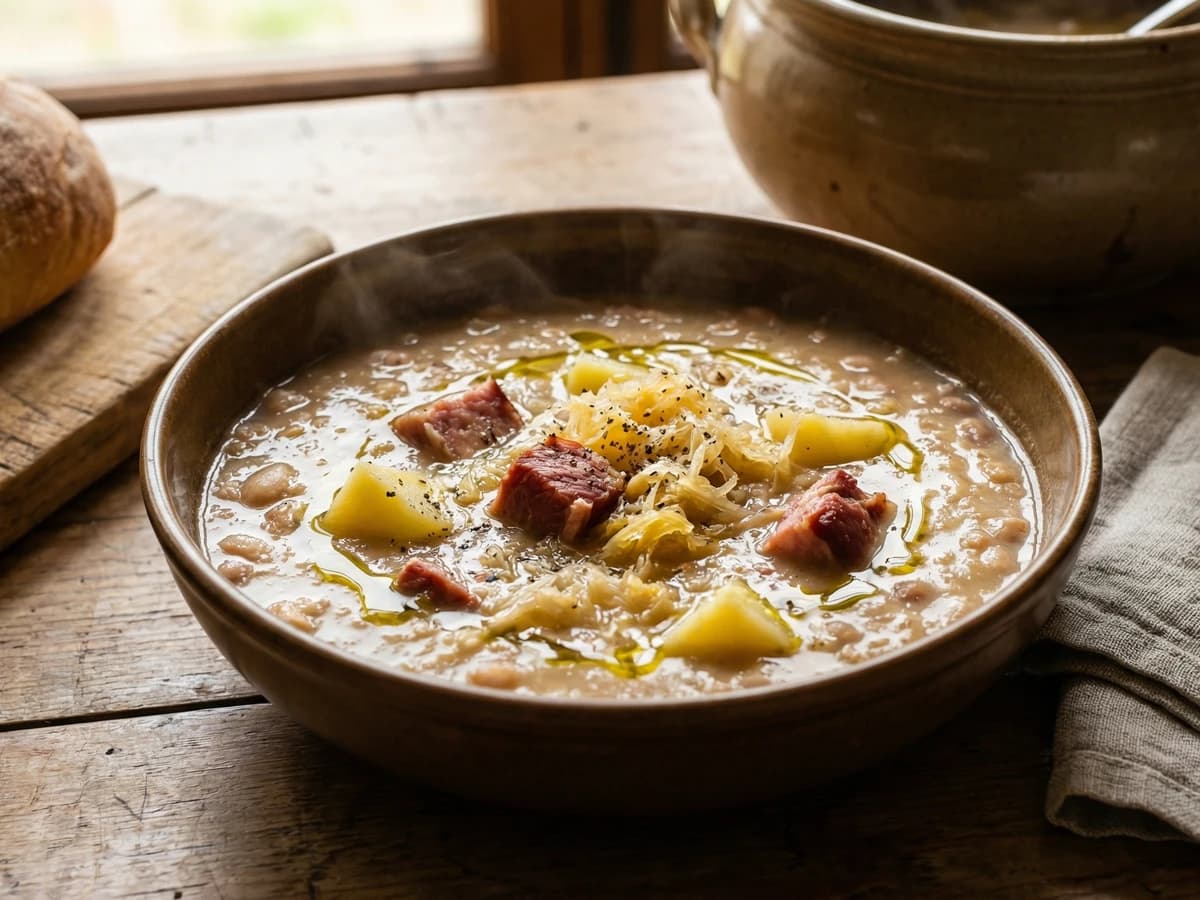
The great soup of Trieste, where Austro-Hungarian sauerkraut meets Italian beans and the smoke of cured pork. A dish that proves Italian cooking has always absorbed its neighbors.
Chef Graziella
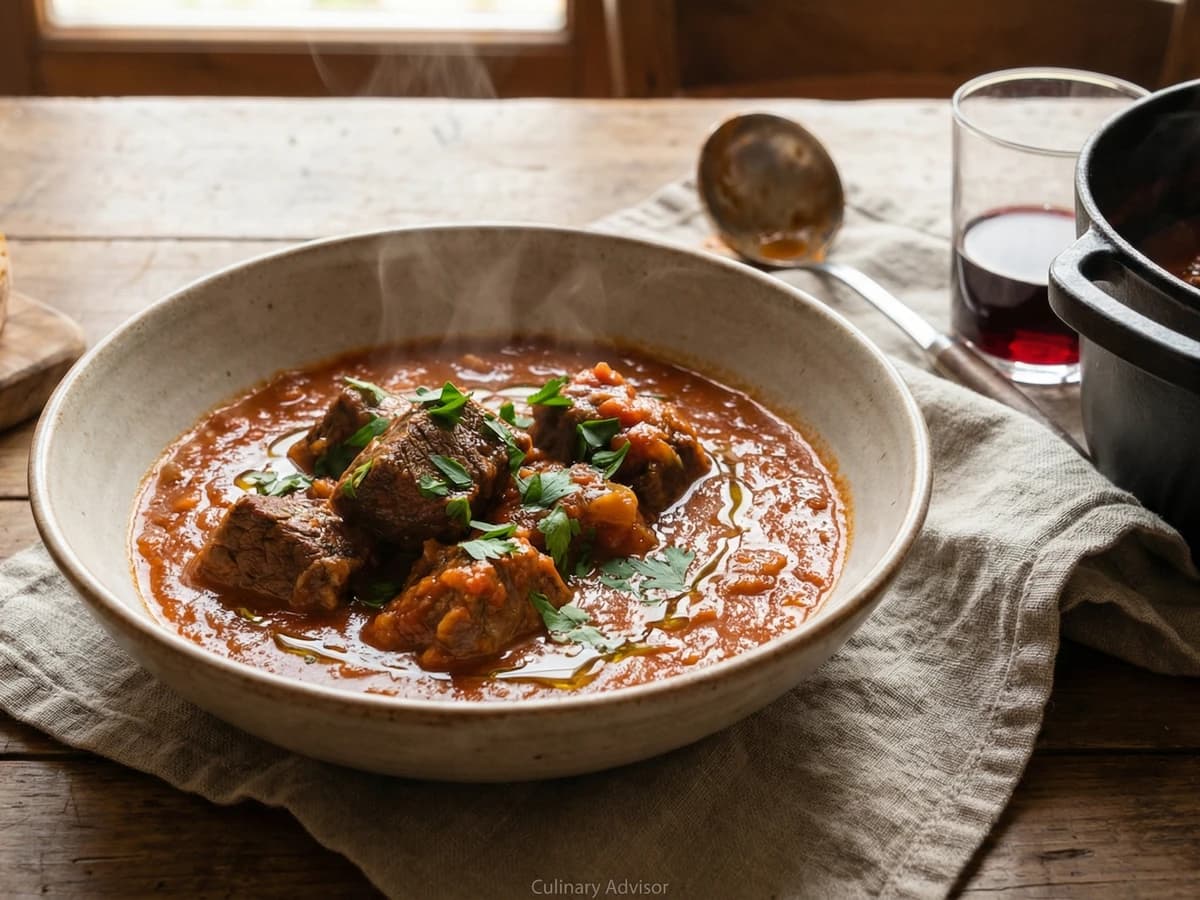
The Italian grandmother's answer to beef stew: chunks of chuck braised with patient soffritto, good wine, and San Marzano tomatoes until the meat surrenders and the sauce becomes something worth sopping bread in.